


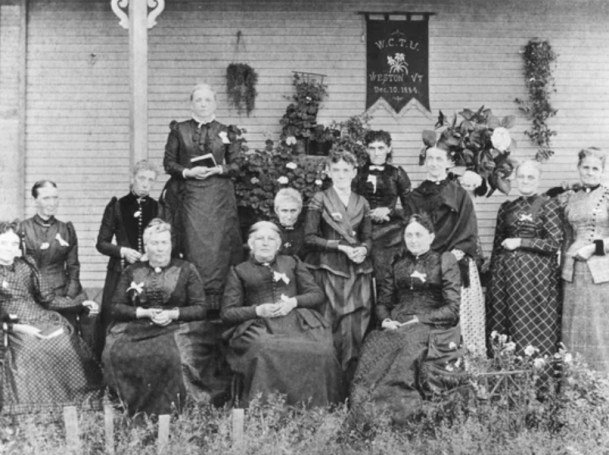
Naomi Douglas was by all appearances an unremarkable Vermont farmwife. Life many women of the era, her life revolved almost exclusively around her farm and family. The boundaries of her life might as well have been the boundaries of her hometown of Shoreham.
That changed in the spring of 1885, when a member of the Woman’s Christian Temperance Union paid a visit. The woman asked Douglas if she would speak at a gathering of county temperance leaders. Douglas agreed reluctantly, doubting, as she wrote in her diary, that she had the “ability to do it in a proper manner.”
The appointed day arrived, cold and wet. Douglas only had to venture as far as the familiar Congregational church in town. Once inside, however, rather than sit quietly in one of the pews, as she might have preferred, Douglas stepped up to the pulpit to deliver her address. She noted that the church was crowded with women from around the county and state, as well as a prominent woman evangelist from Buffalo. Douglas later remarked that it was “not an audience of our people.”
The talk must have gone well, as Douglas would over the years continue to accept invitations to speak at other temperance gatherings. The transformation of Douglas from farmwife to politically active woman is indicative of what had been happening to thousands of women across the Green Mountain State for at least the last decade. Women who had considered themselves important only within the context of their own homes now saw a role for themselves in politics. They weren’t running for political office — that was decades away. They were seeking a more basic right: the right to have their voices heard.
As was the case with Naomi Douglas, the cause that fired their political passions was temperance or, more accurately, the lack of temperance in American society. Alcohol abuse was the major drug problem of the day, and Vermont was hardly immune. Early in the 19th century, the people in some Vermont towns spent more on liquor than on schools and all other public expenses combined.
By the mid-1800s, the temperance movement had been greatly successful. By one estimate, Americans managed to cut their liquor consumption by two-thirds in the years between the Revolution and the 1840s. Still, temperance leaders saw plenty of work to do.
Crime and poverty seemed to be spreading. Temperance leaders saw drink as the root of these problems. Some historians see the temperance movement as partly a Yankee response to the growing number of newer immigrants in places like Vermont. State leaders fretted that while many Vermonters were emigrating west in search of opportunity, they were being replaced by immigrants from Ireland, Italy, Quebec and elsewhere. The Yankee establishment, feeling it was losing power, latched onto temperance as a way of asserting moral authority over the state, these historians argue.
With the Civil War having ended slavery, temperance replaced abolition as the moral issue of the day. Just how strongly people felt about the issue can be seen in an incident from 1874. That spring a famous temperance lecturer, Dr. Diocletian Lewis, was passing through St. Albans on his way to give a speak in Montpelier. Local temperance leaders prevailed upon him to speak during his brief time in St. Albans. His address lit the passions of temperance advocates in town. Soon the St. Albans Women’s Temperance Association formed and some 50 of its members marched through the streets singing.
Usually the St. Albans organization dealt more quietly, though more directly, with the issue. A few members of the group would visit one of the roughly 40 establishments that sold liquor in town and speak with people there about the dangers of alcohol. Though manufacturing or consuming alcohol had been prohibited in Vermont since 1852, the illegal trade prospered.
Throughout that spring, temperance associations sprang up around Vermont. Eventually, seemingly every community had one. Frances Willard, leader of the national Woman’s Christian Temperance Union (WCTU), believed that “the most significant outcome of this movement was the knowledge of their own power gained by the conservative women of the churches.”
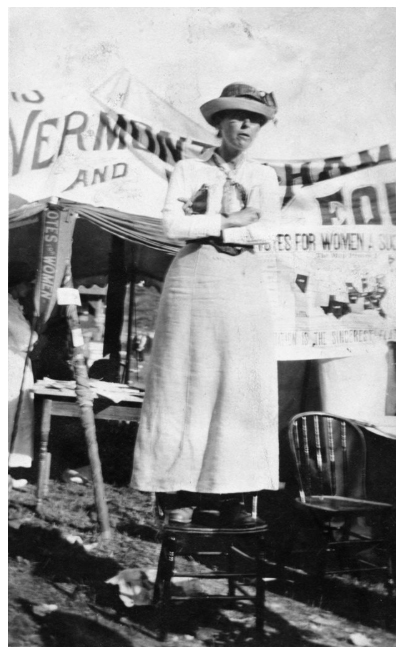
In an era where women were denied the right to vote, joining a temperance society was about the only socially acceptable political action they could take. Since men were widely seen as the ones with the drinking problems, women were viewed as the victims and as the ones with the moral authority to confront the issue.
To temperance leaders, the issue was a local one, or at least that is how they addressed it. They continued to try to cajole the owners of saloon, hotels and stores to stop selling alcohol and persuaded hundreds, if not thousands, of Vermont men to sign sobriety oaths. But they couldn’t get officials to enforce the state liquor ban.
Stymied, temperance leaders pushed for women to be granted the right to vote. The best way to promote temperance, they argued, was through education. To affect how children were taught. they needed the right to vote in local school elections.
Vermont’s temperance leaders petitioned the state Legislature for the right, and a bill quickly became law in 1880. The law, however, only gave the right to vote in school elections to people who paid taxes. In essence it turned the old Revolutionary refrain around and made it “no representation without taxation.” Since most women didn’t own property, they didn’t pay taxes and therefore could not vote. Some could now vote, but often didn’t, perhaps feeling uncomfortable being part of a conspicuous minority. “It is safe to say that the majority of refined and intelligent women fear the right to vote more than they hope for it,” said a temperance activist from Addison County.
Two years later, the WCTU successfully lobbied the Legislature for a temperance education law. It became the first such law in the nation. Within 10 years all but three states had passed such laws. In Vermont, the law required that students be taught the negative effects of alcohol on the body.
The law went too far for some, however. The superintendent of schools in Thetford complained that it required that one-quarter of every textbook on physiology discuss the dangers of alcohol abuse. He thought all the discussion of how alcohol was produced was more likely “to prepare the young to engage in the liquor traffic” than to produce temperate citizens. He advocated “a vigorous protest” against “filling the minds of our children and youth with the views of extremists.” When the young realize the exaggerations they have been taught, he warned, they will “cast all caution to the winds (and) rush into lives of dissipation.”

The temperance movement’s political victories caused a split within its ranks. Some activists feared that pushing for political rights for women was a distraction from the cause of temperance. These conservatives within the movement, led by Anna Park of Bennington, broke with their more progressive counterparts in 1889 and formed their own temperance movement. They resolved to stay out of politics. The schism in Vermont mirrored what was happening in the temperance movement nationally.
In the meantime, suffragists were lobbying the Vermont Legislature to extend the rights of women to include voting in town meeting. National women’s suffrage leaders toured the state, arguing that denying women the right to vote constituted “indefensible oppression.” Lawmakers didn’t see things that way. A representative from Rutland warned against granting the right to vote to “such a dangerous class as the women of Vermont.”
A bill granting women full municipal suffrage easily passed the House in 1886, but the Senate defeated it. The pattern would repeat itself numerous times over the next three decades. In a seemingly orchestrated dance, one house of the Legislature would approve women’s suffrage and the other would defeat it. Vermont women wouldn’t win the right to vote in their municipalities until 1917, but they had to be taxpayers.
For all the frustrations it faced, the temperance movement had its successes. It helped tame the excesses of a drug problem plaguing the state and, perhaps more importantly, it made activists out of a whole generation of farmwives like Naomi Douglas. The tragedy is that they would live most or all of their lives without the full right to vote. But because of their work, the same wouldn’t be true of their daughters and granddaughters.
(The events described in this column are detailed in articles in Vermont History, the journal of the Vermont Historical Society, by the late Deborah Clifford, who was a leading historian on the links between the temperance and suffrage movements.)
