

Editor’s note: Jon Margolis is VTDigger’s political columnist.
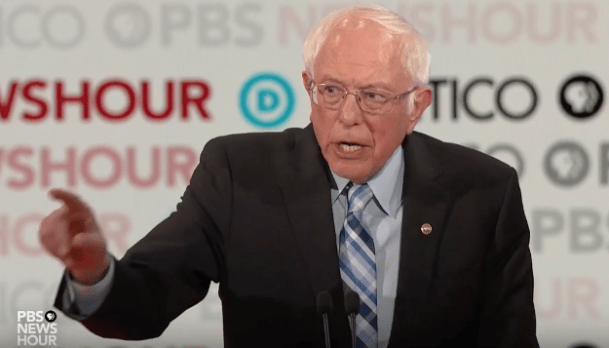
For Bernie Sanders, the good news about Thursday’s candidate debate was that with only six opponents on stage, he had more chance to strut his stuff.
The bad news was that so did the other six, and a few of them were in better form than Vermont’s most celebrated political revolutionary.
Just as a performer, no one was in better form than Sen. Amy Klobuchar of Minnesota, who was both more aggressive and more impressive than she had been in the five earlier debates.
At one point, she took on Sanders over his “Medicare for all” proposal that would abolish private health insurance plans. Turning to Sanders, who stood just to her right, she said a Democrat can be “progressive and practical at the same time” urging universal health care through expanding the Affordable Care Act instead of doing away with private insurance.
“The way I look at it,” she said, “if you want to cross a river over some troubled waters, you build a bridge. You don’t blow one up.”
But politically, the candidate who did himself the most good – and therefore did Sanders and the others the most harm — was former Vice President Joe Biden, who has remained the polling front-runner despite a series of stumbles, including lackluster (at best) performances in the earlier debates.
On Thursday in Los Angeles, Biden was neither stumbling nor lackluster. He was sharp, concise, and sensible. Challenged about his oft-repeated statement that it would one day be possible to cooperate with Republicans, Biden said, “I refuse to accept the notion, as some on this stage do, that we can never, never get to a place where we have cooperation again. If that’s the case, we’re dead as a country. We need to be able to reach consensus.”
He was in good humor, too. At one point, when Sanders kept raising his hand seeking attention while Biden was talking, Biden said, “Put your hand down, Bernie.” Even Sanders had to laugh.
Contrary to some predictions, Sanders did not get into a squabble with Sen. Elizabeth Warren of Massachusetts, his chief rival for the support of the so-called “progressive lane” of the Democratic primary electorate. In fact, Sanders was barely mentioned in the New York Times writeup of the debate.
Instead, Warren got into the prickliest spat of all six debates with South Bend, Indiana, Mayor Pete Buttigieg.
No surprise there. The two of them are fighting over some of the same voters, especially in Iowa and New Hampshire, the earliest-voting states, where Buttigieg has been steadily rising in the polls.
Warren criticized him for raising money from rich donors, some of whom recently attended a fundraising event at a California wine cave.
“He had promised that every fundraiser he would do would be open door,” Warren said of Buttigieg, “but this one was closed door.” (It wasn’t.) “We made the decision many years ago that rich people in smoke-filled rooms would not pick the next president of the United States.”
Buttigieg shot right back that Warren was “issuing purity tests you cannot yourself pass.” Her own campaign, he noted, “is funded in part by money you transferred (from her 2016 Senate reelection campaign) having raised it at those exact same big-ticket fundraisers you now denounce. Did it corrupt you, Senator? Of course not.”
A lively scuffle. One that both of them lost. Not that there was no winner. The winner was Klobuchar, who finally ended the dispute by saying, “I did not come here to listen to this argument. I came here to make a case for progress. And I have never even been to a wine cave.”
Neither have most people, who probably aren’t even sure what a wine cave is. Nor, from the evidence on hand, do most voters care very much about the intricacies of who gives political money to whom. It isn’t that people don’t know that the wealthy have disproportionate power over government and politics in part (but only in part) because of their political donations. Most voters (like all the Democratic candidates) want to reverse or overcome the 2010 “Citizens United” Supreme Court decision that gutted most campaign finance laws. But there is no evidence that any candidate has lost an election because the candidate raised too much money.
Still, the exchange might have hurt Buttigieg, especially when combined with criticisms from Klobuchar about his lack of experience and his defeat when he ran for Indiana state treasurer in 2010. A sliver of the Democratic primary electorate may prefer a candidate who does not raise money from the very wealthy, and almost all Democratic voters want a winner.
There were two other candidates on the stage. One was billionaire businessman Tom Steyer, who wore a nice tie. The other was businessman Andrew Yang, who didn’t wear a tie, but keeps hanging around, getting just enough support to qualify for these television debates, where he almost always (including this time) speaks less than the other candidates but seems both sensible and appealing.
If nothing else, he got off the best line of the night. During a discussion over both money and women in politics, Yang said, “I’m on the record saying that you need both strong men and female leaders in government, because the fact is, if you get too many men alone and leave us alone for a while, we kind of become morons.”

