


Professor Chuck Schnitzlein hopes the Sustainable Innovation MBA (SI-MBA) at UVM will help his students make meaningful change in the world.
Businesses can be a big driver of social change, Schnitzlein says.
“I think this is really forward looking,” he said, “because we’re facing such important challenges that are not being addressed by government.”
The SI-MBA program was recently recognized as the best “green” MBA in the country by the Princeton Review. It placed fourth in the world on the 2019 Better World MBA rankings compiled by Toronto-based sustainable business magazine Corporate Knights.
The program is in its sixth year. It offers a 12-month curriculum that focuses on how to integrate sustainability missions into corporate planning and government policy.
Program Director Caroline Hauser explained the SI-MBA is broken up into four, eight-week “modules” and a summer session working with local and national companies.
Currently, 30 students are enrolled in the program, half are from Vermont.
“Most of our students come from a non-business background,” Hauser said. The MBA training can help students influence a future employer to support sustainable practices. Students are bringing those practices to Microsoft, Starbucks and Burlington’s Community Economic Development Office.
Hauser said she wants to make UVM “the center for sustainable education” and serve at least 50 students. She’d like the program to work more closely with outside lecturers from large companies and address the challenge of climate change head-on.
Schnitzlein previously taught at full-time MBA programs at the University of Miami and the University of Arizona. The top ranking from Princeton Review is just the beginning, he said.
“What really distinguishes this cohort is they have shared values,” Schnitzlein said. “They understand the importance of business as an institution but they also understand that business has tremendous potential to address critical problems that we’re facing.”
After graduating from Wesleyan University, New Jersey native Taran Catania, a SI-MBA student, worked on environmental policy for five years in Washington D.C., including as a staffer for U.S. Sen. Martin Heinrich, D-N.M.
“I basically hit a point where I became impatient with the rate of change and I saw the influence business had on policy decision,” Catania said.
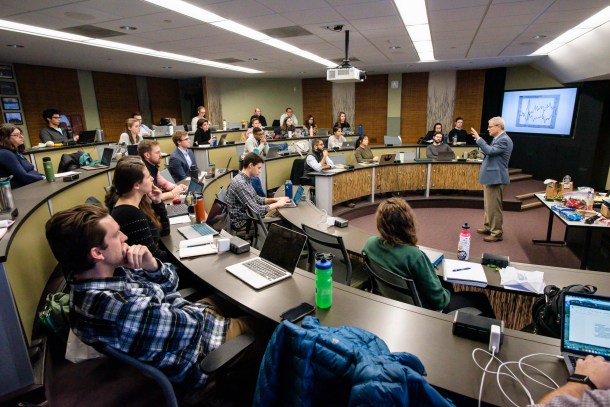
At a recent SI-MBA finance class, Schnitzlein discussed risks associated with deciding whether to go forward with a project.
He used an example of a wind farm, and when the best time to sell the business would be. If the company is planning to sell the wind farm, they may want to take into consideration the costs of other forms of energy, which may make the wind farm more valuable in the future.
Schnitzlein said these kinds of discussions happen on a regular basis at corporations, and students need to be able work across departments to realize change.
“I really enjoy teaching these students because we have shared values,” Schnitzlein said. “They want to make the world a better place.”
In May, a group of five SI-MBA students participated in the Total Impact Portfolio Challenge organized by the Wharton School of Business at the University of Pennsylvania. The challenge pitted 26 graduate students teams from 19 schools against each other to come up with a unique impact investing strategy. The students had to create a portfolio for a fictitious family office valued at $100 million “that would meet return, risk and positive impact objectives,” Schnitzlein said.
The UVM team made it to the finals, and were flown to Philadelphia, where they won the challenge, beating prestigious schools like Yale, Columbia, Fordham and Boston University.
Sara Farnsworth, of Springfield, is one of Schnitzlein’s students. The 43-year-old single mother of two said she took a non-traditional route for her undergrad degree before applying for the SI-MBA program where she is one of the oldest students in the program.
Farnsworth said she began her studies at community college, “but I didn’t really know what I wanted to do,” she said.
She found her way to Johnson State College and graduated after 10 years with a degree in business administration. There, Farnsworth took classes in sustainability that sparked her interest.
Learning about the SI-MBA program, she said, “I was just blown away.”
She hopes to start an independent sustainability consulting firm after graduating.
Catania says businesses need to consider more than the bottom line.
“Part of the fact that it’s asking us to be collaborative is so much the nature of doing sustainable business,” she said. “You have to think about variables that we haven’t thought of before in business decisions.”

