

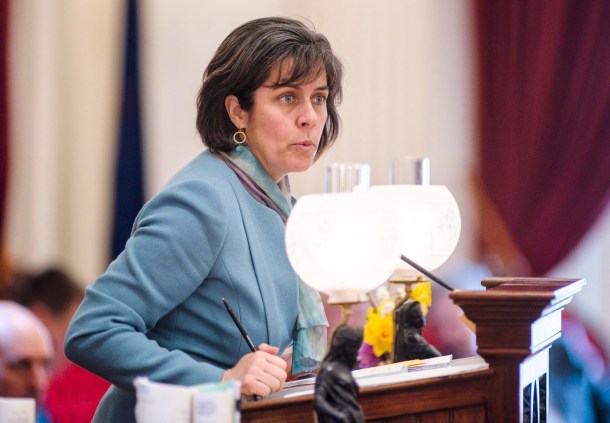
House Speaker Mitzi Johnson says passing legislation to legalize a market for marijuana in Vermont is not among her priorities in 2020. That stance distances her from a commitment made by fellow Democratic leaders to bring a bill to a floor vote this coming session.
Johnson, D-South Hero, has been resistant to supporting a legal marketplace for the drug, even as the policy has been adopted into the Vermont Democratic Party platform. She said in an interview Saturday that there is no guarantee the latest bill, which stalled in the House last year, will reach the floor in 2020.
“I have long said that a bill has to earn its way,” Johnson said. “This is a huge step, and we need to make sure we do it right.”
The speaker said that if the bill earns the 76 votes it needs to pass, and addresses concerns about roadside safety, youth usage and the impacts a marijuana industry could have on the environment, it will see a vote next year.
“For me to step forward and say ‘We will have a bill to the floor’ implies that I will do everything in my power to get it there,” Johnson said. “And in this case, I’m handing the power back to the representatives, where it belongs, to say work it out, do it well, listen to your colleagues that have concerns and be open-minded enough to address the issues they’re raising.”
For many Democrats in the House and Senate, legalizing a market for cannabis is a top priority. Even some Republicans have said now that the drug is legal they also support a system to tax and regulate it.
Last May, when it was clear the bill wouldn’t make it to the floor, House Majority Leader Jill Krowinski, D-Burlington, said Democrats are “totally committed” to creating a legal marijuana market and that they would “finish it early” in 2020.
On Saturday, Krowinski said this was still the plan and that the House would definitely vote on the legislation in the upcoming session.
“A version of that will get to the floor,” Krowinski said of the bill.
Johnson would not promise a House floor vote, and noted that the majority leader has been “a much stronger supporter of the bill” than she is.
“I believe we’re both correct because I’m saying if it’s done and done right and earns the votes, it will go to the floor,” she said. “I’m not going to be the kind of speaker that uses my one vote to kill a bill that a tri-partisan majority of the chamber wants to vote on.”
On a personal level, Johnson said she has reservations about expanding marjuana legalization in Vermont to include a tax and regulated market for the substance.

“I’ve never been terribly comfortable with this idea. So if you’re asking me individually, I’m not sure this is the right thing for Vermont,” Johnson said. “I don’t know that legalizing it and creating a legal market are as good, and fixes as many things, as advocates say it does.”
In 2018, Vermont legalized marijuana possession, and the personal cultivation of small amounts of the drug. But it did not legalize marijuana dispensaries, or establish any way for people to purchase the substance legally.
Many proponents of legalization say there is urgency to create a legal market for the drug as a consumer protection, given that many users are now buying marijuana on the black market.
“I think Vermont is in a really weird position when it comes to cannabis,” Attorney General TJ Donovan, a Democrat and legalization advocate, said at an event last week.
“In fact, I think we’re probably in the worst position we could possibly be in — where we legalized possession of cannabis, but we’ve remained absolutely silent on how Vermonters obtain it.”
For the first time Monday, the department voiced support for regulating marijuana now that’s it’s legal in the state. But it is not taking a position on whether it should be taxed.
Cynthia Seivwright, the director of the department’s Division of Alcohol and Drug Abuse Programs, told the “Dave Gram Show” on WDEV that if lawmakers are going to move forward with a legal market for the drug, regulation is important to control its potency and to make sure minors can’t access it.
“So we at the Health Department support the regulated system,” she said. “If we’re going to have a legal system in Vermont, it needs to be regulated.”
Sen. Dick Sears, D-Bennington, the chair of the Senate Judiciary Committee, said he was surprised that more officials, including Johnson, don’t share the sense of urgency to swiftly establish a way for Vermonters to safely obtain the drug, and capture revenue from its sales.
“I just am baffled by some of the responses I’ve seen, and not just the speaker, but others,” he said, also referring to Gov. Phil Scott and his administration.
Like Johnson, the governor has said he can only support the legislation if it includes additional investments in roadside safety and public health education initiatives.
Sears said that most senators who supported the 2018 legalization bill did so assuming that the Legislature would quickly follow up with a measure to create a legal marketplace for the drug.
“I think most of us who voted for that and supported that were expecting a tax and regulate in this biennium,” Sears said, referring to the Legislature’s two-year cycle. “There was never a promise made, but I thought there was an expectation.”
Last year, it appeared that momentum to pass tax and regulate legislation in the House was growing. Rep. Sam Young, D-Glover, who proposed a separate bill to legalize a cannabis market, said the after polling the House, he felt it “certainly” had the votes to pass the measure.
Johnson said as lawmakers take up the legislation again this winter, she is concerned in particular that the marijuana industry could damage Vermont’s environment, and wants to ensure there are adequate regulations and protections in place.

She said that large-scale marijuana grow operations “have very significant energy and water impacts” in other states, like Colorado. In 2018, Colorado Public Radio found that marijuana cultivators used 4% of the city’s total electricity.
Last year, the House made several key changes to the bill after they received it from the Senate, including investments in roadside safety initiatives.
House legislators added a provision that would legalize roadside saliva testing for law enforcement officers to screen drivers for drug impairment— which the governor has said is a requirement if the bill is going to earn his support.
The Senate has opposed saliva testing, and raised civil liberties concerns about the practice because while the tests can detect the presence of drugs in someone’s system, they can’t determine whether someone is under the influence at the time they are administered.
However, the House bill requires law enforcement officers to obtain a warrant before they can administer the tests. Sears said they could consider the saliva testing, as long as a warrant requirement remained in place
Lt. Gov. David Zuckerman, a Progressive/Democrat, and a longtime advocate for legalizing a taxed and regulated market, said he was glad to hear Johnson is willing to let the bill move forward in 2020.
But he added that he hopes she gives the bill more “guidance” through the committee process so that it can pass next year.
“We currently continue to leave youth access and quality of product at the whims of the unregulated, underground market,” Zuckerman said.
“And if we take this issue seriously and we care about youth access and risk of adulterated product, then each year of delay is an evasion of our responsibilities.”
Clarification: An earlier version of this story referred imprecisely to the state Health Department’s position on legislation to tax and regulate marijuana. The department supports regulation but has not taken a stance on taxation.
