

Snacking has become so complicated these days that market research firms dedicate teams to studying it. Candy companies send their marketing gurus on around-the-world tours to analyze it. There are trade shows and magazines devoted to it.
Amid the competition for consumers, Lake Champlain Chocolates is trying to figure out how to get a handle on what people want.
Life was a little simpler when Jim Lampman founded LCC back in the 1980s. Lampman, who then owned the Ice House restaurant in Burlington, and his pastry chef came up with some chocolates that sold very well as gifts, and the company grew by promoting its high-end creations as affordable luxuries.
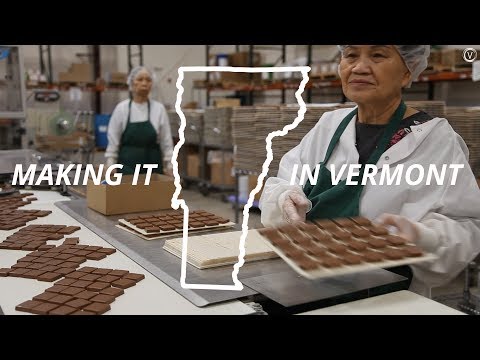
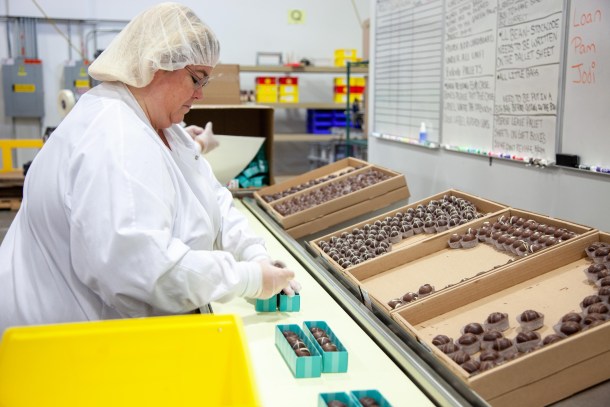
A decade ago, LCC grew out of its Pine Street location in Burlington into a new 15,000-square-foot space for packaging and shipping in Williston. Last year, the company expanded again, moving manufacturing to Williston and installing a new production line to create novel flavors and shapes from the 1 million pounds of chocolate that it buys from European suppliers. Nearly 100 people — up to 150 during the busy holiday season — work for the company now, making chocolate and shipping it around the country.
But the world of chocolate consumption has changed. The food and beverage market has been diversifying over the last few decades, noted Eric Lampman, Jim Lampman’s son and the president of the company. One of the first products to give people a taste of high-end, rare and unusual products was beer, thanks to the wave of microbrewing that started gaining momentum in the 1990s. Since then, artisanal bread, cheese, wine, vegetables, chocolate and other specialty items have proliferated, raising the bar for chocolate-makers.
Meanwhile, creative food marketers have added an array of novel flavors, like avocado and pepper, to chocolate, upending the traditional standbys of cream and caramel.
Lake Champlain Chocolate, still focused on chocolates as traditional high-end gifts, has seen its sales falter in the face of new competition and trends, Eric Lampman said. The company is still honing its response. While sales are flat, he said, LCC has high hopes for new chocolate bar machinery that the company installed last year.
Organic and low sugar
When it comes to chocolate, the industry’s micro-manufacturing segment is known as “bean to bar” — the practice of sourcing and knowing every ingredient in the chocolate starting with the cocoa bean. In 2012, LCC brought out its own “bean to bar” range, called Blue Bandanna, but stopped it in 2018.
“It’s extremely labor intensive to make your own chocolate on a small scale,” Eric Lampman said in a recent interview at the company’s manufacturing facility in Williston. “It takes a bunch of different machines, and it’s really challenging to make a consistent product.”
The industry is also impacted by years of public health messages that nudge people toward lower sugar consumption. Meanwhile, consumers are also looking for organic products.
The good news is that scientific studies — many sponsored by chocolate industry giants like Nestle, Mars, Barry Callebaut (the largest cocoa processor in the world, which is based in Switzerland and has a factory in St. Albans) and Hershey’s — have come out with research showing that dark chocolate has health benefits.
Accordingly, even though candy sales overall are dropping, U.S. chocolate retail sales have risen from $14.2 billion in 2007 to $18.9 billion in 2017, according to Vox.

“You really have to thank Mars and Hershey for doing so much research,” said Jim Lampman in a phone interview. “We’ve been blessed with so much great PR.”
Mars, Mondelēz International, and Nestlé are trying to build a healthier image for their products. Meanwhile, a constellation of other companies have jumped into the market with chocolate protein bars and other snacks.
And snacks — once frowned upon — have themselves started to serve as meal replacements.
All this market disruption has chocolate companies of every size weighing their next move.
“Should traditional chocolate makers reformulate their products with less sugar content (and if so, should they announce it)? Should they reduce portion or package sizes (and if so, should they reduce prices)? More generally, is obesity their responsibility?” asked the authors of an ISEAD case study contest for business school students. “Is collaboration with competitors, researchers and advocacy groups the solution? How can they grow their business without contributing to the obesity epidemic?”
To these questions and more, LCC is still seeking answers. In order to save money, the company has worked closely in the last half-dozen years with the Vermont Manufacturing Extension Center to create a streamlined, organized, very efficient factory layout.
“In the old building on Pine Street, when we were growing up 10 years ago, the facility hardly had elbow room,” Eric Lampman said. “There was product everywhere, carts everywhere. It was like a commercial kitchen. We have definitely grown up in that way.”
Now it’s looking for a way to capitalize on the cachet of the Vermont name and come up with shapes and flavors that it will set it apart in the crowded marketplace. LCC hasn’t started making a low-sugar bar, but it has added to its dark chocolate offerings. And it’s evolving away from its image as a gift company, now that boxes of chocolates aren’t the common gift they used to be.

Adding CBD, or cannabidiol, a hemp-derived compound now used in an array of health, beauty, and food products, is not one of the innovations LCC is considering.
“I just don’t believe it’s right to sell something with an unproven, unregulated food product at the moment,” Eric Lampman said. “The FDA has not made a legal ruling on its safety.”
Fierce competition
Lake Champlain Chocolate isn’t the only chocolate company battling to stand out in the crowded field. Membership in the Washington, D.C.-based Fine Chocolate Industry Association has tripled since it was founded in 2007, said Executive Director Bill Guyton. Eric Lampman is on the group’s board.
“All of the companies are moving quickly to kind of stay ahead of the curve of what consumers want,” said Guyton. “Consumers are looking for new and exciting types of products, and different types of flavors from different origins. The companies that are able to apply that are the ones who are going to really succeed in the future.”
Eric Lampman has traveled to dozens of countries to sample cocoa from a range of suppliers in Africa and central America. The family knows that consumers care about cocoa, and Eric Lampman’s interested in the industry that produces the bean, too. Now he’s trying to figure out a way to parlay that interest and experience into a marketing push to help LCC stand out.
“I’ve got to believe there’s 1,000 chocolate companies in the U.S.; it’s incredible,” said Eric Lampman. “It’s a very competitive marketplace.”
The competitors aren’t just dabbling; they’re creating attractively packaged, interesting-looking bars with creative marketing campaigns, father and son said. New companies position themselves as large contenders, and they move intimidatingly fast when it comes to product cycles and product launches.
“It’s people who have an idea for a distractive category disrupter — they create a product which is sugar-free, and they use stevia in place of sugar. That erodes people making the decision to buy good-tasting chocolate such as ours,” Eric Lampman said.
Jim Lampman separately observed the impact of “disrupters” in the industry. “There’s one called Tony’s Chocolonely, they were here in town in their big van at the South End arts and business celebration in September; Tony uses the same chocolate I started the company on, made in Belgium and processed in Belgium. They are shipping over larger-than-normal chocolate size bars with a catchy name, good pricing, and they probably don’t make any of the chocolate themselves. They probably are a marketing company more than anything else.”
Meanwhile, “we’re kind of flat,” Eric Lampman said. “We’re working on how to get out of a flat trajectory. It’s a challenge with all the new entrants to the category.”
Part of the problem, said Jim Lampman, is that people are more willing to change brands whenever something new pops up.
“The younger people today don’t have that sense of loyalty to a brand as much as we did when we were growing up,” he said. “Marketing data shows us that.”
But Lake Champlain Chocolates still ships to 1,500 stores, and Vermont loyalty supports three retail stores — two in Burlington and one in Waterbury Center.
The new molding line can make bars two and a half times faster than the old one could, said Jim Lampman, “but once we got it all set up, we ran into all this category growth, and the leaders, like Chocolove and Endangered Species, are 20 times our size in chocolate bar revenues.” So it’s not running at full capacity.
“That doesn’t mean we’re not doing a good job in the natural and specialty category,” Jim Lampman added. “We’re in the top 10 in the U.S., that’s what the SPINS data tells us, and that’s not a bad place to be.”

Editor’s note: Videographer Mike Dougherty’s wife is employed by Lake Champlain Chocolates.
