

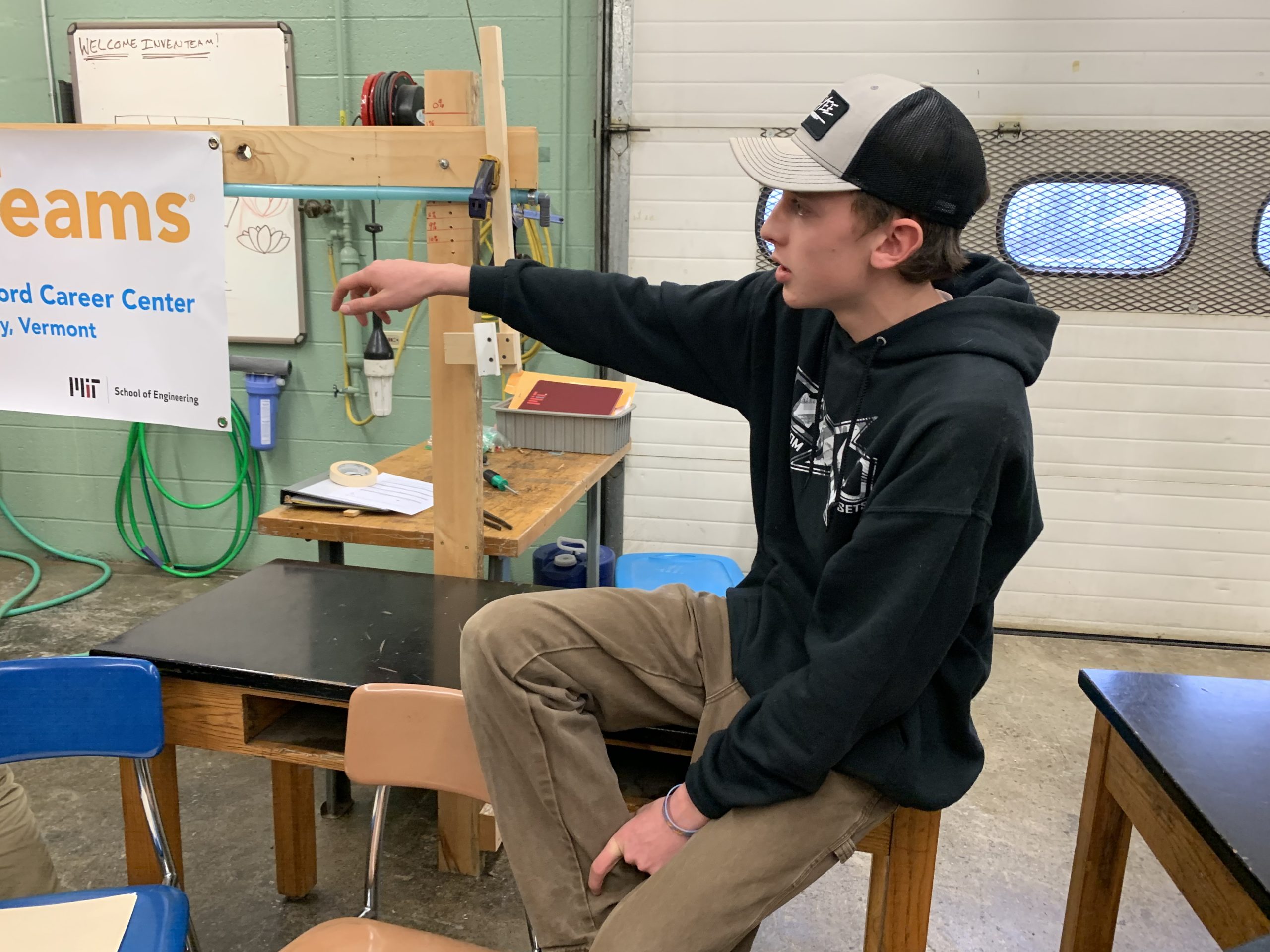
MIDDLEBURY— A group of Addison County students and their instructors have been awarded a prestigious $10,000 grant to refine their invention that allows maple sugar farmers to measure the flow of sap in their lines.
The team, which spent the last four years working on the project at the Patricia A. Hannaford Career Center, received word of the award late last month. The InvenTeams grant to continue their work was from the Lemelson-MIT Program at the Massachusetts Institute of Technology.
Founded in 1971, the Hannaford center offers programming for high school and adult students of Addison County. The majority come from Middlebury, Mount Abraham and Vergennes high schools.
The group was one of 14 to receive awards and get the opportunity to display their product in Washington in June.
Jake Burnham, who teaches engineering, architecture, computer science and programming at the center, said the grant money will go toward prototype development.
“We currently have a device that is piecemealed together from parts that were off the shelf at a hardware store and things that we’ve 3D printed to prove that the idea works,” he said. “Now we have to build some more commercially viable units.”
The current prototype has a provisional patent, and the center plans to apply for a utility patent, so students and instructors could not reveal too much about how the tool works. However, Burnham explained that their invention fills a technological gap in the maple industry and should help sugarers improve production and cut costs.
“They have the tools right now that will predict sap flow based on other indicators but nothing that actually measures the flow of sap in the line,” he said. “This will allow a large producer to identify areas of their sugarbush with high flow rates and low flow rates so they can tune their efforts.”
On Monday, the high schoolers currently working on the project demonstrated their prototype for Agriculture Secretary Anson Tebbetts and acting Labor Commissioner Michael Harrington.
The state officials were in Addison County as part of Gov. Phil Scott’s Capitol for a Day program. Tebbetts said that when he heard about the efforts at the career center, he knew he wanted to see the project for himself.
“Immediately my reaction was, ‘Wow, this is really impressive,’” he said. “I wanted to learn more about it.”
The idea for this “maple meter” originated in forestry and natural resources instructor Aaron Townshend’s class. Since then, he and Burnham have collaborated on the project with their students.
“Years ago the kids and I had the idea and we developed it in house, tinkering around with PVC pipes or whatever, and then we realized that we couldn’t go any further. Jake stepped up big time and they solved problems we couldn’t solve,” he said. “It could not have gotten to where it’s at without the engineering component.”
For his part, Burnham has helped students build circuits and write computer code, among other tasks.
“The hardware side involves a bunch of cool sensors. We’re trying to measure a thing that is far away from a power source out in the middle of the woods,” he said. “Within the actual program, there are all the things you would expect to see in a relatively complex program but presented in a simple manner because we’ve had several iterations of students working on it, refining it, and making improvements to it, so the next person knows how to read the code as well.”
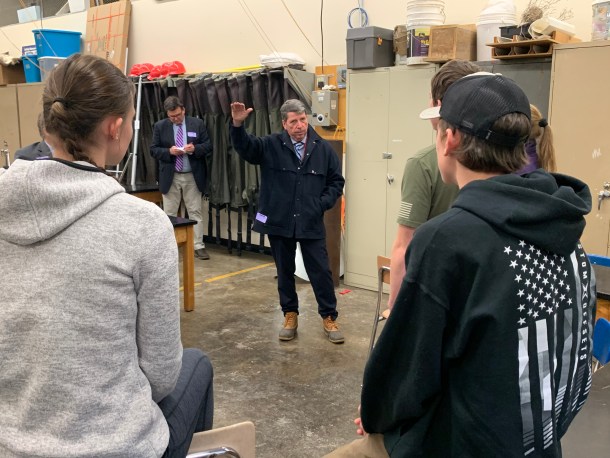
This year’s team includes five students, who have each taken the lead on one aspect of the project. Adin Girard, a junior at Middlebury Union High School, is the sustainability lead. He said part of his job is to make sure the meter lasts out in the woods, despite cold temperatures.
“We don’t want a bunch of them ending up in landfills in a couple of months,” Girard said. “It’s basically making sure that we make a good product at a good cost, and also that it’s food safe.”
Roza Stewart, a senior at Mount Abraham Union High School in Bristol, is the project’s research lead, and she ensures that the team keeps existing information in mind when making decisions about design.
“There’s a lot of things that wouldn’t work efficiently and I need to make sure that I remember those things so that we don’t make that mistake,” she said.
Other team members include Ileigh Aube, the technical lead, and Sam Klingensmith, the communications lead, both seniors at Middlebury. Eben Clifford, the financial lead, is a senior at Mount Abraham.
Said Burnham, “We’ve been very fortunate every year to have students identify the value of this project, whether they were like Ileigh and had no idea what was involved in maple syrup or former students who run their own sugarbushes.”
The next hurdle will be creating 10 sap meters for the University of Vermont’s Proctor Maple Research Center. Burnham said UVM wants the devices for this season. Some of the students have started to feel the time pressure.
“Time is probably my worst fear,” Clifford said. “I know we can get it done. If we all put our heads together we collaborate pretty well. We just have to use our time well.”
Clifford’s family used to run a sugaring operation, and now Clifford collects sap and sells it to a sugarer down the road. He said he is most looking forward to seeing the final product.
“I like testing it and I can’t wait to finally get one and install it and see how it actually works all together,” he said.
In the long term, as the center goes through the lengthy utility patent process, their project has also caught the attention of the maple industry, including Leader Evaporator, a company Tebbetts said has a long history of innovation in maple production.
“This indicates to me that the students may be onto something, if Leader Evaporator is paying attention to them,” he said. “Over time this could transform what’s happening in sugarbushes across Vermont, the region or even into Canada.”
Both Burnham and Townshend also expressed hope that their project brings attention to the work students do at career and technical centers around the state.
“I think it’s a big deal that students are solving a problem where the solution does not exist,” Townshend said. “We’re not talking their cobbling together other technology, they’re creating this technology. So I think the fact that they have solved this problem is spectacular.”
