This story by Sarah Earle was published by the Valley News on Nov. 12.
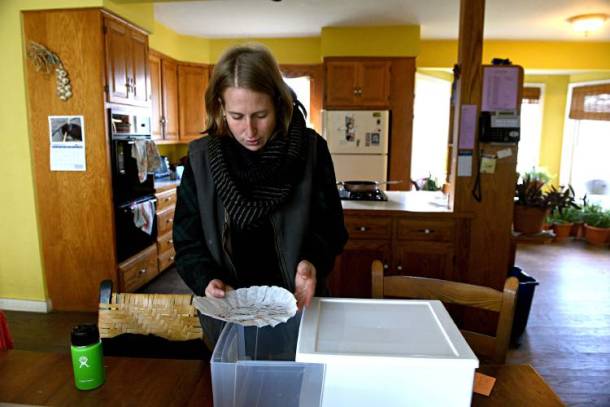
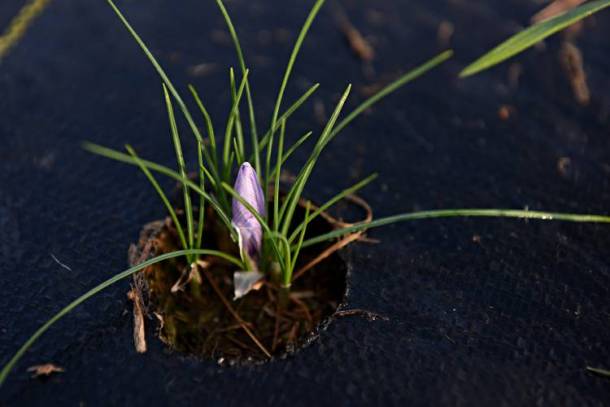
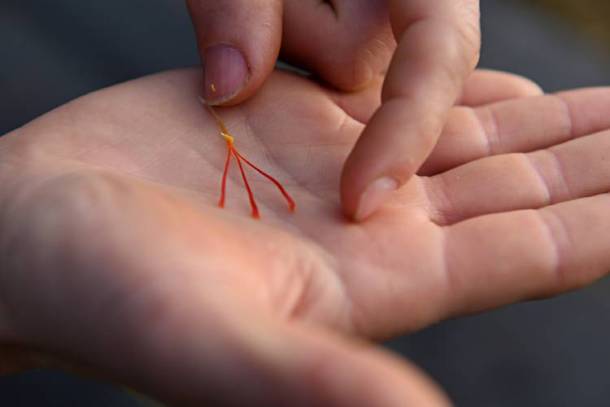
As a thick cloud cover dispersed over Cedar Circle Farm in Thetford one morning late last month, Marnie Williamson took a break from planting bulbs to check on her newest crop. Slim leaves resembling ordinary blades of grass were the only vegetation sprouting up in most of the holes she’d cut in the landscape fabric. But here and there a pale purple crocus bloomed within one of the fringes of leaves, and inside each of those, two or three deep red stigmas poked up like antenna.
For the second year, Cedar Circle is growing saffron, a prized spice recently identified by researchers as a potential specialty crop for diversified farms in the region.
“We just kind of put them in the ground and that was it,” said Williamson, annuals and perennials lead at Cedar Circle. “It’s still a work in progress.”
So far, though, the results are promising. “People were thinking they weren’t cold hardy enough, but it seems to be working,” Williamson said.
Known for its rich color and fragrance, saffron is common in Mediterranean and Indian cooking. It’s grown widely across parts of Asia and Europe but until recently hasn’t made strong inroads here in the United States outside the Pennsylvania Dutch community that brought it here 280 years ago. That’s starting to change.
Last year, Cedar Circle staff harvested about 7 grams of saffron and sold it in the farm stand in 250-milligram jars for $9 apiece. That price is on the lower side of what U.S. growers are charging for saffron, widely known as the world’s most expensive spice. It sold out.
This year, the blooms are appearing more slowly than last year. As of late October, Williamson had harvested just 10 or 12 threads — maybe one-tenth of a 250-milligram jar — and laid them out to dry on coffee filters. Another 10 to 15 threads awaited her in the field. Williamson moved the roughly 300 corms from one field to another earlier this year, and it’s possible the move affected their production. Or, they may just be later this year than last year.
Either way, she’s not worried. One of the benefits of saffron is that it makes its appearance after other crops have been put to bed, when growers can afford to experiment. “Now is the time when I do have time to poke around with these little baby flowers,” Williamson said.
Another benefit: Saffron isn’t necessarily the fussy crop its reputation as the world’s most expensive spice might lead people to believe. Yes, harvesting the tiny red stigmas is time consuming for a few weeks out of the year, but that’s about it, Williamson said.
What’s more, growing saffron requires very little equipment, and it’s so light that it stores and ships easily, said Margaret Skinner, a research professor and extension entomologist at the University of Vermont.
Skinner has been promoting saffron to local farmers since 2015, when, on a whim, the Entomology Research Lab decided to trial it in partnership with a private grower.
The idea came from the husband of a grad student who was from Iran.
“One day he said, ‘Why don’t you grow saffron here?’” Skinner recalled. “My initial reaction, I have to admit, was ‘that’s a stupid idea.’”
But the more Skinner and her colleagues thought about it, the more intrigued they were by the prospect.
“We have come to realize that diversification is the key to success (for Vermont growers),” Skinner said. “When we started thinking about the whole idea of saffron, we thought maybe this would be a way of diversifying their crops even more.”
And after the trial crop was successful, word started to get out. When Skinner held her first saffron workshop in the spring of 2017, 90 people showed up.
She has no hard data on saffron production in Vermont, but based on responses to a recent survey she conducted, she estimates that roughly 200 farms in Vermont are currently growing it. And from what she’s heard, they’re getting good results.
“It’s a little amazing to us all,” said Skinner, who has gotten so many inquiries about saffron from all over the country and beyond that she recently started the North American Center for Saffron Research and Development. “It does survive here, and it grows quite well.”
It also seems to sell quite well. While Cedar Circle sells the spice straight from its farm store, other growers are selling to local restaurants or online. One grower who works in New York City has been buying from fellow Vermont growers and distributing it to restaurants there.
Establishing a strong market without creating more demand than they can fulfill is one challenge on the horizon for growers, Skinner said. Developing industry standards also will be key, she said. The saffron market is rife with impostors, and growers are still learning their way around the product.
“If we want to have either a high quality U.S. brand or Vermont brand, we want to make sure that it’s high quality saffron … that we have a consistent, reliable product,” Skinner said.
Cedar Circle Farm hopes its early experiments with saffron will help other growers navigate such challenges. While a lot of farms are eager to experiment with new crops, many don’t have the time or resources to track their results, said Eric Tadlock, executive director of the farm and education center. “Research and development is at the core of what we do here,” he said.
So, as Williamson gathers the stigmas, she’s also gathering valuable information. “We have a unique opportunity to track results,” she said.