


MIDDLEBURY — Nearly two decades ago, Greg Newman of Bristol was charged with marijuana possession. Law enforcement officers searched his house while investigating an incident involving another person and discovered a paper bag containing the drug under his kitchen sink.
He was charged with drug possession and pleaded guilty to a felony. Now, 20 years later, Newman wants to remove the charge from his record.
“Even though this is like a black stain way in the back of a shirt I don’t wear anymore, I still want it off my record,” he said. “Especially because I wasn’t involved in the original altercation to begin with.”
In an effort to get the process started, Newman attended a legal expungement clinic at the Addison County Courthouse last Friday to see if he was eligible to have his felony charge cleared. He was among a handful of people who showed up at the clinic in an effort to erase charges ranging from drug possession to petty theft.
Similar events have been hosted in other counties in Vermont. At each one, volunteer attorneys help people fill out petitions to have qualifying criminal convictions expunged. Lawyers at the clinic were also available to help attendees apply to seal eligible charges, which has a similar effect as expungement.
Mairead O’Reilly, an attorney with Vermont Legal Aid, has been helping to lead expungement efforts across the state, and started organizing countywide clinics in 2017 at the request of state’s attorneys. She said the process starts by clarifying what charges people actually have on their record.
“Our first step is to do a thorough, comprehensive background check on folks and analyze whether a case is eligible under the ever-changing expungement law,” she said.
Most recently, a new state law went into effect in stages on July 1 and Oct. 1 expanding the list of expungeable offenses in Vermont. The new qualifying offenses include some instances of forgery and burglary, and possession of certain drugs such as marijuana, cocaine and heroin.
After the background check, O’Reilly said the next step is checking for outstanding surcharges. While it no longer costs $90 to file an expungement petition, it can still be challenging for people to clear criminal charges if they have not yet paid previous court fees.
“We represent folks who have very low incomes and every criminal conviction is assessed a $147 surcharge,” O’Reilly said. “That amount, that debt, goes to a collection agency and some folks have interpreted that statute to say a case cannot be expunged if the surcharge is still owed.”
O’Reilly said she is currently advocating to change the policy that allows expungements to be held up by outstanding surcharges. In the meantime, clients have to pay.
The next step in the process is to present the finished petitions to the state’s attorney, who then can agree to, or stipulate to, the expungement.

If the state’s attorney stipulates, the petition goes through. However, if the state’s attorney chooses not to stipulate, O’Reilly said she follows up with clients about whether to submit the petition anyway and risk having it denied by the court.
Dennis Wygmans, the Addison County state’s attorney, said that once he stipulates to a petition, the process moves fairly quickly. Within a month, the expunged charges should disappear.
As they filled out expungement petitions at Friday’s clinic, O’Reilly and the volunteer attorneys used a special browser plug-in to help speed the process. The plug-in was designed specifically for this purpose by creators at Code for BTV, a brigade of Code for America. Lawyers can download the tool to their web browser, use to it scan court records and automatically fill out expungement petitions with all the same information.
Nick Floersch, the Code for BTV brigade co-captain, said his team met with O’Reilly to ask how technology might help the expungement process.
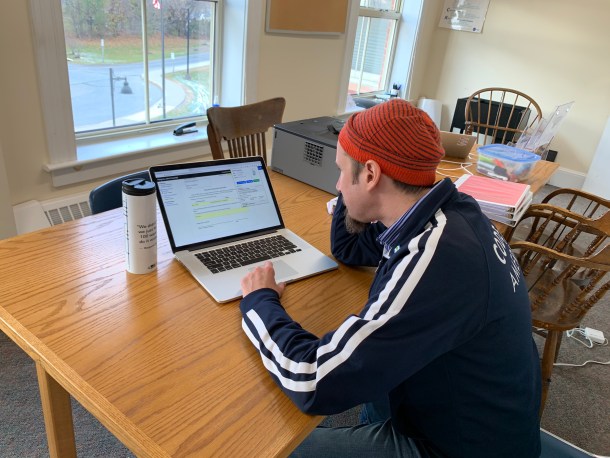
“What she needed was help making the process of running the clinics faster,” he said. “We had thrown out a bunch of ideas for things we could do with Vermont Legal Aid and we came back to this one as the most relevant.”
This clinic was the first time a larger group of attorneys had tested it out.
“It’s a huge timesaver,” O’Reilly said. “For someone who files these regularly it cuts the work down by two thirds.”
Even though the clinic had somewhat of a light turnout, volunteers count it as a success, and many spoke about expungement as an important legal tool to help vulnerable members of society get back on their feet.
Newman was able to successfully file an expungement petition and is now waiting on the result. Although he feels that having a felony on his record ultimately did not impact his life very much, he acknowledged that most people do not share that experience. He described expungement as an opportunity for fuller reintegration into society.
“You want to support people in society to become better members of society,” Newman said. “You don’t want to push people out of society so they feel more drawn to the darker edges of our culture because that’s where they’re accepted, you want to pull those people up into the light.”
Wygmans expressed a similar sentiment, and hopes to have expungement clinics in Addison County twice a year.
“Especially in this day and age, when it’s so easy to look up a person’s record, I think that this is a really important tool for somebody to be able to move on,” he said. “It’s also part of the restorative process. If you have paid your debt, shouldn’t you get credit for that?”
