


After yet another summer with headline-grabbing cyanobacteria blooms in Vermont, the state still does not have recreational or drinking water standards for cyanotoxins.
State officials say that Vermont has instead mounted a robust — albeit voluntary — effort to inform the public about risks of cyanobacteria blooms and test drinking water for toxins.
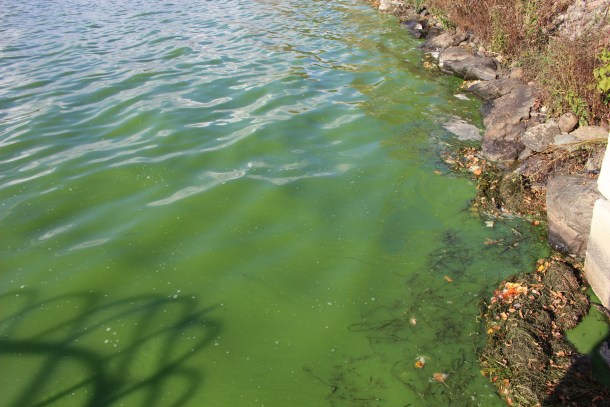
During the last week of October, multiple locations on Lake Champlain, Lake Carmi and Derby Bay in Lake Memphremagog had alerts for cyanobacteria blooms.
The blooms, which are expected to become more common in Vermont with warming waters and heavier precipitation events due to climate change, are considered an “emerging public health issue” by the Centers for Disease Control and Prevention. While cyanobacteria are native to Vermont, nutrient-laden runoff combined with warm waters can lead to explosive — and potentially toxic — blooms.
With two dogs dying this summer in Stowe from cyanotoxin exposure and blooms lasting until November, some environmental advocates question whether Vermonters are informed enough about the risks posed by the ever-changing blooms.
Exposure to cyanobacteria can lead to rashes or skin irritation, diarrhea, vomiting, liver damage and numb limbs. Children and pets are at greater risk of being exposed to cyanobacteria because they’re more likely to swallow water or play near the shoreline, where blooms are generally densest.
Recreation safety based on visual monitoring
Vermont has had a cyanobacteria tracking program for the past 16 years to monitor beaches and lake accesses, mostly in Lake Champlain, for the potentially toxic blooms.
Monitors originally took water samples to test for cyanobacteria toxins, but in 2012 the state and the Lake Champlain Committee switched to visual inspections in order to monitor at more sites. Reports are classified as “generally safe” if little to no cyanobacteria are present, “low alert” if small amounts of cyanobacteria are present, and “high alert” if high amounts are present — forming dense blooms or colored waters.
Department of Health, Department of Environmental Conservation and LCC staff review incoming reports, reaching out to beach managers as soon as possible if incoming reports show there might be a bloom present. At some town beaches, like in Burlington, staff also conduct visual inspections for blooms and do not reopen beaches until after toxins testing comes back clean.
But beach managers are not required to test for cyanotoxins before reopening beaches. James Ehlers, executive director of Lake Champlain International, feels it’s “irresponsible” to list any beach as generally safe without testing for toxins.
“There should be standing warnings for water bodies that have had historic cyanobacteria outbreaks that toxins may be present all season,” he said. “I mean, we shouldn’t be relying on the death of people’s pets as our educational moments.”
However, Bridget O’Brien, toxicological analyst with the state Department of Health, said that Vermont data indicate that the toxins do not persist after the blooms are gone.
O’Brien said that the state has been collaborating with towns on “new and better ways” to spread the word about cyanobacteria, including over social media. The department has also been meeting with parks and recreation staff at lakes around Vermont to encourage them to regularly monitor for blooms.
“Lake Champlain gets so much attention that some folks aren’t aware that cyanobacteria blooms can be present other places as well,” she said.
In recent years, scientists have started looking into whether the toxins can become airborne in water droplets produced by waves or boats. The concern is that even for people who are not swimming in water, aerosolization of the toxins could be another route for exposure.
Dartmouth neurologist Dr. Elijah Stommel has found a correlation between areas with cyanobacteria blooms and occurrences of ALS, including Shelburne Bay and Mascoma Lake in New Hampshire.
However, a 2017 review by USGS found that the hypothesis that cyanobacteria could contribute to degenerative neurological diseases is “not supported by existing data.”
No drinking water standards
Vermont has health advisories for three cyanotoxins — microcystin, cylindrospermopsin, and anatoxin-a. The state Health Department has health advisories for dozens of potential drinking water contaminants but drinking water managers are not required to test and treat for contaminants unless there are also federal or state drinking water standards.
Currently, Ohio is the only state with legally enforceable drinking water standards for cyanotoxins.
The state Department of Environmental Conservation’s drinking water program encourages public drinking water supply managers to conduct daily visual inspections for cyanobacteria during the summer and fall, and to reach out to the state to see if cyanotoxin testing is needed.
The state has also worked with the Lake Champlain Committee for the past five years to obtain funding for weekly cyanotoxin testing at the 22 drinking water supplies in Vermont that take in water from Lake Champlain. Testing this year cost $22,000.
None of the Lake Champlain samples taken since 2015 have detected cyanotoxins in raw or treated water. There are also 10 drinking water utilities in Vermont that are testing for cyanotoxins through the EPA’s unregulated contaminant monitoring program.
In addition to inspecting for algal blooms, water managers have been trained to look for other indicators of cyanobacteria blooms, like changes in pH, turbidity and an increased demand on chlorine.
The state’s drinking water program also advises private well owners to test their water — and to, of course, not drink any green water. About 30% of households in Vermont drink from private wells, according to the Health Department.
However, managers of public drinking water supplies in Vermont are not required by law to test for any of the toxins.
“I believe that it should be a drinking water standard,” said Jen Duggan, Vermont director of Conservation Law Foundation. “I think without a regulatory requirement to test and treat, you’re not protecting public health.”
Ehlers expressed concerns that the Lake Champlain drinking water managers stop testing for toxins at the end of September, though blooms in recent years have persisted through the fall.
“It’s worse now than it is in June and this is the case every year,” he said.
Bryan Redmond, drinking water and groundwater protection division head for the state Department of Environmental Conservation, said that “there is not a cause for concern in drinking water at this time” from cyanobacteria in Vermont.
He added that the division’s limited resources are focused on federally mandated testing and two new programs Vermont launched this past year to test for lead in daycares and schools and for PFAS compounds in drinking water systems around the state.
“The data so far show that we are prioritizing our limited resources where the biggest risks are to make sure Vermonters are protected,” he said.
Ohio, which ramped up its cyanotoxin testing after detecting microcystin in Toledo’s drinking water in 2014, became the first state in the country to set drinking water standards for cyanotoxins. The state also partnered with universities in a landmark research project to better understand and reduce harmful blooms.
Tom Bridgeman, a University of Toledo limnologist who is the co-chair of the research initiative, said daily testing of water during the bloom season is important. The Ohio initiative has put buoys in Lake Erie that act as sensors “to detect when a bloom is coming toward the water intake” point.
Bridgeman said beach and drinking water managers should not solely rely on visual inspections of blooms. For one thing, scientists, including researchers at UVM, are still trying to better understand what leads the blooms to become toxic, as even toxin-generating species do not always produce toxins.
“One thing we’ve learned is that the amount of toxin produced by the algae can vary by a factor of 10,” he said. “So the amount of cyanobacteria doesn’t necessarily correspond that well to the amount of toxins being produced.”
