

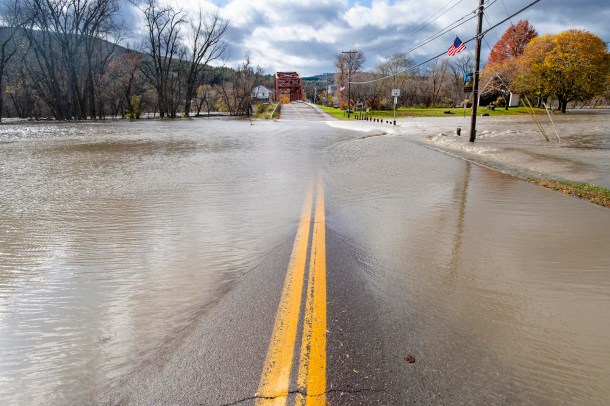
Gov. Phil Scott plans to submit a major disaster declaration to the federal government after state officials determined Vermont experienced at least $5 million in public infrastructure damage in the storm and flooding that hit late last week.
Erica Bornemann, the director of Vermont Emergency Management, said Thursday that the state faced at least $5 million in damage to infrastructure including roadways, railways, wastewater treatment facilities and recreational areas.
That number is an early estimate. She said she predicts the total cost of the damage will likely be higher — somewhere between $6 million and $10 million.
“We are really in the short-term recovery phase of this event and the impacts of this will be felt over the long term,” Bornemann said.
About 250 Vermont residents have reported damage to their homes, ranging from driveway washouts, to basement flooding, to complete destruction.
Addison, Chittenden, Franklin and Lamoille counties were hit hardest by the storm.
“We saw widespread wind-related damage throughout the state, but most of the water damage was in the northern part of the state,” the governor said Thursday.
If President Donald Trump signed the governor’s declaration, the state would be able to receive federal funds through the Federal Emergency Management Agency (FEMA) to make repairs.
Scott has 30 days from when the storm took place on Oct. 31 to make the declaration request, but said Thursday that he’s nearly certain he will do so.
State officials also said that Vermont will likely be able to receive funds through the Federal Highway Administration for damage on some state roads.
The governor said he expects that a Richford bridge on Route 105 that was severely damaged and needs a permanent replacement would be eligible for $1 million to $2 million in assistance from the Federal Highway Administration.
More than 50,000 homes were left without power the day after the storm. Electricity had been restored to most homes in the state on Monday, four days after it hit.
Some parts of the state, including North Troy and Johnson saw record flooding levels last week.
Rainfall ranged from 2.5 to 4 inches across the state and wind gusts up to 45 miles per hour were recorded in several locations.
