


RUTLAND — Former Air Force pilot Craig Popkess believes more people should seek out opportunities to hear from veterans, especially these days when the average citizen is unlikely to know a soldier or a veteran personally.
“There’s just very little acquaintance with veterans and our stories don’t get heard,” said Popkess, now an assistant professor at Vermont Technical College. “People don’t understand what we’ve been through.”
Popkess was on active duty with the Air Force from 1972-87 but did not see combat.
When citizens have limited contact with service members, Popkess said, there is a disconnect between the majority of those who vote for leaders and the soldiers who execute the foreign policy those leaders put in place.
“We end up sending people off the war without really understanding what they’re going through,” he said. “And without really being willing to treat them when they come back for what happened there. Because a lot of bad things happen at war. War is very hard.”
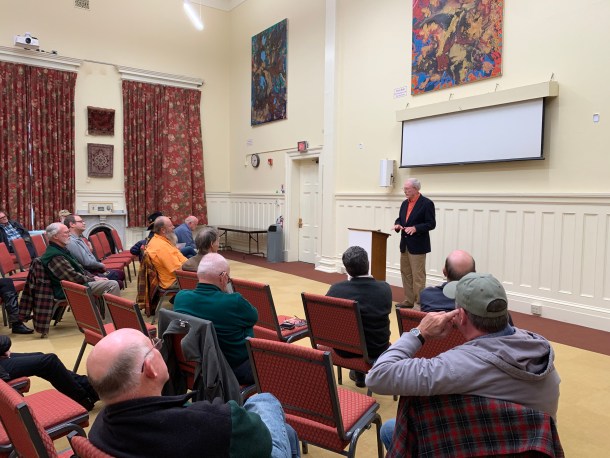
Popkess and other veterans spoke at a Veterans Town Hall in Rutland on Sunday, one of a series of events leading up to Veterans Day next Monday. Similar gatherings — designed to provide a platform for vets to share their experiences, unscripted, with the public — took place in Colchester and St. Johnsbury over the weekend.
Kyle Aines, who hosted the Rutland town hall, said he believed the proceedings went well, although he wished that more civilians had shown up to listen. Of the roughly 30 attendees, nearly all were veterans.
“I was incredibly impressed with the testimony from all the veterans,” said Aines, who served two tours in Iraq as a combat medic. “Their storytelling, it was really impactful and incredibly moving.”
Aines, now associate director of veterans and military affairs at Community College of Vermont, also spoke at the first Vermont Veteran Town Hall in Burlington in 2017. Since then he has hosted a similar event annually in Rutland.
The Veterans Town Hall model was first suggested by author Sebastian Junger in 2015, and since then has been adopted in communities across the country.
In accordance with Junger’s suggestions, the Rutland event was billed as non-political and would not include a question-and-answer period. Rather, the forum was intended to allow veterans to tell their community what it felt like to go to war without judgment or debate.
At events like the town hall, attendees had the opportunity to hear directly from veterans who served in different wars. Some of the speakers discussed how they feel about surviving when others were not so fortunate.
Richard Czaplinski said he signed up for the Reserve Officers’ Training Corps (ROTC) at the age of 17 while in college and ended up serving stateside during the Vietnam War and working in Washington. He said his path very well may have kept him from being drafted and deployed overseas.
“My dad said he didn’t want to sign my ROTC papers because he wanted me to stay on the farm, but he signed anyway,” he said. “If my dad hadn’t signed for me, it might have been a very different route. Sometimes I think about it. Somebody else died in Vietnam because I didn’t. I think about that stuff.”
Czaplinski told the audience that after he left military service, he ended up protesting the Vietnam War.
“I think a lot about that war, and a lot of the wars since then, and I can go from being depressed about what we do sometimes overseas to outraged about it,” he said. “These days I try to do everything I can to work for peace.”
Czaplinski was not the only person who mentioned his ambivalence toward war and conflict.
Rob Bromley, who served as a nurse in Iraq and who now works at the Rutland Regional Medical Center, said his experience overseas raised a lot of questions for him. He told the audience that the Iraqi translators he worked with during his deployment opened his eyes to the impact the war had on local civilians.
“I got to know those guys really well and we worked very closely. They had families that were on the outside in danger and they couldn’t call them, couldn’t see them. It brought into question what we were doing there a lot for me, what we were there for and what we were doing,” Bromley said. “You can get wrapped up in that all day and get twisted round and round and never come to a conclusion. For me, I was a nurse in a hospital, so I just did what I did. I patched guys up and I tried to help them.”
Many of the veterans who spoke also mentioned the positive aspects of their service, in addition to the challenges.
“There is bad sometimes in our military service, but there is so much good,” Aines said. “Once I was able to deal with those bad things that happened to me, I could think back around my military service and think about all the good times, all the fun that I had, all the friends I made and the good experiences we had together.”
Popkess believes that his time in the military helped shape how he approaches his work since then.
“Every job I’ve held over the last four or five decades has benefited from the discipline, the fraternity, the training, the pride and the mutual respect that the military engenders in all of us who serve,” he said.
Above all, the speakers at the Rutland event talked about the importance of veterans sharing their experiences and civilians showing up to listen.
Said Aines, “The lack of civilian presence [at the forum] has only cemented my resolve to keep doing this — that this needs to be here. The fact that veterans by far outnumbered the civilians, I need to keep doing this kind of work.”
