


This report, the second in a two-part series on the concentration of property ownership in the city of Burlington and its impact, takes a closer look at the nonprofit sector. Part I , published Sunday, examined the city’s largest private property owners.
BURLINGTON — The two largest property owners — the University of Vermont and the UVM Medical Center — are the economic engines of the state’s largest city.
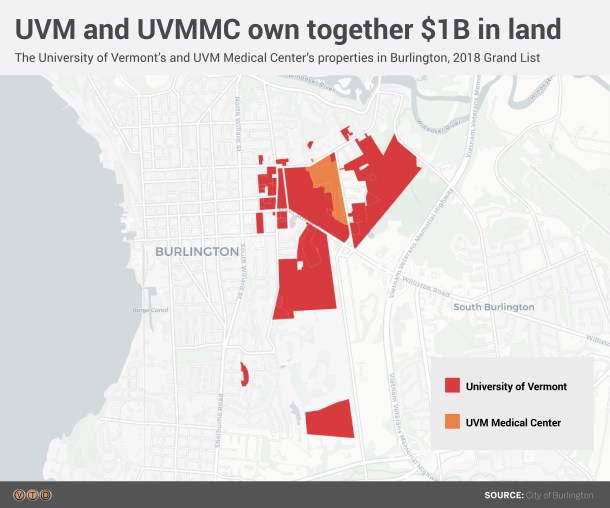
But as tax-exempt institutions, the university and the hospital own more than $1 billion in property in the city and do not pay property taxes.
City officials have butted heads with the university and hospital over the years in negotiations over how much the institutions should help foot the bill for city services.
Tax-exempt entities own 44% of the land and 31% of the total property value in the city, according to a VTDigger analysis.
Of that, the university and the hospital own 20% of the total real estate value in the city. The university owns $681 million in property value, 13% of total property value in the city, while the hospital owns just under $400 million in property, 7% of real estate value.
The university and the hospital have much more property value than the next largest nonprofit organization in the city. Two housing-related nonprofits, Cathedral Square Corp. and Champlain Housing Trust, are third and fourth in nonprofit property value, with $38.6 million and $32.7 million, respectively.
The Community Health Center of Burlington owns $7.9 million in property value.
Some tax-exempt entities in the city contribute payment in lieu of taxes to the city because they are exempt from property taxes. The city received a total of $5.7 million in fiscal year 2019 from the state, utilities and nonprofits in lieu of taxes.
For example, Burlington Electric paid nearly $2.5 million in lieu of taxes in 2019 and the state paid almost $774,922. On the nonprofit side, the Howard Center chipped in $60,217 and Champlain Housing trust paid $39,149.
The Champlain Housing Trust pays property taxes on many of its properties despite its nonprofit status. The trust does not pay property taxes on locations at which services are offered and some community facilities where nonprofits are based, such as the Old North End Community Center, Donnelly said.
Cities across the country are increasingly seeking payment from tax-exempt organizations to pay back the city for services they consume that would normally be covered by property taxes.
Additionally, other nonprofit institutions, including the University of Vermont, Champlain College and the University of Vermont Medical Center pay the city fees for services they receive, for example fire and police department responses. In 2019, the university paid $1.38 million, Champlain College paid $128,153 and the hospital paid $473,464, according to the city’s budget.
By comparison, the Handy family pays $1.4 million in taxes on the $48.8 million in property they own, according to VTDigger’s analysis.

UVM and Champlain College also contributed to Mayor Miro Weinberger’s sustainable infrastructure plan, which is funding infrastructure upgrades citywide. UVM paid $386,000 in 2019 and Champlain College paid $61,890.
Champlain College also paid a $260,000 development fee for construction at 194 St. Paul St., and $670,524 in real estate taxes.
University of Vermont
During the latter years of his time as mayor (1981-89), Bernie Sanders put pressure on both the hospital and the university to help pay for city services. While the city lost a court battle against the hospital, both organizations now pay the city for some of the services they receive.
UVM pays a total of $1.38 million annually for city services. It also pays the Burlington Police Department $94,000 to help offset the costs of patrols in neighborhoods near campus.

Across the country, municipalities are pushing large colleges and universities to contribute more for the services they receive.
Weinberger has also tried to get both UVM and Champlain College to pay more for city services when he pushed them to contribute to his plans for infrastructure upgrades.
In 2018, Weinberger was able to get the University of Vermont and Champlain College to collectively pay $8.9 million over 20 years to cover the debt service payments on the city’s sustainable infrastructure bond.
Thomas Gustafson, UVM’s vice president for university relations and administration, said the university believes it is in “a reasonable place” in terms of its contributions to the city. But it is a voluntary agreement, he said.
“The city may not think we pay enough, and we probably think we pay too much,” Gustafson said. “We’re sort of maybe in the sweet spot right now.”
Weinberger said while the university’s tax-exempt status and subsequent responsibilities to the city government have been debated for a long time, he believes the university has been stepping up in recent years.
“UVM, over my seven years and the years leading up to this administration, has taken significant steps in the right direction, on a voluntary negotiated basis, to take on greater financial responsibility for a variety of issues within the city,” he said.
The university has increased its payment to the city in the past 10 years, from $894,174 in 2009 to the $1.38 million paid in 2019.
UVM’s contributions to the city of Burlington are on the higher-end compared to similarly sized institutions nationwide, said Joe Speidel, the university’s director of local government and community relations.
“We think that what we’re doing is fair,” Speidel said. “I think that it really does demonstrate our commitment when you look at what other institutions are doing.”
Gustafson said that the university’s main source of income is student tuition, and an increase in payments from the university would likely lead to increased student tuition.
Aside from the payments to the city, the university impacts the area in other ways, primarily by employing nearly 4,000 faculty and staff members. The university generates $1.3 billion annually for the local economy, a 2016 study determined.
The university has faced criticism for housing only 60% of its students on campus, which puts additional strain on an already tight housing market.
Weinberger said the city has been in discussion with the university about building more student housing. The high number of students living off-campus contributes to the city’s housing crisis, he said.
“I think it’s clearly a contributing factor to why we have one of the tightest, most-pressured housing markets in the country,” Weinberger said.

A wide-range of factors contribute to the housing crisis in Burlington, Gustafson said, including UVM students’ desire to live off campus.
“I guess we contribute to it, but we’ve also contributed to solutions,” Gustafson said.
The university has added 868 beds in the past 10 years and is looking to add more housing on the Trinity Campus, near the UVM Medical Center. Overall, the university houses more than 5,700 students, according to its website.
Speidel said if the plans move forward, that the university would likely partner with a developer to build housing aimed to be competitive in the market with upperclassmen and graduate students, not more traditional dormitory style housing.
UVM Medical Center
The University of Vermont Medical Center owns just under $400 million in property value, placing the institution second in the city behind only the University of Vermont in total property value ownership.
Mayor Bernie Sanders’ administration sent a $2.9 million tax bill to UVMMC in 1987, sparking a legal fight with the hospital. The hospital, which is tax-exempt, refused to pay and said the additional cost would trickle down to patients.
After the hospital sued the city, a judge ruled that as a charitable organization, the hospital did not have to pay the tax.
UVMMC entered into a 30-year agreement with the city in 1999, when then-mayor Peter Clavelle challenged the hospital’s position that a new addition would be exempt from the property tax.

After another legal battle, the hospital and city reached an agreement that the hospital would pay $325,000 a year for services, increasing 2% annually. In 2019, the hospital paid the city $473,464.
Clavelle said that the city had argued for decades that the institutions should help pay for the services provided by the city — keeping up the streets and sidewalks, providing traffic control and parking and providing emergency services, among others.
“We’ve argued for decades now that the taxpayers should not bear the costs, that there’s a group of beneficiaries at the hospital and university that should contribute,” he said. “Over the years, there has been significant progress that has been made in recognizing the burden the institutions place on the city providing services.”
The hospital also paid an additional $137,689 as a payment in lieu of taxes for the lease of the UHC campus on South Prospect Street.
The 1999 memorandum of understanding also established some guidelines for the hospital, which is located in a residential neighborhood. The hospital agreed to use the properties it owns on East Avenue solely for residential purposes and to communicate with neighbors about its planning process.
“We understand that our presence here has tremendous benefit to the community, we also understand that, you know, we have neighbors surrounding us,” Dawn LeBaron, the hospital’s vice president for hospital services, said.
UVMMC reported close to $210 million in community benefit to the IRS this year. This benefit takes a variety of forms, said Rick Vincent, the hospital’s CFO.
“Some of that is in direct patient assistance for patients who cannot pay, it takes the form of subsidized services where we provided the services essentially at a loss,” Vincent said.
In fiscal 2018, the hospital provided a total of $6.78 million in free or discounted care to uninsured patients, almost $1 million of which was provided to residents of Burlington. The hospital also provided $16.8 million in care to Medicaid patients that was not reimbursed by the government.
As for city services, LeBaron said the hospital’s security team handles a large majority of the security incidents at the hospital, and Burlington police were only called when an individual’s behavior reached a criminal level.
“They really have to hit the criminal level to make that happen,” she said. “We’re not calling them for anything other than something that would go into that realm.”
The hospital’s internal security team responded to 1,387 security incidents, of which 123 resulted in calls to the Burlington Police Department seeking assistance. The Burlington Fire Department responded to 10 calls for false fire alarms at UVMMC, for which the hospital paid $3,860.

The hospital also donated approximately $775,000 to local community organizations, including the Howard Center street outreach team and the Chittenden County Opioid Alliance.
“If we can partner with folks out there in the community that are doing this great work, we’re pleased to be a part of it to the degree that we can make it work financially,” LeBaron said.
Weinberger said these donations represent an increase in the hospital’s financial efforts to address community health problems preemptively.
“The financial conversation we’ve had with them have had a tight nexis with total population health and addressing community health issues,” he said. “I have found that really exciting, those conversations and what has come out of them has been some of the most hopeful and innovative work that has happened during my time as mayor.”
Weinberger acknowledged his administration has taken a different approach from previous administrations, such as the Sanders’ administration, which sued UVM.
He said his administration has instead approached the hospital in a more collaborative way, which Weinberger said led to the payments to community health initiatives.
“That didn’t just happen, that happened because we put real effort into pursuing what seemed like opportunities for productive collaborations that would have some benefit for both institutions,” he said.
Clavelle said that despite the historic tension, it is also important to acknowledge the contributions those institutions make to the city.
“The city is a vibrant, dynamic city to a large extent because it is the home of significant institutions of higher education as well as medical institutions,” he said. “They bring much to Burlington’s vitality and economic well-being.”
Felippe Rodrigues and Christopher Remmel contributed data analysis and graphics to this report.
Correction: An earlier version of this story referred imprecisely to the circumstances under which the Champlain Housing Trust pays property taxes. In addition, the value of property owned by the Community Health Center of Burlington was misstated. It is $7.9 million.

