This article by David Corriveau was published by the Valley News on Oct. 26.
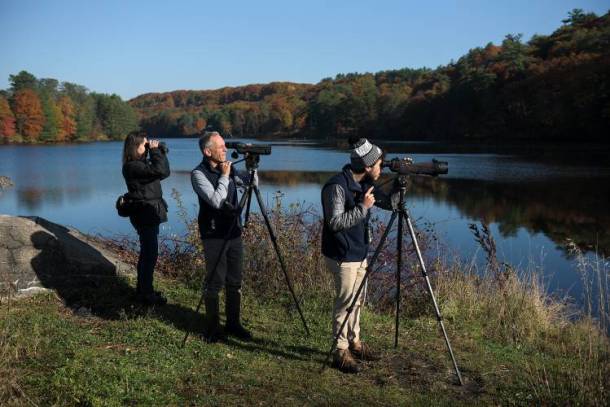
WILDER — Minutes into a bird-watching walk around Kilowatt Park recenty, four naturalists from the Vermont Center for Ecostudies spied a bald eagle flying just above the trees along the far side of the Connecticut River.
“And there’s another one,” Executive Director Chris Rimmer said, pointing to a trailing mate. “They’re nesting adults.
“There’s something we can be pretty positive about.”
Professional and amateur bird-watchers alike are welcoming any and every promising omen a month after a scientific report estimated that almost 3 billion fewer wild birds are winging, breeding and nesting around North America than in 1970.
That sobering news, marking an overall decline of nearly 30%, runs counter to the rebound in populations of America’s national bird from near-extinction over the same period, thanks to environmentalists, scientists and governments who joined forces to ban the pesticide DDT.
Naturalists of all stripes are taking cold comfort in the report’s documentation of the bigger picture that many of them have observed for years.
“If you watch the trends long enough,” ecostudies center co-founder Kent McFarland said during last Tuesday’s scouting expedition, “honestly, it wasn’t a surprise.”
Lyme, New Hampshire, resident and lifelong bird-watcher Blake Allison seconded that notion.
“Anecdotally, there’s been some thinking in the Upper Valley birding community for a while that numbers of, for example, dark-eyed juncos — a species mentioned in the report — at winter feeders have been going down,” Allison said. “It’s disquieting, I would say, to have your suspicions confirmed in such a dramatic fashion. It’s happening in front of people’s eyes, in their lifetimes. The impact is clearly severe.”
Among the confirming information in the report is a marked decline of grassland species such as red-winged blackbirds, meadowlarks and whippoorwills.
“Some of that is just the fact that there’s less grass than there used to be,” Allison said. “In places that weren’t just built over by housing development, New England has flipped its forest coverage from 10% over a century ago to the upper 80s.”

In addition to sheer loss of habitat, throw in the continued use of herbicides and pesticides in agriculture and lawn maintenance, as well as cat owners letting their pets prowl outdoors, and “it’s clear that the grassland populations are tanking,” Rimmer said.
Among local efforts to mitigate and prevent human impacts on wildlife in our corner of the world, the Upper Valley Land Trust has negotiated more than 500 easements to conserve 52,000 acres of open land against development.
“These are fields, edges, riparian areas, shrubby young woodlands and mature forest blocks,” land-trust programs director Alison Marchione said Friday. “Protecting large swaths of habitat is the No. 1 thing that we do for birds in our region.”
In the 20 conservation areas that the land trust owns, Marchione added, “we use active management to create … habitat that is ideal for young fledgling birds and is a required habitat for many species to reproduce.”
Beyond conservation lands and preserves, populations of some varieties of birds are thriving in places they never used to, for reasons scientists are still trying to suss out.
“I’ve definitely noticed changes in the bird population since I started as a kid, both positive and negative,” ecostudies biologist and Upper Valley native Spencer Hardy said. “You can tell a different story for every species.”
Hardy pointed to several warblers — such as the Cape May, the baybreasted and the Tennessee — that used to be rare in this area. Their population has “skyrocketed” in the last few years, he said, as the birds venture farther north to feed on the spruce budworm, which he noted is good for the trees.
On the other side of the coin, Hardy has noticed a decline in the kinds of songbirds who used to flock around his parents’ feeders in Thetford and later Norwich, in the late 1990s and early 2000s.
“We used to see lots of rose-breasted grosbeaks and evening grosbeaks,” recalled Hardy, a 2012 graduate of Hanover High School. “They were charismatic and easy to identify. I have vivid memories of watching them all summer, all winter, for many years. Now it’s a pretty exciting day when I see one or two.”
Susan Tiholiz feels the same thrill — and the same worry — when grosbeaks appear among the more ubiquitous black-cap chickadees and other common winter species clamoring for space around the feeder at her home in Thetford, to which she moved from Texas four years ago.
“If something is rare,” she said, “you appreciate it more.”

Among the 28 species they spotted during the 90-minute outing in Wilder, Hardy, Rimmer, McFarland and ecostudies outreach naturalist Nathaniel Sharp particularly appreciated identifying a merlin, a small, peregrine-like falcon that appeared to be migrating from northern Canada to the American South. In addition to the eagles and the merlin, Sharp entered more than 200 individuals into the Cornell Lab of Ornithology’s eBird app for birders around the world to see. The turnout included almost everything but a partridge in a pear tree. At the high end: 43 grackles, 41 robins, 37 blackbirds and 16 goldfinches.
Other soloists included a ruby-crowned kinglet, a common merganser, a pileated woodpecker, a winter wren, a brown creeper, a rock pigeon and a merganser of undetermined origin who might have been red-breasted.
In addition to helping naturalists report sightings and identify trends in populations, ebird.org also allows outreach experts like Sharp to further encourage interest among the human population, beyond the Audubon, school and library groups he leads on outings.
“We call it ‘citizen science,’” Sharp said.
Tiholiz, one of the top observers and online recorders of birds in New Hampshire’s Grafton County as well as Orange and Windsor counties in Vermont, said she hopes that such efforts will raise awareness among people for whom the loss of 3 billion birds might be too big a number to grasp, and among those who might ask why they should care.
“When even one small creature, whether it’s a bird or a snail, goes extinct, it’s signaling that something is very wrong,” she said. “In the case of birds, they’re already living on the edge, what with migration and all the forces around them affecting how they live. They’re telling us, in these great numbers, that this is really serious. Eventually, it’s going to impact us. They serve all these ecosystem services: pollinating plants, spreading seeds, controlling insects. They provide a lot to humanity.”
Tiholiz credited her late sister Linny, and Linny’s husband, naturalist Ted Levin, with sparking her interest in the natural world during her visits to the Upper Valley from Texas in the 1980s and 1990s.
“My mind just opened up,” Tiholiz said. “All these things I never noticed, how intricately everything is woven together. Here we are at the top of all that, but eventually, if we don’t make some changes, we’re going to cause so much destruction that there’s not going to be much left for us.”