

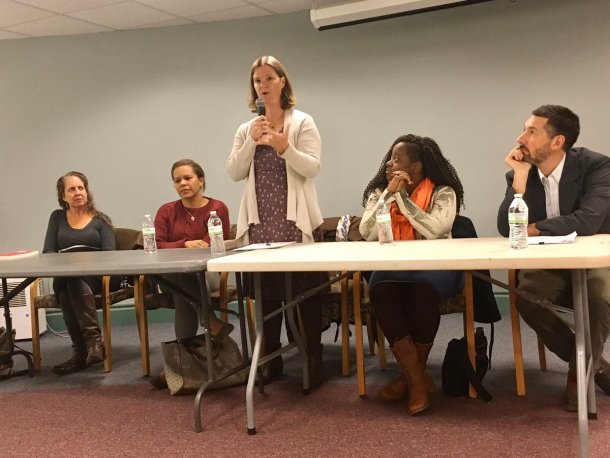
MIDDLEBURY — White people need to get more involved in the fight for racial equality. That was the message at a recent panel discussion about race in Vermont.
The event, hosted by the Addison County Democrats Monday night at Ilsley Public Library, was billed as part of a continued local effort to spotlight issues of race and racial justice around the state.
Stuart McAninch, secretary of the Addison County Democrats and co-organizer of the event, said the goal of the evening was to provide local residents a better idea of what they can do to organize around racial issues. Given the increasingly diverse demographics of the United States, McAninch believes these conversations are crucially important.
“We’re one of the whitest states in the country now, but I don’t think that’s going to last,” he said. “If we’re talking about a goal for Vermont to not stay at perpetually 675,000 people but to grow socially and economically, diversity is going to come to this state, and we’d better be prepared to handle that in a healthy way.”
According to the Census Bureau, the most recent population estimate for Vermont is about 626,000 with nearly 95% of its residents classified as white.
The four panelists — including two African American women — spoke about criminal justice reform, educational reform and local activism, and each had recommendations for how attendees might further the cause of racial justice in their own communities. The discussion was moderated by Sen. Ruth Hardy, D-Addison.
Joanna Colwell, the founder of Middlebury’s chapter of Showing Up for Racial Justice, spoke about the need for white people to educate themselves about race.
“I think if you are white in this country, unless a whole bunch of really extraordinary circumstances occur, you’re going to grow up stupid about race, and so then it’s your responsibility to get less stupid,” she said. “It’s a very personal journey but it’s also a journey of community and working with one another.”
James Lyall, the executive director of the ACLU of Vermont, spoke about his organization’s efforts to reduce racial disparities in Vermont’s criminal justice system, which are some of the most pronounced out of any state in the country.
“A big piece of the problem is we know that these racial disparities are there, and policy makers and state leaders have known that for years, but we still don’t have a way to pinpoint them and address them.”
He called on the audience to support legislation that requires the collection of more data.
“People ask what’s your top racial justice priority and one of them is data collection,” he said. “If you cannot identify a problem, you cannot solve it.”
Former Rep. Kiah Morris, D-Bennington, who directs the Vermont Coalition for Ethnic and Social Equity in Schools, said there are large disparities in how classrooms address race and racism, in part because local schools and supervisory unions have control over how statewide standards are implemented. She asked community members across the state to get involved in education reform efforts.
In 2017, Morris formed the coalition to advocate for Act 1, a new statute enacted this year that created the Agency of Education’s Ethnic and Social Equity Standards Working Group. The working group is conducting a three-year review that will end in a formal recommendation for improving the way Vermont schools teach students about racial diversity.
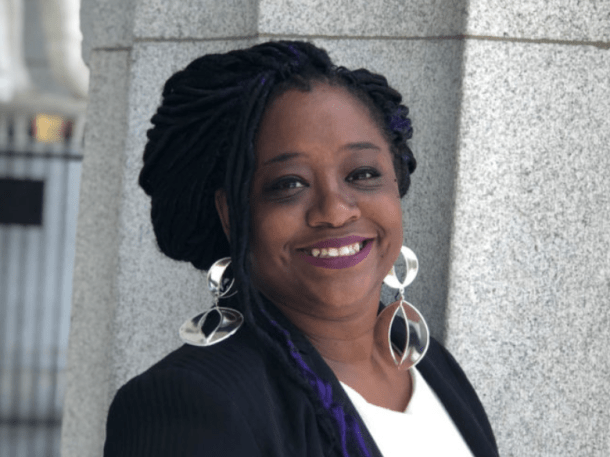
“We need to have youth that are ready, that are activated, that are anti-oppressive, anti-racist, and have a clear understanding of social justice principles to be global citizens and represent Vermont as we should be represented,” she said.
Morris, who had been the only African American woman in Vermont’s Legislature, withdrew from her re-election effort in August 2018, citing racially motivated threats and online harassment.
Tabitha Moore, the president of the Rutland Area NAACP, discussed the barriers she faces trying to build up communities of color and asked that white allies fight for racial justice alongside people of color.
“I’m not going to talk at you,” she told the audience. “I’m going to ask you to do things with me because I’m tired, y’all. I have three kids and three damn jobs and this I do for free.”
Moore offered concrete steps that attendees could take, including contacting the Rutland Board of Aldermen to ask members to implement implicit bias training for city officials. The issue is currently under discussion in the area.
Colwell suggested that attendees donate to organizations led by people of color, as well as individual people of color through GoFundMe or other online tools, as a form of direct reparations.
“Direct reparations is people who have access to money sharing it with populations who have had it generationally taken it from them,” she said.
Audience members had the chance to practice this philosophy for themselves a little while later when someone asked if the panelists — particularly Morris and Moore — were being paid for their time. This prompted leaders within the Addison County Democrats to promise an honorarium for the two women.
As the event wrapped up, panelists urged participants to find a way to do racial justice work in whatever form that might take.
“What’s most important to me is calling people in,” Moore said. “If you want to know how to help with racial justice and you don’t have all the time in the world, there are plenty of people in this room who can help you with that.”

