

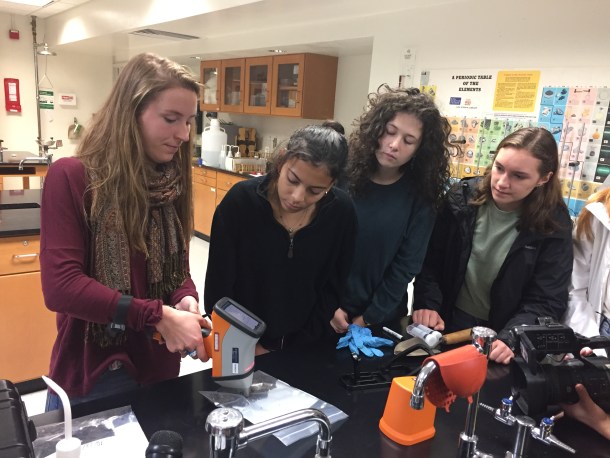
Scientists at the University of Vermont will work with middle and high school students in the Burlington and Winooski school districts to test for lead in soil and water samples collected across the two cities.
The pilot project, funded in part through a $25,000 grant from the Environmental Protection Agency, will allow researchers at UVM to dramatically expand an existing database of results of samples collected around the Queen City.
“We’re really excited as scientists and educators at the University of Vermont, to do what is really core to our mission as a land grant university, which is to work with students and educators in our community to do science that matters,” Paul Bierman, a geology professor at UVM, said at a press conference at Burlington High School Friday morning.
UVM scientists plan to go into the high schools this fall for an initial meeting with students, where they’ll show them lead minerals, share old advertisements for the metal, and explain the health effects of the pollutant. In a subsequent visit, they’ll teach students how to collect field samples at home, retrieving soil from their backyards and water from their kitchen taps.
All told, UVM scientists say they expect to collect samples from 1,000 to 2,000 properties across Burlington and Winooski. Nico Perdrial, an assistant professor of geology at UVM, said the resulting data should give researchers and the public “one of the first complete pictures” of the level of contamination found in both cities.
The project’s aims are two-fold: to get a broad base of data about the problem, and to get students engaged in STEM.
“We hope that this experience will encourage our students to pursue careers in science,” said Lisa Sitek, the chair of the science department at Burlington High.
UVM professors will also teach a short course over the summer that both high school teachers and students can take on the project. The hope is that high school students can then mentor middle school students and show them how to carry out the testing.
Lead, a toxic metal that was widely used in paint, gasoline and plumbing for decades before its health effects were understood, is now often found in alarmingly high doses in soil and drinking water. The neurotoxin can damage the brain, kidneys, nervous system and red blood cells. Because developing bodies absorb the metal more easily, young children and infants are at the highest risk of lead poisoning.
Lead contamination is a nationwide concern, but it is particularly acute in New England, where the housing stock is generally older.
In the last legislative session, state lawmakers passed one of the strongest lead testing laws in the country, mandating that all drinking and cooking water fixtures in every school and child care center in Vermont be tested for the toxin. Testing is well underway, and the Vermont Health Department has already begun releasing results to the public.
