

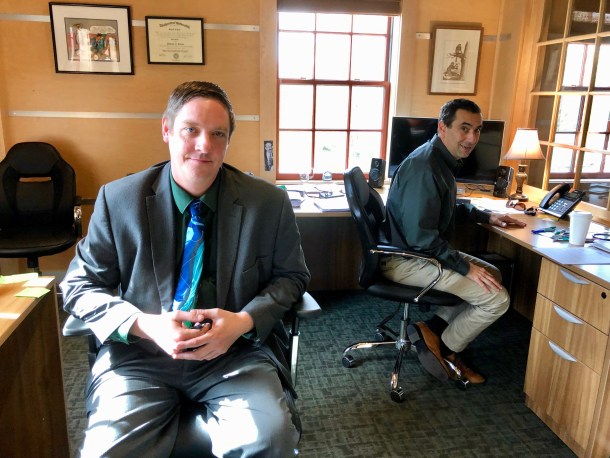
As partners in a one-year-old law firm focused on cannabis, Tim Fair and Andrew Subin are cultivating a new crop of legal knowledge with little precedent.
The two lawyers, owners of Vermont Cannabis Solutions in Burlington, are busy these days fielding questions from people wondering if they can sell their hemp crops out of state or out of the country, operate cannabis lounges, or serve cannabis as part of a catering contract. Landowners call to ask if the federal government will seize their land if they lease it for cannabis cultivation. Clients need legal opinions on the use of cannabis in Airbnbs, at massage parlors, and in restaurants; they want to know under what circumstances they can give cannabis products away.
In this fast-changing regulatory environment, “these questions are not just like, ‘Yes, that’s legal,’ or ‘No, it’s not,’” said Fair, who started the firm on his own in 2017 and joined forces with Subin last year. “These require a ton of thought and talking to colleagues and research and coming up with an explanation.”
Fair, 42, and Subin, 54, are both longtime marijuana users who fiercely support the right of the public to use products that contain THC (the psychoactive ingredient in the cannabis plant) and CBD (or cannabidiol, a chemical in the plant that has been approved by the FDA for one medical use and is widely believed to ease a variety of other ailments). They’re building their practice as the regulatory and business environment for cannabis growers, processors and users changes with dizzying speed.
The two — who represent about 100 people — last week attended an institute in New York City put on by the International Cannabis Bar Association, and this week they were back in Vermont, fielding calls from growers who need buyers, buyers who need growers, and a panoply of other characters in the complex cannabis supply chain. About 900 farmers are registered with the state to grow cannabis for CBD; Fair and Subin estimate that Vermont’s cannabis acreage — much of which is being harvested right now — has doubled this year over last.
VTDigger spent some time with Fair and Subin last week learning about the cannabis landscape in Vermont this autumn. The interview has been edited for length and clarity.
VTDigger: What issues did the cannabis lawyers talk about when they got together last week?
Andrew Subin: There are a lot of people awaiting the FDA regulations. The big topic of discussion was: “What is the FDA going to do, and how are we all going to respond?” It was touched on by just about every panel. Because on one extreme, CBD is approved by the FDA as a drug. And it’s a simple rule: you can’t put drugs in food. That’s a long-standing FDA rule – which they have the authority to ignore.
Obviously, a really robust industry has grown up with CBD in food, and consumers are calling for CBD in their chocolate and water and lip balm and everything. Some of the important senators, like Mitch McConnell, don’t want to see the end of commercial hemp production for CBD, so therefore we predict the FDA is not going to just say “no drugs in food,” and say yes, certain forms of CBD will be allowed in food.
The vape crisis was also a huge topic. Many of us attorneys represent clients who were making or selling THC vape cartridges. We have a lot of clients involved in that.
There are also intellectual property issues, tax issues … in some states, they’re taking about mergers and acquisitions of $500 million companies that are buying each other. And patent and trademark seeds and growing techniques. As cannabis develops into being more like other industries, you have every type of legal dispute: shareholder disputes, breach of contract, all the normal legal disputes that companies have with each other.
Timothy Fair: Then you have the dynamic between CBD edibles and topicals — products meant for human consumption and not. They will most likely be regulated differently as well.
AS: It’s a completely new field of law that has to be invented every day. There are different laws in every state; how are you going to figure that out?
VTD: What kind of services do your clients generally need right now?
AS: We’re getting calls mostly from people who are having a problem with not knowing how to best harvest and dry their crop; not knowing who is going to buy their crop; and not knowing what their yield will be. We try to help broker deals between our clients who are processors and our clients who are cultivators.
It’s a little bit chaotic; it would have been nice if a lot of the deals between farmers and processors were set up before the season and before the gold rush mentality started.
TF: The 2018 Farm Bill said hemp is allowed to move freely in interstate commerce, but shipments of it are being stopped in South Dakota, South Carolina, Idaho, so our clients are asking, “How can we protect ourselves?” That requires us being somewhat familiar with the hemp laws in all the states.
We had a client sending a 7,000-pound shipment to North Carolina a few months ago, and I set up a network of cannabis law attorneys — I called to make sure they were on board — so if the driver was stopped in New Jersey, he’d have a number to call. If police believed what he was carrying was marijuana, they would need that contact person.
We also have to make sure nobody is making health claims. We cruise our clients’ websites and even the testimonials, and if it says the product cured them, they have to scrub that. Otherwise, they’re risking enforcement action.
VTD: Why have so many more people rushed into growing this year?
TF: With the signing of the 2018 Farm Bill, people had a lot more confidence. They saw how much money was made in previous years, and it was significant. But the people who were getting involved in this when Vermont had its pilot project, before legalization, were experienced. They knew hemp; they had a plan. This year, you had a lot more amateurs who wanted to make $100,000 an acre. We’ve stressed to our clients that that’s not exactly how this goes.
The ones we had the most faith in were the ones who started out small, people who were talking about drying and curing the crop. And those are the ones who are going to be successful.
VTD: What kind of experience are processors having?
AS: They’re in a good position. But they are having trouble finding a place to do the processing. With a lot of the commercial real estate in Vermont, many landlords have said “no” to cannabis for the time being. I think they’re being overly cautious, but if you’re going to bring in several hundred pounds of hemp every day, there is a smell to that, and your neighbors might not want it. There’s a perception that cannabis processors don’t make desirable neighbors. I disagree.
For processors at the moment, some of the most attractive commercial real estate is buildings that really have no other viable use right now. We have a client looking at setting one up in an old hockey rink in Morrisville. In Springfield, a company set up a lab and processing in an old warehouse. And we’ve heard of someone looking to lease an old 90,000-square-foot warehouse for drying in Rutland.
VTD: Some business owners are still avoiding cannabis and CBD products out of fear of legal problems. What are the risks?
TF: Cannabis sativa, whether it’s hemp or high THC, has been demonized for so long. There’s so much stigma attached to it, whether it’s interstate transport, banking, landowners, building owners. Fear I’ll get robbed, fear the government is going to come in and take my property, I’m going to be arrested for illegal drug use; we’ll be shut down and lose our charter. That’s the overarching issue that permeates every issue we work on.
VTD: Is this fear misplaced? Hemp shipments have been seized.
TF: It’s getting more and more misplaced every day. The Farm Bill was a huge step that federally legalized hemp. The hemp seizures are local, by states, so is there some concern? Absolutely. The Farm Bill says it’s OK, no problem, but in some places it’s not OK. But the federal government has given up on taking action on cannabis as long as people are acting in compliance with their own state law. We have seen some federal cannabis prosecutions in Vermont this year, but those people were not acting in accordance with Vermont state law.
VTD: What are your predictions for the next six to 12 months?
TF: The industry will grow and continue to be normalized, and the next major catalyst will be the Safe Banking Act, which has made its way through the House. If that becomes law, then the dam breaks. Legalization of adult use cannabis is coming, and when the Banking Act passes, that is the signal the real money can come in now, and that’s going to open up the floodgates for the whole industry.
AS: It will be a long time, maybe never, before there is a full adult use national marijuana law. It’s more likely the feds will let the states do what they want. They won’t force South Dakota and Idaho to allow adult use cannabis.
And in Vermont, in the next six to 12 months we anticipate passage of an adult use bill this winter, hopefully signed by Gov. Scott. That will open up a lot of opportunity for people to start making business plans and getting their funding together. We’re not going to open up recreational stores on the same day; it will be an 18-month timeline before we have stores open. It will be a hugely busy year once the bill passes.
