Jon Margolis is VTDigger’s political columnist.
There is almost no way to do this right.
There is no way not to do this.
Through no fault of his own, Sen. Bernie Sanders has been laid low. He had, said his campaign “a blockage in one artery.” Doctors in Las Vegas inserted two stents in that artery, the campaign said.
Cardiologists consulted by news organizations (doctors who had not treated or examined Sanders) said the procedure was neither unusual nor alarming, and unlikely to keep Sanders in the hospital for very long.
Harold Dauerman, a cardiologist at the University of Vermont Health Network, told reporters that based on information released by the campaign, the senator’s condition should not be a cause for alarm.
Dauerman, who has not treated Sanders, said that most patients who undergo the procedure are “fully active with relatively little limitations within 24 to 48 hours.”
It seems reasonable, then, to hope not just that Sanders recovers his good health and lives many more years, but that he’s back on the campaign trail in a week or so. In that week or so, perhaps commentary ought to be limited to wishing him well. Delving into the political consequences of his illness might be considered inappropriate, even tasteless.
Sorry. This is the news business. We can’t always be appropriate or even tasteful. Besides, what’s the point of pretending that people are not thinking (and covertly talking) about what they are obviously thinking (and covertly talking) about?
There are political consequences here, and however unfair it may be, they are not good for Sanders. His campaign may be effectively over. Even if it is not, it has been damaged. Voters have enough to worry about without worrying about their president’s health. Even some of Sanders’ most devoted supporters are likely to start considering other candidates.
A person who has blockage in an artery has coronary artery disease. That’s a heart disease. Heart disease is “the leading cause of death” in the United States, according to the Centers for Disease Control and Prevention. When a 78-year-old man has heart disease, people are going to worry about his health. Even if he makes what appears to be a full recovery, many voters are likely to worry about just how durable he is.
There are no doubt thousands of men Sanders’ age who have had artery blockages and stents and returned to their normal lives, living fruitfully and happily for years. But most men Bernie Sanders’ age are retired. Their full lives center around puttering in the garden, reading, playing with their grandchildren, maybe some travel. The more energetic among them play some golf or tennis once a week.
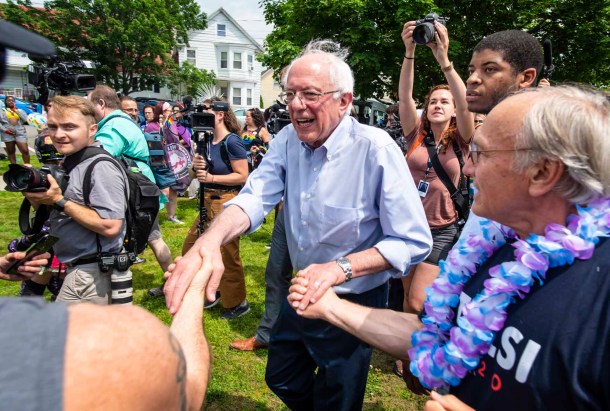
Being president of the United States is not like being retired. Neither is running for president, and Sanders – perhaps to demonstrate his stamina despite his age – has been campaigning at a vigorous if not furious pace. Not only has he held three or four events every day, with few days off, but he has made a point of showing off his physical fitness – shooting baskets, playing catch, pitching in a softball game his campaign arranged in Iowa in July. It was as though one of his campaign tactics was to display how healthy he was, to divert attention about how old he is.
What happened Tuesday in Las Vegas sabotaged that ploy. Sanders’ age and health are now in the middle of the political radar screen, and likely to stay there.
And while it has not been much discussed (because discussing it would be inappropriate?), age may be on the minds of the voters. Former Vice President Joe Biden’s occasional stumbling in debates and on the podium have called attention to his age (76), and a Pew Survey last May found that only 3% of Democratic voters preferred a candidate in his or her 70s. More than 70% said they’d be more comfortable with someone in his or her 40s or 50s.
How – and how much – Sanders’ illness will impact the Democratic campaign from here on is uncertain. It depends first of all on when he resumes campaigning.

No, it depends on whether he resumes campaigning. From what is known now, there is no reason to think that his ailment is life-threatening. But that doesn’t mean he’ll be able to return to the punishing pace of the campaign trail any time soon, or even soon enough to maintain political viability.
If and when he does go back on the trail, it will be to a campaign in which he has been losing some support in the last few weeks, much of it to Sen. Elizabeth Warren of Massachusetts. In the poll that came out Wednesday morning, from Monmouth University, Warren was leading the Democratic field, with 28%, to Biden’s 25% and 11% for Sanders.
It is Warren who is most likely to benefit if Sanders voters start thinking about throwing their support elsewhere. The two of them agree on most policy issues.
How a weaker Sanders (or a Sanders withdrawal) would affect Biden is more difficult to figure out. He’s the best-known of the other contenders. But also the oldest. The more that voters are thinking about age, the worse it is for Biden.
It’s possible that the biggest beneficiary of Bernie Sanders illness will be one of those other Democrats, the ones polling at 1 or 2%. If millions of primary voters start thinking that they have to consider another candidate, who knows which one they might choose?
Of course none of those candidates will admit that such a thought would even enter their minds. Talk about some people benefiting from another person’s misfortune is inappropriate if not tasteless.
But it is – alas – news.