WEYBRIDGE — Any local Civil War buff or Morgan horse enthusiast will tell you that the Morgan horse was instrumental to the success of the 1st Vermont Cavalry, which traveled south to join the Union army in 1861. Every soldier in the cavalry was issued a Morgan, and the breed was chosen in part because of its endurance.
“The Morgans are a great, versatile, all-purpose athletic horse,” said Margot Smithson, operations coordinator at the UVM Morgan Horse Farm in Weybridge.
However, Smithson said that the real key to the breed’s battlefield success was their temperament.
“The most remarkable thing about them is their personality,” she said.
“They just have this heart where they want to work for their person. In battle, Morgans consistently were calm and fearless under fire.”
The Morgan’s role in the Civil War is part of what the staff at the UVM Morgan Horse Farm hoped to celebrate on Saturday at the farm’s second annual Cavalry Day.
“It’s teaching people about the history of the farm, the history of the Morgan, and how important our little state animal is to our national story,” Smithson said.
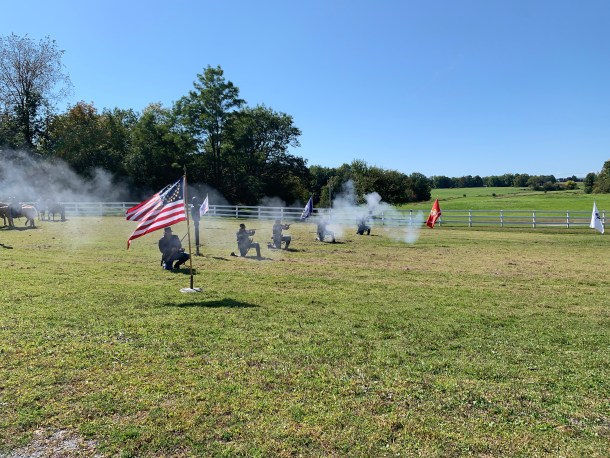
The festivities included tours of the barn, a showing of the stallions and the main attraction: Civil War reenactments by the 1st Vermont Cavalry, Company K, which chose its name from Addison County company in the state’s original Civil War cavalry.
Timothy Short, the group’s commander, led the drills on the lawn. He described his troupe as “horse and history enthusiasts” who want to keep the stories of Vermont’s Civil War participation alive.

“I wish people understood the relationship between the state pride of the Morgan horse and how well they did during the Civil War,” Short said. “When [the 1st Vermont Cavalry] first arrived on the scene in D.C. and Virginia on their Morgans, all the other guys made fun of their little horses. But they turned out to be some of the best horses for the war.”
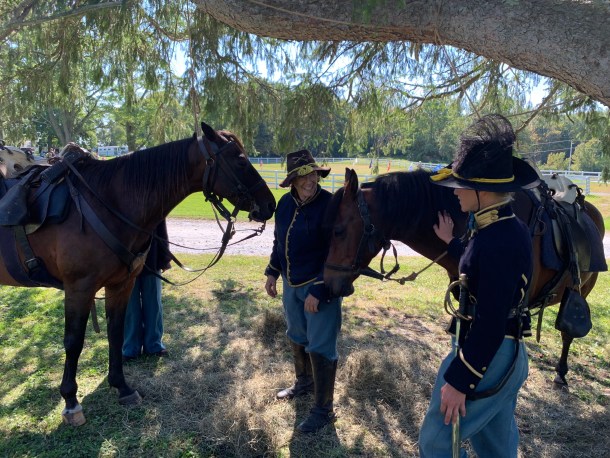
The nine reenactors dressed in full uniform regalia, despite the heat, and their horses were tacked up in replica saddles from the period. Short led the group through practice saber exercises before the riders used the same maneuvers to demolish a series of cabbages on fence posts. The demonstration ended with the firing of 1863 Sharps Carbine rifles.
The history of the Morgan horse in Vermont, however, begins well before the Civil War. The first Morgan horse, Figure, lived in Randolph, Vt., after he was was born in 1789 in Massachusetts. Figure was sometimes referred to by his owner’s name, Justin Morgan, which is where the breed gets its name.
Smithson said that the history of the Morgan horse is unique not just to the state but to the Middlebury area.
“Middlebury doesn’t know it but it has this incredible Morgan history right here,” she said. “We probably get 8,000 visitors a year. There have been so many people who come to the state for the horse farm.”

The Morgan Horse Farm was founded in 1878 by Joseph Battell, who also created the original Morgan Horse Register.
“He did a lot of research into bloodlines and published the first two volumes of the Morgan Horse Register, which denotes how your horse traces back to Figure,” Smithson said. “By researching the bloodlines, people say he helped save the breed.”
Near the end of his life, Battell arranged for the federal government’s new Morgan horse breeding program to take place on his farm. The government’s cavalry remount program bred Morgans in Weybridge from 1907 to 1951, and to this day the “Government family” is the largest of the four families within the breed.
The farm still breeds Government Morgan horses, and according to Smithson, theirs the oldest continuous Morgan breeding program in the world. At the peak of their operation, the government had 120 horses on the farm and bred 30 to 40 foals a year.
“Many, many of the existing Morgans in the country can be traced back to this farm somewhere in their pedigrees, which is pretty remarkable,” Smithson said.
After the U.S. shut down their remount program, the University of Vermont took over the farm and still runs it today. For a number of years, the farm had its horses, a dairy facility, a beef cattle operation and a steady stream of UVM students visiting for various classes. In the ’70s, the farm was rebranded as a tourist attraction.
Recently, Smithson said, the staff at the farm have been working hard to reintegrate with both the university and the local community.
“We’ve kind of flown under the radar for the last 10 or 15 years, and we’re sort of reinvigorating and reimagining the farm and trying to get ourselves out there,” she said. “We’re working hard to reintroduce Addison County to the Morgan Horse Farm and all the things that are going on here and the resources we have for people to learn about Vermont’s state animal.”
Cavalry day is part of this effort, Smithson explained, and after two years she is ready to call the event a success. In addition to teaching people about the important role that horses play in Vermont’s agricultural economy, she hopes that visitors walk away understanding that the history of the Morgan is in many ways the history of the United States.
“Morgans participated in the pony express, the gold rush, they brought the settlers west, the Morgan horse is really kind of essential to the American story,” she said. “Figure was born in 1789, and he is coming off of the heels of the American revolution. So here’s this new nation with this new breed of horse.
“It’s this wonderful, can-do-everything, all-purpose thrifty little Morgan. It was really something that the early Americans took pride in.”