

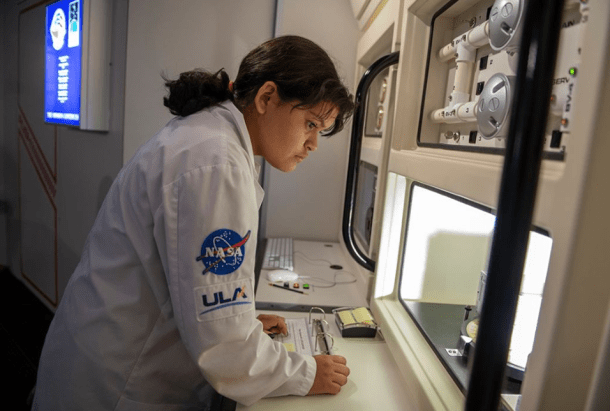
For educators in rural Franklin County, the Challenger Center for Space Science Education sounded like just what the community needed.
The Washington, D.C., nonprofit had promised to help the Swanton area build a STEM teaching facility with a space simulator. For Missisquoi Valley Union Middle/High School, nearly 40 miles north of Burlington and 65 miles south of Montreal, the center would bring to town an enrichment opportunity not often available in the rural area.
This was around 2010, as educators, pundits and parents around the nation were starting to grow increasingly alarmed by reports that U.S. students weren’t prepared in STEM — the popular acronym for science, technology, engineering and math. Meanwhile, the Franklin County Industrial Development Corp. saw the proposed center as an economic development tool. The Challenger Center was founded in 1986 by the families of the astronauts who died in the Challenger disaster in 1986.
“The original idea was pull in students from northern New York, even students from Montreal,” said Dan Palmer, who was assistant principal for the Missisquoi Valley middle school at the time. He’s now co-principal. “Our science department kind of picked it up and said, “This will be a really good idea.’”
But a feasibility study showed the rural area’s population couldn’t sustain such a center, and that the Challenger Center itself might not be the kind of partner the nonprofit would want. Now the town’s trying to get back $45,000 that it raised from local individuals and businesses and paid over to the Challenger Center with the expectation it could get the money back.
The genesis of the STEM project
After teachers at Missisquoi Valley visited a Challenger Center and started talking about trying to get one in Franklin County, a local group formed a board in 2010, applied for nonprofit status, and in 2011 signed an agreement with the Challenger Center to pay $50,000 as a deposit to put a flight simulator on hold. Only $5,000 was non-refundable.
The group raised $250,000 from local businesses and others.
“The Challenger widows and widowers were on this board when we were doing this, and we thought if they were supporting all this” then it was a worthy cause, said board member Jacqui Hood. “We tried everything we could to raise money; we had bake sales, we solicited local companies.”
In 2014, the group commissioned a feasibility study that found that the costs of such a center outweighed the benefits.
“I would be extremely skeptical about getting into a business relationship with them,” said researcher Jim Boylan of Mad River Research, who wrote a lengthy report outlining his attempts to get detailed information from Challenger Center staff in Washington.
Based on Boylan’s report, which examined Challenger Centers in other rural areas, the Franklin County group canceled its plans. In 2015, it started asking the center to return the deposit, minus the $5,000 that was non-refundable.
Four years later, the group is still asking. They have had some local lawyers write letters to the center for them, and received a letter back from the Challenger Center saying the $50,000 was consumed by administrative costs, and not refundable.
Last summer, the board asked Vermont Rep. Peter Welch to reach out to astronaut Mark Kelly, who served on the Challenger board at one time and knew Welch through his wife, former Rep. Gabby Giffords.
“Peter wrote a personal note to Mark asking him to review a letter from the Vermont group signed by Tim (Smith) outlining their appeal for reimbursement,” said Lincoln Peek, Welch’s communications director. “Mark responded saying he would review it and subsequently gave Peter an indication that some of the money would be reimbursed. As far as we know, there has been no follow-up by the Challenger Center.” Smith is executive director of the Franklin County Industrial Development Corp.
According to the group’s 2011 contract, “the $50,000 reservation fee is refundable to your Learning Center less all administrative, design and out of pocket costs incurred by the Challenger Center in development of the project,” Daria Teutonio, the Challenger Center’s senior director of community engagement, said in a June 2015 letter to Smith. “During the almost four-year period since the contract has been signed, we have expensed all the funds from the reservation fee.”
Pressed for details or an accounting of those costs, the center hasn’t responded, said Smith.
Lisa Vernal, vice president of communications for the nonprofit, told VTDigger this month that the group now has 40 Challenger Learning Centers that serve more than 250,000 students around the world.
“Challenger Center does not owe the Franklin County Industrial Development Corp. any money,” Vernal said in an email.
But the all-volunteer board isn’t ready to give up. It raised almost $250,000 before members decided to cancel their efforts, and they said donors had been supportive, asking them to use the money for grants to teachers who are providing STEM enrichment to students in the region.
And they’re still trying to get their money back.
“I have served on many boards, and this is a board of incredible dedication and integrity,” said board member Lise MacDonald of Swanton. “None of us have asked to be reimbursed for anything. It seems too egregious that we find ourselves having been hoodwinked.”
In hindsight, the whole thing seemed slightly shady, said Smith. He said that the Challenger representative, Community Relations Director Marty Schwartz, made one trip to Franklin County to talk to the board and pressed them heavily to apply for grants.
“It almost seemed like Marty got a commission or bonus for every one he sold,” Smith said. “Maybe it’s the Washington, D.C., way: the callousness of the letters saying, ‘Nope, your money is gone; basically you are out of luck.’”
‘Smoke and mirrors’
The Franklin County board feels the Washington group could easily afford to repay the money.
The Challenger Center, which has offices near Capitol Hill, reported revenues of $4.1 million in its 2017 annual report. It. Nearly half of that came from federal grants and related match funding, and $1 million came from the federal Science, Space, and Technology Education Trust Fund. It made 16% from an area described as affiliation fees, and then another 13% from corporate, foundation and individual giving; program upgrades from existing learning centers, and other sources, the report said.
On 2017 tax documents, the center reported it had 21 employees, 30 board members, and a payroll of $2 million. Then-president and CEO Lance Bush made $264,000 that year and got a $25,000 bonus.
The Franklin County board members were initially chagrined about losing the $45,000, which accounts for the delay in making their fight with Challenger more public, MacDonald said. But not so embarrassed they’re willing to give up.
“As a board, I think there was a point where we were embarrassed that we in good faith had spent $50,000 of our fellow community members’ money and we lost it,” she said. But now she thinks the group was up against a money-making operation that pitched itself as an educational benefit.
“To them it’s just some small town in Vermont and they think sooner or later we’ll go away,” she said. “In retrospect, it was smoke and mirrors.”


