


[C]oventry Village School, as its principal puts it, is bursting at the seams.
A speech-language specialist has been meeting with students in a glorified closet. Instrument lessons are being held in hallways. And the pre-K through 8 school had to cart in a mobile building this year to house two additional classrooms.
Why?
Because the tiny town’s lone school has seen a nearly 60% increase in enrollment over the last decade, even as Vermont saw an almost 7% decrease overall.

Coventry had 94 students in the 2008-09 school year, according to state data. For the 2018-19 school year, it had 148.
“We are not only bucking the trend,” Principal Todd Rohlen said. “We are bucking it dramatically.”
The growth has confounded teachers and officials. It’s not as if the town has swelled over the same period: The number of people there is estimated to have dropped by more than 2% from 2008 to 2017, the latest year available for census figures.
Bringing in the mobile building has temporarily alleviated some of the bloat, and school board members are now considering asking voters to greenlight funds for a permanent expansion.
But the enrollment boom remains a mystery.
A struggle for space
The long, brick school building abuts the bottom of a hill off U.S. Route 5, on the south end of town. It was built in 1995, according to last year’s municipal plan, after “it became apparent that the town’s (old) K-8 facility had reached its maximum student capacity.”
The current dilemma began in the 2008-09 year, when 94 children were enrolled. After that, the student population increased in all but two years, ending with a 57.4% gain from the 2008-09 to the 2018-19 year.
Over the same period, enrollment statewide dropped by more than 6,000 students, at a rate of 6.7%.
Last academic year, when the Coventry headcount reached its peak of 148, officials faced a struggle for space.
“They were legitimately compromised in their ability to fully serve students,” said John Castle, superintendent of the North Country Supervisory Union, to which the Coventry school belongs.
Take special education, Castle said. “Those services really didn’t have the spaces needed.”
The greater number of students made it harder for teachers to prioritize modern education techniques, like small group-work and one-on-one meetings, Rohlen said.
So, things shuffled.
Reading groups, math support and special-education activities started filling the library. “You can imagine it’s not a library anymore,” Rohlen said.
Kids who need separate testing spaces ended up cooped up in closet-like rooms — such as the slender room for the building’s computer servers, which is still used for exams. Sometimes, Rohlen gives up his office, he said.

The speech specialist uses a cramped room off the gym to meet with students.
“Imagine trying to give speech services in a gym,” Rohlen said. “When PE’s in session, it’s hard.”
The room next door is a “reset” space, he said, where employees can assist stressed-out students. Inside is a tiny trampoline.
“They’re not designed to do work with kids in there,” the principal said.
Music class has presented several problems. Holding instrument lessons in the hallway, rather than in practice rooms, can disrupt other students — especially when the players are young children still learning.
And the school counselor’s office is attached to the music classroom, behind a door at the far side. That’s not ideal, the principal said.
Music just outside the door can prove challenging for the counselor’s work. And having to march through a classroom of peers to visit the counselor’s office can cause anxiety for students seeking help, given the stigmas surrounding mental health.
“You need a private space, a confident space, for those things to happen,” Castle said. “Schools weren’t built 30 years ago (with that) in mind.”
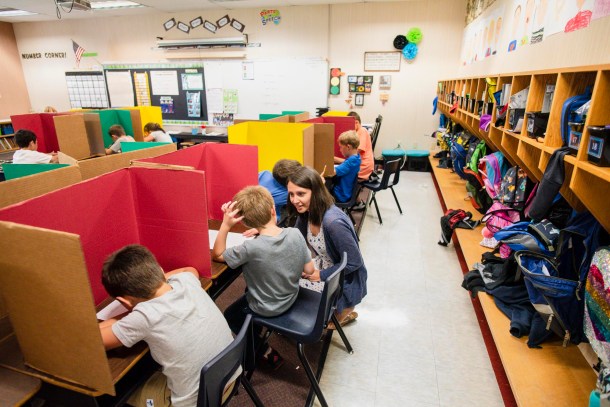
Coupled with changing needs in education and an increasing population, the building’s limitations became more pronounced.
“Part of it is how we utilize space in schools today,” Castle said. “There is a need for more space for small groups … there’s a need for special education or other academic supports … there may be a need for office space for ancillary staff.”
As Coventry Village School Board chair Matt Maxwell put it: “The way that education is specialized these days, sometimes a lot of people need different areas and private areas. And it’s hard to make it all work.”
The school board hosted a forum last year to hear from community members about the space problems.
“There were many parents there saying there just wasn’t enough room in the school,” Maxwell said.
They weren’t happy with students and services constantly being moved around.
“Nobody really had a permanent space,” he said.
Theories abound about increase
In his office on a recent afternoon, Castle shook his head and held up his hands.
“I don’t really have an answer for why there’s been such an increase,” he said, laughing.
He and other officials can’t point to a single reason behind the steep climb in enrollment numbers. But they have a few theories.
Families in Coventry have high-school choice, an option that exists nowhere else in Orleans County, according to the state Department of Education.
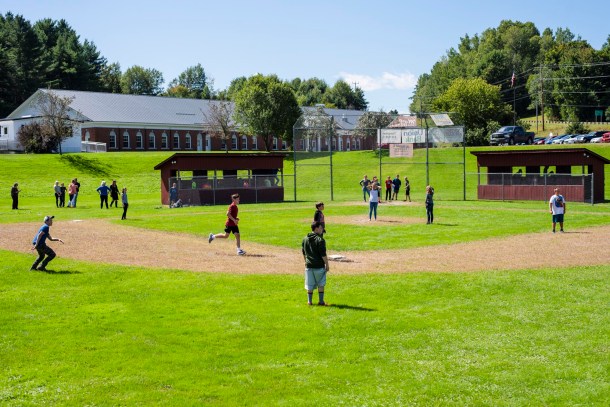
That could be an attraction for parents, would-be or current.
Rohlen and Maxwell believe Coventry’s lack of a municipal tax has been a factor, too.
“You’ve got that sweet landfill money,” Rohlen said.
Casella Waste Systems pays the Coventry government a fee to operate the state’s only landfill in the town. The company paid the town more than $1 million over the 2018 fiscal year, accounting for 93% of Coventry’s total revenue, records show.
Town Administrator Amanda Carlson suggested Coventry’s lack of zoning could also be a reason why people move there, and that the Coventry Town Foundation — which provides social services — could be a draw, too.
“All of those benefits that come with the town, I just think its a combination of all of those,” Carlson said.
But school choice and no taxes existed before the last decade’s boom, Castle said.
Instead, he pegged part of the growth on the 2015 development of a pre-K program at the school. Those services had previously been offered through three districtwide centers.

The 2015 school report lists 12 students added in the rollout of the pre-K program that year. Total enrollment jumped from 105 to 132 students between 2014 and 2015, according to state data, so the program didn’t account for the entire increase, or the yearslong trend.
Maybe, Rohlen and Maxwell think, the growth boils down to the quality of the school.
“Our staff is unbelievably dedicated, so that could very easily be a part of it,” Rohlen said.
He described the school’s artists-in-residence program, which last year hosted Jeh Kulu Dance and Drum Theater from Burlington for a week.
“Schools our size generally don’t have that,” he said. “Schools in the Northeast Kingdom generally don’t have that.”
Fixing for now — and the future
On a recent Thursday, Coventry teacher Eric Matte greeted his middle-school math class with an announcement.
“Welcome back to the modular,” he said. “Very exciting stuff — our first little class in here.”

He was referring to the new mobile building, a long, white unit to the left of the school with a gleaming metal ramp. This was the first day of classes inside it.
With the building on campus, the school has addressed some of the space constraints. The unit allowed administrators to expand the pre-K program — 3-year-olds can now attend, and 4-year-olds can stay for a full day — and move it to a larger room.
The old room — never designed for those services, Rohlen said — is now free for conferences.
The school has a two-year lease on the mobile building, but it has to be moved to a new spot soon. Per state regulations, the building needs to have a solid foundation after 180 days, Castle said. He said plans are in progress to pour a cement slab on the property.
Meanwhile, Maxwell said the board has hired consultants to study expanding the main school building — either horizontally, or by renovating the second, unused floor.
Construction will require voters to approve a bond, and the earliest they can do that is at the March town meeting.

Castle supports a long-term solution like that. Still, he holds some questions.
“When is a shift demographically — either a spike or a dip — when is that an anomaly, or when is that more of a long-range trend?” he asked.
He wonders if the trend will hold, urging caution on making a major investment too soon.
For now, at least, Carlson isn’t complaining.
“I think it’s fantastic that people are coming here, that they want to live here,” the town administrator said. “It really is a wonderful problem to have.”
