


MIDDLEBURY — Not long ago, money was so tight at Danforth Pewter that the company did away with its water dispensers and its custodian. The latter duties rotated among office staff, including CEO Bram Kleppner.
“I took the bathrooms,” said Kleppner, who became CEO in 2011, after Danforth had a string of bad years.
Danforth had lost $200,000 the year before. Kleppner told the company’s founders, Fred and Judi Danforth, and its 30-odd other shareholders that if Danforth Pewter didn’t at least break even in 2011, the 45-year-old company should close its doors.
But Danforth ended up with a profit of $328 in 2011, and its owners kept it going.
Now, after riding decades of changing whims and a drastically altered retail landscape, Danforth Pewter is opening new stores, buying other pewter companies, seizing control of its Amazon presence, and dispatching nearly half a million catalogues a year to the aging cohort of customers who still want to leaf through a paper volume to order gifts. This holiday season, it will launch products in Canada for the first time.
The tankard metal used by colonials
Pewter was the tableware material of choice for working people before the Civil War. Only the wealthy could afford ceramic cups and bowls; everyone else made do with the handy metal, mainly tin, that didn’t rust or tarnish or break when you dropped it.
That was before Chinese ceramic imports wiped out the pewter industry by putting ceramic and glass within reach of average people. By the 1870’s, the pewter market had dwindled so far that the Danforth pewter company in Connecticut gave up the business.
But a century later, a later Danforth – this one Fred, a recent graduate of Middlebury College, was urged by his wife Judi to revive the family’s tradition. With pewter itself popular as tableware once again, the two artists started a pewter company in a Woodstock barn in 1975.
Surviving the whims of the gift business
Fred and Judi Danforth’s business took off in the late 1980s, when they became the exclusive licensees for Disney’s classic Winnie the Pooh figures. Danforth shipped truckloads of Winnie the Poohs to gift stores around the country, and the money flowed in. The company doubled in size.
But tastes changed, and 10 years later, Disney moved on. Fred and Judi Danforth obtained licenses for brands like Curious George, Beatrix Potter, Dr. Seuss, and the Smithsonian, and that helped a little, “but it was nothing at all like what Winnie the Pooh had been,” said Kleppner, who joined Danforth in 2007 and became CEO in 2011. “It was really 12 to 13 years of trying to figure out how to reconfigure things to make it work.”
To keep the company afloat, leaders instituted some drastic measures in 2011. Kleppner laid off 10% of the workforce. He cut his own pay by 80% – making him ineligible for company health insurance – and everyone else’s pay by 60%. The corporate office had a roster on the wall showing whose turn it was to clean the halls and bathrooms.
And Kleppner looked for new ways to reach customers. In 2012, he joined a catalogue cooperative that gave them prospects from 11 other mailing lists. Danforth sent out 40,000 prospecting catalogues to possible new customers in 2012, and 80,000 in 2013, he said.
Profits started to rebound. The company made $180,000 in 2012, and has had a string of profitable years since, paying down its debt and investing in retail. Kleppner said sales are now headed toward $10 million a year, with 5% or 6% as net income.
And this year, Danforth is sending out 500,000 catalogues. About 400,000 of them will go to prospects between October and early December.
Kleppner aspires toward social good in the management of the business — particularly when it comes to employee pay and benefits — and he’s not happy about the environmental impact of the catalogues. But they seem to work, he noted.
“It is upsetting to us that we mail half a million catalogues and a few thousand of them will generate orders and 100,000 will get, if we’re lucky, recycled,” Kleppner said. “If we’re unlucky, they’ll be trashed or burned without anyone getting anything of value out of it.”
And Kleppner thinks within five years, the catalogue business will be done.
“If you grew up shopping in a catalogue, that’s what you like to do, and that cohort of catalogue shoppers is aging,” he said. “The people who grew up shopping on their mobile devices will never particularly enjoy shopping from a catalogue. Catalogues are going to go away; it’s a question of when.”
When Kleppner became CEO, Danforth had stores only in Vermont — in Burlington, Quechee, Middlebury, Waterbury and Manchester. In subsequent years, they closed the Manchester store, opened another Middlebury store, and moved the Quechee store to Woodstock.
In 2009, they bought a pewter company that had a store in Virginia’s Colonial Williamsburg, and have kept that store open. They have also added stores in Portland, Maine, and in National Harbor, Maryland. Last month, they opened another store in Portsmouth, New Hampshire.
Now they’re looking for spaces in Mystic, Connecticut, Asheville, North Carolina, and Annapolis, Maryland.
A company built on keepsakes looks forward
Meanwhile, the company is using customer feedback for 80 to 100 new designs for its pewter every year. About a million individual pieces of pewter go out of Danforth’s doors every year — most of it Christmas ornaments, medals, keepsakes, jewelry and small figures. The company makes the pewter bottle stoppers — this year’s resembles an armored hog — for Whistle Pig, the Middlebury whiskey distillery, and other custom items.
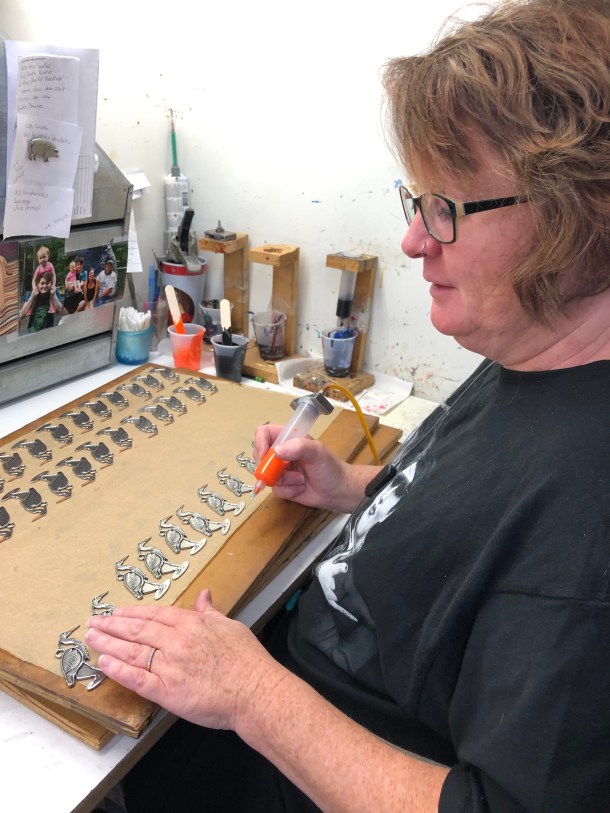
Danforth’s pewter is mostly tin, with a little bit of copper and antimony. There’s no lead. Danforth buys its pewter from a company in Rhode Island and uses rubber molds and sometimes a procedure called spinning — similar to shaping clay on a wheel, but with pewter — to make almost all of its products.
Danforth bought other pewter companies in 2009, 2012 and last year. Now the company has about 100 people on the payroll, many of them at its stores.
The fortunes of the gift items are closely tied to the holidays; half of Danforth’s sales happen in the fourth quarter of the year. Last year, Danforth’s Amazon sales doubled.
Four years ago, Danforth asked retailers to stop selling Danforth products on Amazon, and last year it registered a trademark for the first time. That enabled them to register their brand on Amazon, giving Danforth its own branded area and a space for videos.
Kleppner expects Danforth to open a new store every one or two years. The company has no goals for international growth beyond Canada; he said there’s plenty of untapped potential in the U.S. market.
“It pains me to say this, but there are probably people living here in Middlebury who have never heard of Danforth Pewter,” he said. “We’re tiny, and the U.S. market for holiday ornaments and earrings is immense, and we could happily mine that vein for the rest of our careers and never get close to the end of it.”
