

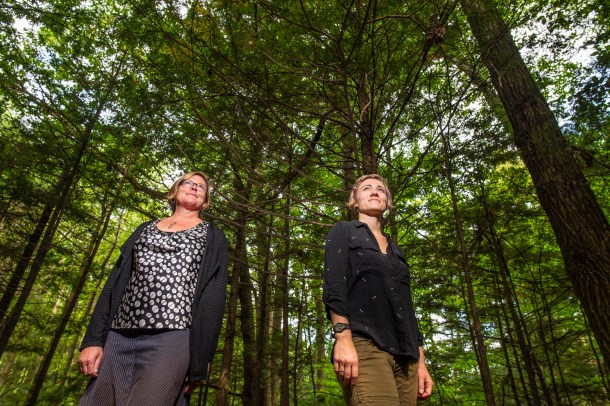
Alex Neidermeier has seen the destruction hemlock woolly adelgid can wreak on forests.
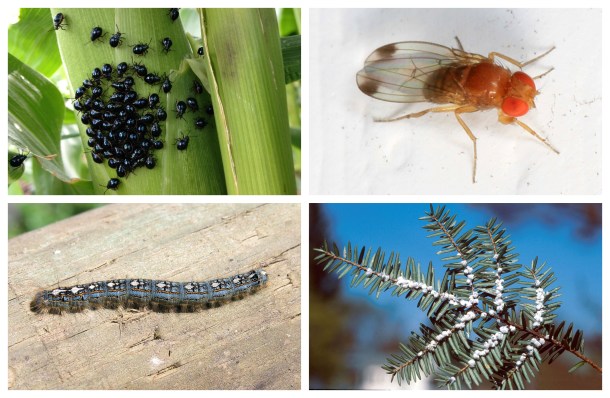
The pest, named for the white egg masses it forms at the base of hemlock needles, was first spotted in the U.S. in a Richmond, Virginia, park in 1951. Since then, the aphid-like insect has almost completely wiped out the Carolina hemlock, an Appalachian Mountains native that grows on rocky hillsides.
Neidermeier is a University of Vermont natural resources graduate student originally from North Carolina. She said the hemlock die-off is especially noticeable in the Great Smoky National Park in the fall against the red and yellow leaved deciduous trees and sprawling evergreens.
“They’re kind of like these eerie, very tall gray trees that are all along the skyline in Great Smoky National Park,” she said, adding that some call the dead hemlocks “gray ghosts.”
Eastern hemlock are considered a keystone species in Vermont. They shade rivers and streams, and scientists have found that certain kinds of fish are more abundant in streams in forests where hemlock outpaces hardwood forests.
“When you remove that tree that’s keeping the soil moist and cool, you get these different species that come in following that and so even the soil type can totally change,” explained Neidermeier.
Hemlock woolly adelgid, or HWA as entomologists call it, has been found so far only in southern Vermont — almost exclusively in Windham County. Barbara Schultz, forest health program manager for the state Department of Forest, Parks and Recreation, said so far the pest has been concentrated in Vermont’s “warmest climate zone,” or USDA Hardiness Zone 5B.
As Vermont’s winters warms, the same trends that have contributed to a tick menace that’s making headlines in Vermont, and increasing the risk of people contracting lyme disease, are also raising new worries for farmers and foresters.
Climate scientists say Vermont has already transitioned from hardiness zone 4 state to hardiness zone 5. Warmer weather in Vermont could allow pests that are currently “cold limited” to flourish.
Because all the Hemlock woolly adelgid are female — and don’t need sexual reproduction — they can more quickly pass on mutations to offspring that would help them survive the cold, said Kimberly Wallin, a forest entomologist with UVM and the US Forest Service who has spearheaded hemlock woolly adelgid predator research on both coasts.
Ecologists agree that overall, pest pressure is supposed to increase in Vermont as a result of climate change, but that assessment is invariably hedged with “it’s complicated.”
Scott Merrill, a systems ecologist at the University of Vermont who researches agricultural pests, said warmer winters likely make it easier for certain pests to survive. But it could also make it easier for their predators to survive.
Agricultural researchers are concerned with “range expansion” of pests like corn flea beetle, which carries the disease Stewart’s wilt, into Vermont. Stewart’s wilt can cause corn leaves to develop long, yellowed streaks, wither and die.
“Most people in Vermont probably don’t know about that because it hasn’t been really a big issue here,” he said. “But in 20-30 years, it will be a more regular pest.”
A 2018 study in the journal Forest Ecology and Pest Management projected that 50-80% of Vermont’s sugar maples could face climate-driven decline by 2071. The study recommends forest managers should identify and preserve possible sugar maple refuges.
“We don’t have a blank, flat climate in Vermont,” said Mark Isselhardt, UVM Extension maple specialist. “There’s a diversity of elevation and cold pockets and that there will be some areas that will remain suitable longer.”
While Vermont overall is projected to see increased precipitation, climate scientists also project that there could be more short droughts, which is also of concern to the maple industry, said Isselhardt.
Maple trees will likely be threatened both by changes in climate and the increased pests present in that changed climate. For example, one climatic “unknown” is whether the forest tent caterpillar, which currently defoliates trees in Vermont on a 10 to 20 year cycle, could start to impact maple forests on the shorter cycle that is common down south, said Isselhardt.
“There is also concern about the ‘next thing’ that might be an insect that has yet to be introduced,” he added.
Joshua Faulkner, farming and climate program director at UVM Extension, said that berry farmers have been dealing in recent years with the fruit fly spotted wing drosophila, which first showed up in Vermont in 2011 after Tropical Storm Irene. A study from Cornell found that early to midseason blueberry growers could lose 30-50% of their crop if no action is taken to manage spotted wing drosophila, while late season raspberry growers stand to lose 80% of their crop.
Rachel Schattman, a USDA postdoctoral research fellow, and others are experimenting with nets to protect organic berry bushes from the fly.
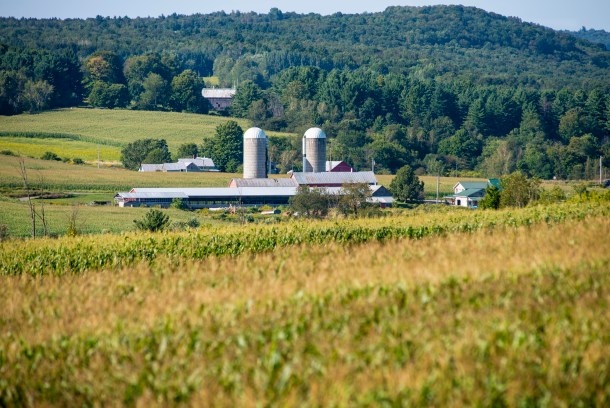
Increased moisture on fields — a result of a general increase in precipitation — also creates the “ideal situation” for certain diseases, like tomato blight, he said. Farmers in Vermont have started putting more tomatoes in hot houses in part to deal with that threat.
“That’s how a lot of disease gets transferred is when rain hits the soil, the soil splashes up onto the plants and that carries disease to that plant,” said Faulkner.
A warming climate can also sometimes kill off pests. Merrill, the UVM ecologist, studied an aphid species in Colorado that researchers originally thought was killed off by cold, but actually turned out to be knocked back by heat.
And then there’s the studies that have been coming out documenting insect dieoffs, although entomologists caution against claiming an insect apocalypse is fast approaching.
Merrill says he thinks the challenges facing the insect world writ large are a case of “death by 1,000 cuts,” rather than one factor.
A study that came out last year showed that half of Vermont’s bumble bee populations are gone or in peril. Merrill said he’s seen more communication with farmers about the importance of pollinator health for crops.
And it’s hard to say whether the larger challenges facing insects will also cause pest populations to drop or increase if competitors are declining in population, he said.

“The food webs are really complex,” he said. “And sometimes you remove one piece and nothing will happen. And sometimes you remove one piece and the whole thing kind of unravels.”
Not all new invasive species can be chalked up to climate change. Schultz, the forest health specialist, said the spread of emerald ash borer, the invasive that has now been found in most of Vermont within the past year, may not be linked to climate change as it is not especially cold-limited.
“I think emerald ash borer is a problem no matter what we do to the climate,” she said.
The spread of hemlock woolly adelgid seems to be more directly linked to climate change
The silver flies that researchers hope can combat hemlock woolly adelgid on the east coast are native to the Pacific Northwest, where they feed on native adelgids.
A previous graduate student of Wallin, Kyle Motley, found that the flies can survive — and eat the adelgid — on the east coast, which is “great news,” said Neidermeier.
“It’s really amazing when you go through a branch that has had silver flies … and you’re looking at it under a microscope, you can see that there’s very few hemlock woolly adelgid eggs left after they’ve gone through,” she said.
So far, the silver flies have not been released in Vermont. Neidermeier has been researching the life cycles of the two silver fly species to better synch their potential release.
Asked whether there were any possible downsides to using the silver flies to control HWA in Vermont, Wallin said that there is always a risk.
“But does that risk outweigh the potential benefits of saving a keystone species of hemlock?” she added. “You kind of have to balance that.”
