



Mark Bushnell is a Vermont journalist and historian. He is the author of “Hidden History of Vermont” and “It Happened in Vermont.”
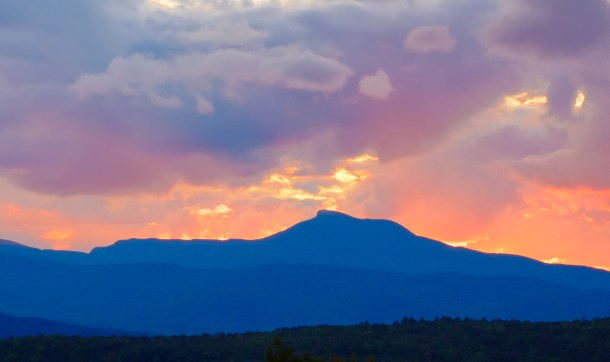
Paddling on a lake in July 1609, Samuel de Champlain took time to look around. This was a new world, from his perspective, and he thought distinctive landmarks needed names. As an explorer and former cartographer to the French king, this is hardly surprising. He gave his own name to the magnificent lake on which he was paddling. And to a distinctive mountain he saw in the distance, he gave the name Le Lion Couchant.
The name is poetic, at least if you speak French. It means the resting lion, though it suggests it is waiting to pounce. But we don’t really have a neat way of saying all that in English. “Couching” doesn’t really cut it. Perhaps that’s why English-speaking settlers changed the name once they dominated the area.
They didn’t return it to Ta wak be dee eeso Wadso, as the Abenakis knew it. That term also implied rest, but in the sense of the mountain being a good resting place. One scholar of the Abenaki language said it meant “prudently we make a campfire in a circle near water and rest at this mountain.” Quite a mouthful in either English or Abenaki.
The new name first appeared on a 1798 map prepared by Ira Allen, a surveyor and land speculator who was nearly as famous as his late brother Ethan. Allen’s map changed the Couching Lion to Camel’s Rump — hardly an improvement. The new name didn’t wear well. By 1830, the mountain was identified on maps as Camel’s Hump.
Naming the mountain after an exotic, non-native animal seems a missed opportunity. The state was still home to catamounts, which had been a symbol of the Green Mountain Boys’ resistance, first to British rule and then to New Yorkers’ claims to land titles in Vermont. What better symbol of Vermonters’ fierceness than a giant lion waiting to pounce? Apparently, early Vermonters saw things differently.
Camel’s Hump may have been the first Vermont mountain to get a European name, but for the past four centuries all the significant peaks in the state have been given new names. Vermont’s mountains have been named for people, both famous and not, for distinctive features, for incidents and for the towns in which they sit, or at least once sat.
Mount Mansfield, perhaps the only peak to rival Camel’s Hump’s fame, was named for the town where it was initially located. The town of Mansfield was once owned by Ira Allen, who bought it sight unseen, only to discover that it lay draped over the highest elevation land in all Vermont. A few people tried settling Mansfield, but found that having the town divided by a huge mountain was rather inconvenient. The town of Mansfield was eventually divided between Underhill and Stowe, but the mountain kept its name.
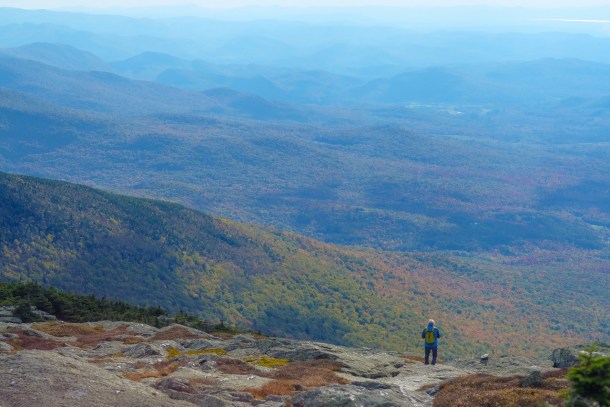
The origin of the name Mansfield is more mundane. The town, and thus the mountain, was named after the Connecticut hometown of the original land-grant owners. And Mansfield, Connecticut, had been named after Major Moses Mansfield, who was one of the original landowners in that town.
Belvidere Mountain is also no longer in the town after which it was named. The borders of the town of Belvidere have changed over the years so now Belvidere Mountain is actually in Lowell and Eden. The name “Belvidere” might have come from John Kelly, one of the town’s original grantees. Kelly was from Ireland, where you will find Lake Belvedere, though it is spelled slightly differently. The name derives from the Italian for “beautiful view,”
Vermont has a Presidential Range of sorts, not to be confused with the famed section of New Hampshire’s White Mountains. The best-known Vermont peak named for a president is probably Mount Abraham, named for Lincoln. (Don’t confuse it with Lincoln Peak, which got its name from Major Gen. Benjamin Lincoln, who was instrumental in the Americans’ Revolutionary War victory at Saratoga.)
Vermont also has Mount Grant, named for Ulysses Grant, which was perhaps meant more to honor Grant’s successful leadership of the Union Army than his presidency, which was less memorable.
The presidency of Grover Cleveland doesn’t conjure images of greatness either, but he evidently accomplished enough to have a Vermont mountain named after him. In Cleveland’s defense, he did manage to win election twice, with an unorthodox four-year gap in the middle.
Mount Roosevelt honors Theodore Roosevelt — not Franklin, who despite being elected president four times, never managed to take Vermont. Those were the days when our Republican politics were as rock ribbed as our mountains.
In 1927, the state Legislature named a section of the Green Mountains the Coolidge Range after native son Calvin Coolidge, then in the midst of his presidency. Appropriately, the range runs between Pico Peak and Plymouth, where Coolidge grew up. Some might argue that Coolidge didn’t deserve a mountain named after him, but some historians consider Coolidge an underrated president. To Vermonters’ credit, we have resisted the urge to name a mountain after that other presidential native son, Chester A. Arthur.
Military heroes also gained a sort of immortality in Vermont’s mountain names. Stark Mountain honors Gen. John Stark, hero of the Battle of Bennington during the Revolution. Molly Stark Mountain is a tribute to his wife. Nestled near them is even Baby Stark Mountain.
The Spanish-American War gave us two peaks in Underhill — Dewey Mountain, named after Montpelier native Adm. George Dewey, and Mount Clark, after Bradford native Adm. Charles Clark. Nearby Mount Mayo was named for Henry Mayo of Burlington, who was commander of the U.S. Atlantic fleet during World War I. Jay Peak is named for John Jay, first chief justice of the U.S. Supreme Court.
Other mountains honor more ordinary folks. For example, Laraway Mountain was named for a family that lived in the nearby town of Johnson, and Woodward Mountain seems to have been named for a family that lived on the flank of the mountain in Waterbury.
A handful of peaks at the northern end of the Green Mountains — Buchanan Mountain, Carleton Mountain and Mount Doll — were named for young men who helped clear the Long Trail there. Domey’s Dome got its name from Capt. R.H. Domey, who long maintained a northern section of the trail.
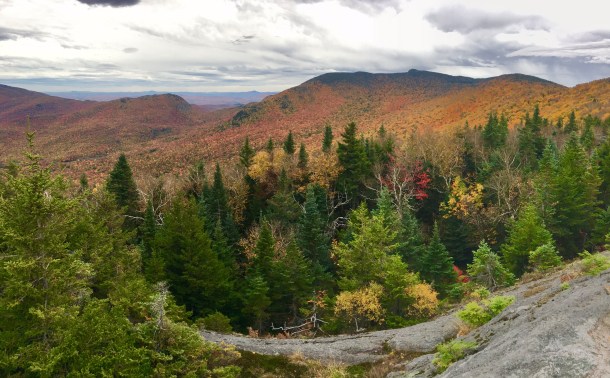
The state’s maps are dotted with Bear Mountains and Burnt Mountains — at least a half dozen of each. The former were apparently named because of encounters with bears and the latter because of fires that once burned there.
The ominous-sounding Bone Mountain was named in honor of Frenchman John Bone, who died after a fall there. The origin of Bloodroot Mountain’s name is less sinister. Bloodroot is a type of wildflower.
Some peaks owe their names to their appearance, thus we get names like Whiteface, Haystack, Sugarloaf, and Bread Loaf.
The Bread Loaf area was once the home of Joseph Battell, one of Vermont’s greatest philanthropists. Battell used his considerable inherited wealth to buy up 34,000 acres of Vermont, including many of the state’s most prominent peaks. Along the way, he named a few. He may have named Mount Roosevelt, to honor the president for creating the National Park System. He named Mount Boyce after his longtime secretary. And he might have named Mount Ellen after the fictional character in “Ellen, or Whisperings of an Old Pine,” a supremely quirky 1,300-page book in which an idealized intellectual climbs a mountain to explain all that she has been learning at college to a tree. It’s as unreadable as it sounds. Another theory is that the mountain was actually named for the heroine, Ellen Douglas, in Sir Walter Scott’s poem “Lady of the Lake.”
Battell was at heart a preservationist. Perhaps it was that instinct that persuaded him to keep the name of a large and distinctively shaped mountain he donated to the state. Or perhaps he just liked the ring of the name Camel’s Hump.
