

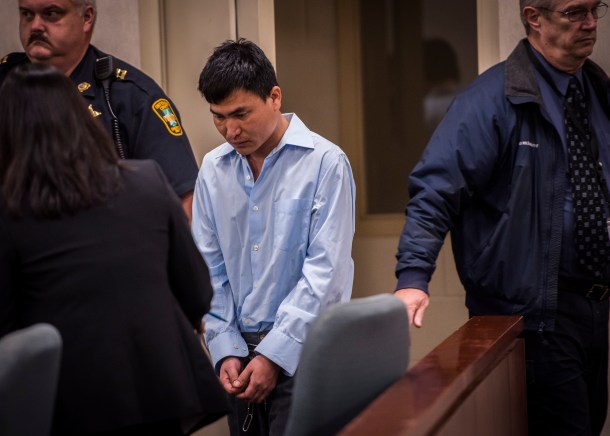
BURLINGTON — Attorney General TJ Donovan has refiled murder charges against a Burlington man after State’s Attorney Sarah George dismissed the charges after determining she wouldn’t be able to counter the man’s insanity defense.
Aita Gurung, who is accused of killing his wife with a meat cleaver in 2017, will again face murder and attempted murder charges after Donovan refiled the charges against him.
Republican Gov. Phil Scott asked Donovan to review Gurung’s case and two others that George dismissed in June. At the time, George said Scott’s letter requesting the review was based on “fear and misinformation” and that Donovan’s review set a bad precedent.
In refiling the cases, the attorney general is reversing the decision of the state’s attorney, which is believed to be unprecedented.
The Attorney General’s Office said it would not be making any additional statements until after the arraignment, which is scheduled for Friday at 1 p.m. in Burlington.
George said Thursday that she would not comment on Donovan’s decision until she knows his justification for it.
Gurung was charged with murder and attempted murder after allegedly killing his wife, Yogeswari Khadka, 32, and seriously injuring his mother-in-law, Thulsa Rimal, on Oct. 12, 2017, at their residence in the Old North End of Burlington.
Gurung had been released from the University of Vermont Medical Center earlier that day after a week-long stay for a mental health evaluation. His treatment provider from days after the murder testified that Gurung was severely psychotic and his ability to “rationally perceive reality was substantially impaired” at the start of his post-arrest hospitalization.
In the case, the state hired an expert to attempt to rebut the insanity defense after defense experts ruled he was insane at the time of the attacks. But the experts hired by the state also found that both individuals were, in fact, insane.
Dr. Albert Drukteinis, the state’s expert, determined that Gurung was psychotic at the time of the attack and was hearing voices telling him to kill his wife, and Paul Cotton, the defense’s expert, determined Gurung was suffering from schizophrenia at the time of the attack.
“Dr. Cotton further explained that Defendant lacked adequate capacity to conform his conduct to the requirements of the law at the time of alleged offenses due to his major mental illness,” George wrote in her notice of dismissal.
George wrote that she would not be able to successfully rebut Gurung’s insanity defense based on the evidence.
The three cases sparked a debate about the relationship between the state’s mental health and criminal justice systems and political influence in the criminal justice system.
In his letter informing Scott that he would take a second look at the cases, Donovan acknowledged that deference to the elected state’s attorney’s decision was “crucial to maintaining public trust in our democratic systems and institutions.”
But he wrote that he shared Scott’s concerns about public safety and decided to launch a review.

George said in June that she would be surprised if Donovan decided to refile the cases, and said she believed doing so would put unnecessary strain on the victims and their families as the state did not have the evidence to rebut the insanity defense.
“It would certainly be really surprising to me if they refiled the cases, I think the law is pretty clear,” George said at the time.
Scott said Thursday that he was grateful Donovan took another look and said he believed the Legislature would examine the insanity defense in the future.
“I’m just thankful that he was able to move forward and look forward to the other cases as well,” Scott said.
Gurung was still in the custody of the Department of Mental Health in June when George dismissed the cases, but due to federal health care privacy law, the department does not inform the public or state’s attorney about individuals’ release from treatment.
