

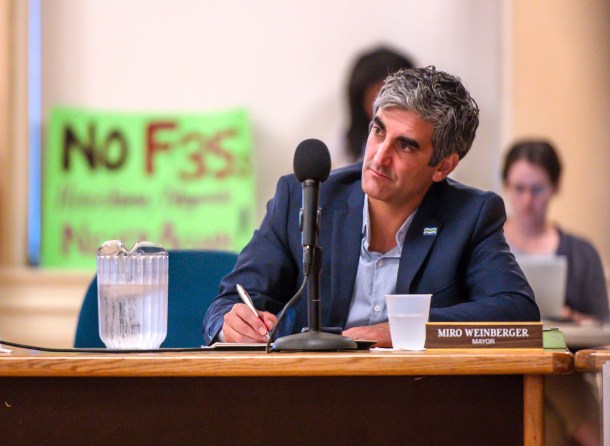
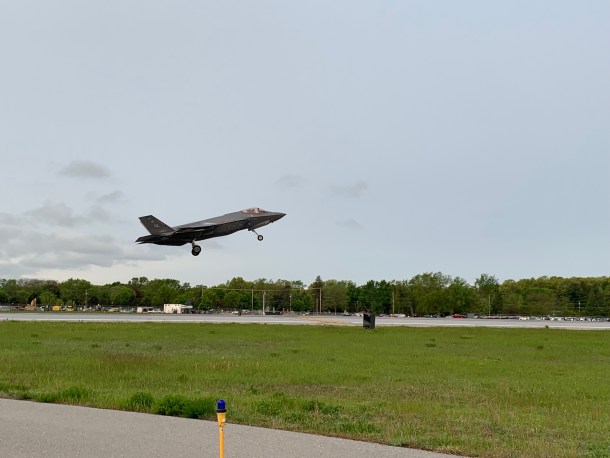
In September, the first of the highly anticipated F-35 fighter jets are expected to touch down at Burlington International Airport and launch a new mission for the Vermont Air National Guard.
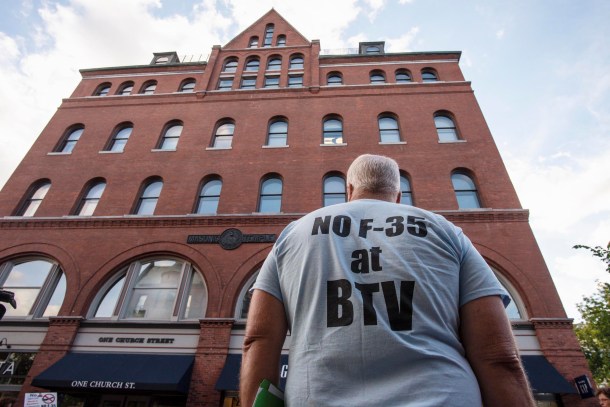
The arrival of the plane — the most expensive and troubled weapons system in Pentagon history — has been hotly debated in Chittenden County for more than six years, when the prospect of the jets coming to Vermont was initially raised.
The overwhelming majority of the state’s political and business leaders support the basing, often at odds with the people in the communities surrounding the base. In recent years, three municipalities near the airport have passed various resolutions opposing the jets — to little effect.
Burlington Mayor Miro Weinberger, a Democrat, has stood shoulder-to-shoulder with his political peers and the plane’s supporters. Last April, after his constituents passed a ballot resolution calling for an alternative mission to the noisy F-35, Weinberger announced that, for the first time in his tenure, he would not sign off on a citizen resolution.
Weinberger is a former member of the Burlington International Airport Commission. He believes a change in direction by the Guard would undo years of work by city officials, and could greatly reduce the Air Guard’s footprint in the state, which he said would lead to adverse economic impacts. In a previous interview with VTDigger, Weinberger noted that federal support for the airport is tied to the military’s ability to use the facilities.
On Aug. 30, Weinberger spoke with VTDigger about the F-35s — from plans to mitigate noise to whether he has any lingering concerns about the plane’s reliability. The interview has been edited for length and clarity.
VTDigger: In April 2018, shortly after the Burlington ballot resolution requesting a different plane was passed, you wrote a VTDigger commentary in which you said “the F-35 noise impacts are expected to change the current sound characteristics modestly and inconsistently.” Since then, new noise maps have come out that show their will be a tripling of homes impacted by the noise. I’m wondering if you still stand by that commentary and whether you were surprised by the scope of the new noise maps?
Mayor Miro Weinberger: I absolutely stand by those comments. We all knew what the final noise maps were likely to show at that point. We’ve had this conversation before, Jasper, right? I really feel like this is going over ground that we’ve explicitly talked about.
In my reading of those noise maps, I think my description is accurate. It is modest and inconsistent in that the noise maps, in some areas, will have less impact whereas other areas show more impact. And while the exact area of this 65-decibel line, which is what drives your projection, shifts — it brings more homes in it — I think calling that a modest change is accurate.
[Read VTDigger’s 2018 series on the Burlington F-35 basing.]
VTD: It’s modest to say that it’s tripling? It’s going from 819 homes to 2,640 by 2023? How is that modest?
MW: You’re really twisting, I think. You’re relying, by saying tripling… [pauses]. I don’t think it’s an appropriate place for us to have a big debate about this.
Those areas that were impacted by the F-16s, they are modestly more impacted by the F-35. The contours shift direction, it means it’s a louder designation. It’s not like there was no noise in those areas under the F-16s, they were just on the other side of this modeling line. I think my description of it being modest and inconsistent is exactly accurate and I stand by it.
VTD: South Burlington City Council Chair Helen Riehle recently told us that in discussions about the planes that you have been “careful” about what you will agree to when it comes to Federal Aviation Administration (FAA) grants for noise mitigation. With many more homes now in this 65-decibel range, it appears as if the price tag could be pretty significant when it comes to soundproofing. Has your office begun budgeting out the required 10% match to secure federal dollars? Do you have any idea of how much money Burlington is willing to spend? Finally, do you take the position that Winooski and South Burlington should also contribute to this match?
MW: I believe your last story on this, when Helen made that statement, was done just after we had the first meeting with them on the issue of the local match — and I have been meeting with Winooski representatives and Helen now for more than two years.
When it was first presented to me, I said to them I understood what their suggestion was and I told them I would have to go back and talk with the airport team and city attorneys before giving them a commitment there. I have been doing that work in the time since then. We actually just met again yesterday. I would say those conversations with the other municipalities have been productive, increasingly productive, and are headed in a positive direction. I’m optimistic we are going to be able to have a three-party Memorandum Of Understanding (MOU) that does a number of substantively significant things. I think we are likely to add a Winooski city representative to the airport commission, much in the way South Burlington (where the airport is located) has had one for decades, I believe.
We are attempting to codify the way in which the airport will take input from those other municipalities while finalizing particular documents related to a noise program. Ultimately it is the airport’s responsibility to make those decisions, but we are trying to build a process that gives real meaningful input to South Burlington and Winooski.
I don’t want to speak for the other municipalities, but our position right now is that we will work with those other municipalities to get as much federal funding as quickly as possible to address these noise impacts. Furthermore, we will work together to try to identify the appropriate sources of the local match. We have a bunch of work to do before the sources of the local match will be secured.
For example, the airport used to receive substantial funds from the state from airport-related revenues. That was one of the ways the airport was able to afford that 10% match for past FAA sound programs. In recent years there has been a change in the state funding strategy such that the Burlington airport’s funds have been cut quite significantly. I think we are going to have to revisit that conversation with the state, assuming there is a robust soundproofing program going forward.
Similarly, South Burlington gets some revenues from fuel sales at the airport that need to be used for airport-related expenditures. I think that should be on the table for discussion. There’s some details to work out here and some potential sources. My hope is that we can be as collaborative with these other municipalities as possible while we pursue that. I’m optimistic we will get to a MOU (Memorandum of Understanding) that reflects that.
One additional important point: We need to find a way to get that local match because we need that federal funding here, it could be tens of millions of dollars. Everyone is aligned on that. This will have positive noise benefits that are projected, of course, but the benefits go beyond that. The application to the federal government, which will be finalized in the coming months, would allow property owners to use these dollars to better insulate their homes, improve the air sealing in their homes, replace older windows with newer windows. You would significantly improve the indoor sound characteristics of these homes but have other very substantial benefits as well.
VTD: Is it fair to say no homes will be razed in future sound efforts around the airport?
MW: There are still some steps to go through before this program is finalized so I want to be careful about being as definitive as how you just asked the question. This new application has not been completed and has not been fully designed. But I will say I want the home demolitions to end and I want the money instead to be used for improving properties that would benefit from these sound measures. I will say that for the existing sound program there’s some remaining work, so I don’t think I can say definitively, ‘no more homes from this day will come down.’ But the point of the new program is for all future funds to be focused on mitigation.
VTD: As I’m sure you know, there continues to be headlines in the news about persistent technical problems with the F-35 program. That said, the planes are certainly getting a lot more reliable than they were even just a few years ago. Earlier this summer, a news organization called Defense News reported that there were a series of problems with the planes, including for the F-35A, which is the model coming to Vermont. It’s not expected that all of these problems will be addressed by the time the Vermont-based planes touch down. Moreover, the planes coming to Burlington are ones created before the development phase has ended. Full-rate production is supposed to begin at the end of this year, and is an important metric in terms of the plane’s reliability. How do you react when reports like this come out ?
MW: We continue to monitor those reports. When you and others have raised awareness about these reports we consistently reach out to Senator [Patrick] Leahy’s office and the Guard seeking clarification. We have consistently received assurances that the planes, when they arrive here, will be ready. We are relying heavily on the federal officials and processes that are set up to ensure the reliability and safety of these aircraft.
VTD: In the leadup to this basing we’ve seen a lot of business and political officials talk about the importance of the Guard as an economic engine in Chittenden County. The Greater Burlington Industrial Corporation released a report about how various upgrades to the Guard base ahead of the F-35 would create jobs and other tangible economic impacts. Has your office tracked any of those metrics? Do you have a sense of whether the basing has created new jobs or other economic benefits?

MW: Well, certainly there’s been an enormous amount of construction at the airport in recent years leading up to the basing. Everything I’ve seen in the data and in our experience of the construction market is that we are in a very strong moment. The construction industry is busy in Chittenden County right now. The investment out there is part of that. That’s probably the most direct indicator I have of that work.
The other information I have is more anecdotal. But I’ll say as recently as last night I was at an event where I met someone who is getting new training as a result of a deployment, so there’s definitely human capital investment of people with existing jobs to get up to speed with the Guard’s evolving mission.
VTD: We recently obtained a document that suggested that at other bases which have recently become home to the F-35, afterburner use is higher than was initially predicted. Folks say there are at least three bases where that’s happening and an environmental impact statement has been delayed because the Air Force estimation of 5% afterburner use is now seen as potentially incorrect.
MW: Yes, I read your report today. That was new information to me and it’s information I’m looking into as a result. It does seem like potentially significant information.
VTD: And if you were able to get some signal that afterburner use in Burlington would likely be more than 5% would you call for a supplemental environmental impact statement?
MW: Again, this is new information to me within the last 24 hours and I’ve just begun to look into it. When I’m further along in that and understand the implications of potential changes, I’ll be in a better position to address that question. At this point I don’t have a full answer for you yet.

VTD: Final question: Do you know when the first F-35 is actually touching down in Burlington?
MW: I’ve heard a variety of dates. I don’t know definitively. There may be people who do know. I’m not certain.
VTD: Has the Guard given you dates?
MW: I believe we have an indication of a potential date but I’m unclear how definitive it is.
VTD: And what is that potential date?
MW: I’d have to get back to you, I don’t have that in front of me. Let me look into it.
VTD: Okay, great. Thanks, Mayor. I appreciate it.
MW: Excellent, we’ll talk to you again.
Correction: Due to a transcription errors, several words were originally incorrect.
