

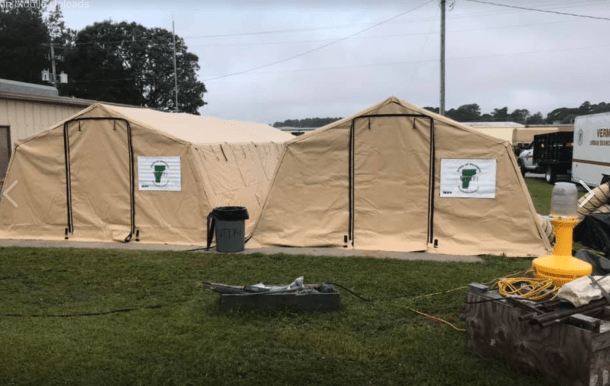
In preparation for the arrival of Hurricane Dorian, Florida sent out a call asking for help with emergency management — and Vermont answered, sending a 15-person swift water rescue squad to report for duty.
But as the team headed south Saturday morning, rescue trucks, trailers and boats in tow, the storm track changed course, veering away from a hard hit in Florida, and instead getting in position to head up the eastern seaboard.
“Sometime around 1 p.m. Saturday, Florida decided to release us, and North Carolina grabbed us up,” said Mike Cannon, the head of Colchester Technical Rescue, and a member of the rescue team.
Saturday night, the group set up shop in Greensboro, North Carolina, where they ended up staying for several more days, doing training exercises and preparing equipment as the storm continued to stall over the Bahamas, delaying its trajectory toward the states.
But as the hurricane started to move away from the islands Tuesday, the team moved a few hours southeast to Elizabethdown, North Carolina, in the same county where the team was based last summer during Hurricane Florence. Cannon called where they were during Florence “ground zero,” being both where the hurricane first hit, and where it saw the most rainfall (42 inches by the end of the storm.)
“Probably no one could have prepared us for that storm,” Cannon said. “There were some pretty dramatic rescues, a lot at night, in an area we weren’t familiar with.”
But although the team is often deployed to unfamiliar places, Cannon said the work itself is something that members are well-versed in back in Vermont.
“We actually have a fair amount of flooding in Vermont,” he said. “Probably two to three pretty significant flash floods a year.”
Assistant State Fire Marshal Pat McLaughlin said in the crew’s regular lives, a lot of them work in the fire service, either as a career or on a volunteer-basis. But he said there are also engineers and police officers who are part of the team.
“It’s as dangerous as any other emergency service,” he said. “There’s a potential for life-threatening injuries and for twisted ankles, but I wouldn’t rank it any better or worse than law enforcement or fire fighting.”
But Cannon said safety is still a key concern while they’re on the road.
“There’s always a risk of something going wrong when you least expect it,” he said.
The team plans to stay in North Carolina for 14 days, unless the storm weakens and the state sends it home earlier.
“We cost them money, after all, so they’ll only keep us as long as they need us,” Cannon said. “And they have plentiful in-state resources too. North Carolina is actually a pretty well-prepared state, but you know, you can never have too much help.”
