


A federal judge Friday has ruled that a lawsuit brought by a group of Bennington residents with PFOA contaminated wells can proceed as a class action.
The decision could open the door for hundreds of local homeowners who live in the contamination zone to join the lawsuit.
“This was a really important decision that establishes significant legal rights for groups who have been harmed by the common conduct of a defendant to seek class based remedies in federal court in Vermont,” said Emily Joselson, one of the attorneys for the plaintiffs.
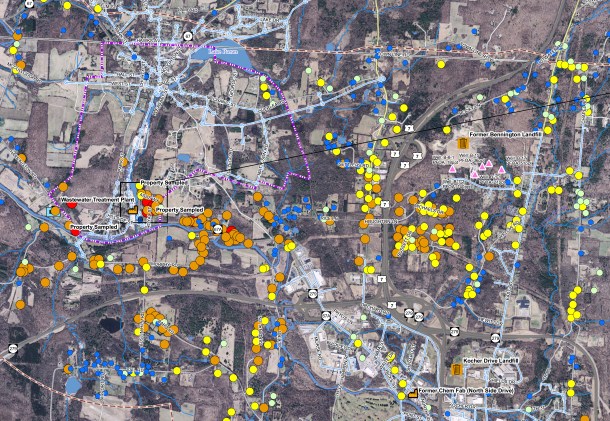
The residents filed a lawsuit in 2016 alleging that emissions from the ChemFab plants in town had polluted their drinking water wells.
Saint-Gobain Performance Plastics, an international conglomerate based in France that owns the former ChemFab facilities, had fought the class action certification.
The plaintiffs want the company pay for property damages from groundwater contamination and long-term medical monitoring. One plaintiff’s drinking water well had 2,730 parts per trillion of Perfluorooctanoic acid (PFOA), according to a court filing — significantly higher than the state’s 20 ppt combined drinking water advisory.
Currently, there are nine plaintiffs. The group filed to expand the lawsuit by obtaining class status for other Bennington residents impacted by PFOA contamination. There would be one class for the thousands of residents who live in the “zone of contamination,” and a smaller class for Bennington area residents with elevated levels of the chemical in their blood.
Federal U.S. District Court Judge Geoffrey Crawford granted the plaintiffs’ request for both class statuses Friday.
He acknowledged that while the plaintiffs and Saint-Gobain believe the PFOA contamination came from different sources, both will have to rely on modeling to determine “source and transport” as neither side has PFOA data from before 2016.
“These are questions for which it is reasonable to anticipate common answers,” said Crawford. “These are not questions in which the individual circumstances of each plaintiff predominate.”
Langrock Sperry and Wool is representing the plaintiffs. Attorney Emily Joselson categorized the decision as an “absolutely essential and major step” forward in the case. She said the plaintiff’s legal team had believed from the start that this case was best treated on a class basis because of the proof of liability.
The case still has a long way to go. Crawford states in his decision that the next step will be to determine whether medical monitoring is allowed as a remedy under Vermont law — and in this case in particular.

“Once he rules on medical monitoring through a motion for summary judgement, then the case would be set for trial,” said Joselson.
Dina Pokedoff, senior communications director for Saint-Gobain Performance Plastics, said that the company was aware of Friday’s “procedural ruling.”
“We plan to appeal this decision and will continue to defend vigorously,” Pokedoff said.
Earlier this year, state officials announced a multi-million dollar settlement with Saint-Gobain to extend municipal water lines for Bennington residents who have wells contaminated by PFOA, a toxic chemical in the PFAS family that has now been phased out by industry.
Chemfab operated in North Bennington from 1970 through 2000, when it was purchased by Saint-Gobain. The local facility, which applied coatings to fiberglass fabrics, closed in 2002 and operations were moved by Saint-Gobain to New Hampshire.
- Read VTDigger’s series on the history of the ChemFab plant and the state’s lax oversight of emissions.
Vermont state officials tested drinking water wells in North Bennington near the former ChemFab plant in 2016. By April 2017, the state had tested 570 private drinking water wells, with 276 showing elevated levels of PFOA, according to the plaintiffs’ amended complaint.
This summer, Vermont started widespread PFAS sampling by all public drinking water supplies, car washes, landfills and other sites. The state Agency of Natural Resources is moving ahead with setting drinking water standards for PFOA and four other PFAS compounds at 20 parts per trillion — among the strictest in the country.
PFOA was used in the manufacture of Teflon in products like nonstick cookware, stain-resistant carpets and fabrics, water repellent clothing, paper and cardboard food packaging. The chemical has been detected in a number of states in apparent connection to manufacturing facilities.
Scientists have linked exposure to PFOA with increased risks of certain kinds of cancer, thyroid disease, immune system damages, developmental problems in children and low birth weight.

