

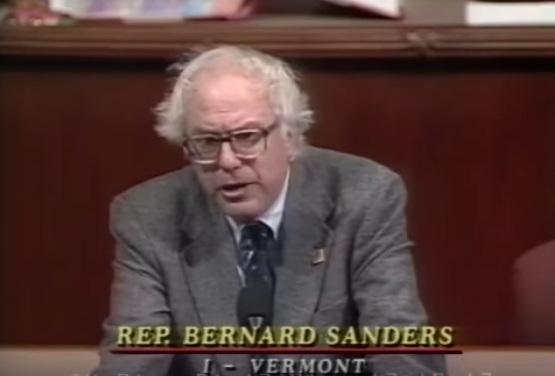
On Oct. 10, 2002, then-Rep. Bernie Sanders voted against authorizing President George W. Bush to go to war in Iraq. Although the Vermont independent was one of 132 House members who opposed the measure, he and his team were said to be concerned about a possible backlash with less than a month left in his reelection campaign.
They were right.
However, the criticism would not come from Republicans nor would it be because of his vote against the controversial war — a war that began over what turned out to be nonexistent “weapons of mass destruction” and that has taken the lives of about 5,000 American service members and around 200,000 civilians.
Instead, the attack would come from the political organization Sanders co-founded decades earlier, and would target his on-and-off support for bombing the Middle East nation throughout the 1990s.
In a 2002 election debate, the Liberty Union Party candidate for Congress, Jane Newton, slammed Sanders for “supporting the weekly bombing of Iraq for a decade,” the Brattleboro Reformer reported at the time.
Now, 17 years later, in his bid to be the 2020 Democratic presidential nominee, Sanders’ vote against the Iraq War has become a hallmark of an anti-interventionist foreign policy platform.
Since he lost the Democratic primary to Hilary Clinton in 2016, Sanders has fully embraced the role of a peace candidate, with the goal of reining in the military industrial complex and eschewing trigger-happy mainstream foreign policy advisers.
After attracting criticism that he lacked foreign policy bonafides during the last presidential election cycle, Sanders has most notably championed his work to end U.S. involvement in the Yemen civil war, where more than 50,000 people have died.
He also has been reluctant to support the deployment of military personnel to Venezuela, even while he has repeatedly condemned President Nicolas Maduro.
Sanders’ campaign says that since Sept. 11, 2001 — when the U.S. was attacked by terrorists, resulting in the immediate death of almost 3,000 people and another 6,000 injured — the Vermont senator has stressed the need for diplomacy and condemned an over-reliance on military action.
However, throughout Sanders’ career in public office he has never rejected military intervention — or war — out of hand, has sided with labor unions over peace activists, and throughout the 1990s supported U.S. airstrikes in Iraq as well as the NATO-led bombing campaign in former Yugoslavia.

“He is not a purist,” said Greg Guma, a longtime Vermont journalist and author of “The People’s Republic: Vermont and the Sanders Revolution.”
“He is an anti-imperialist,” Guma added. “He will usually be against U.S. intervention, but not always and not when it’s pursued cooperatively.”
Sanders also has usually cited the need for humanitarian aid when he has supported military intervention, which has rankled some in the Vermont peace movement over the years.
Though the independent senator has recently doubled down on anti-interventionist talking points, some are still not convinced.
“Well I’m afraid given his track record, we are going to have to be protesting against him, just like we’ve been demonstrating against every other president,” said Jay Moore, a 67-year-old who was part of an anti-war group that confronted Sanders during a 2014 town hall in Cabot.
Siding with labor unions over peace activists
The record Moore is referring to dates back to the 1980s when Sanders, as mayor of Burlington, butted heads with Vermont’s peace activists over the General Electric factory in the city, which was manufacturing helicopter Gatling guns to be used in counter-insurgency operations throughout Central and South America.
Members of the peace movement thought Sanders, who had publicly and privately opposed U.S. involvement in that part of the world, would support their civil disobedience, as they demonstrated in front of the Burlington factory, blocking trucks from entering and exiting.
But Sanders did not approve of the demonstrations, and chose instead to side with the labor union representing the factory workers.
“He made it clear that he felt it was anti-worker,” Moore said.
“He also felt that the peace movement had a bit of an elitist tinge to it,” Guma added.
The Sanders presidential campaign declined to make the Vermont senator available for an interview.
However, Sanders’ foreign policy aide said that there is no conflict “at all” between the Vermont independent’s opposition to the military industrial complex and his support for workers’ rights and the creation of jobs.
The Iraq dilemma
Seven years later, Sanders, during his first successful run for Congress in 1990, would again receive criticism from Vermont’s peace activists.
This time for expressing his support for deploying U.S. troops to the Persian Gulf in response to Iraq invading and occupying Kuwait.
Members of the peace movement said this stance contrasted with his fervent denunciation during the 1980s of American intervention in El Salvador and Nicaragua.
Sanders would backtrack, saying he only supported the deployment of troops as long as it was for peacekeeping and defensive military tactics, according to the Burlington Free Press.
Sanders would win that election with 56% of the vote — beating out Republican Peter Smith, Democrat Dolores Sandoval and his Liberty Union Party co-founder Peter Diamondstone.
Later, voting in line with Sen. Patrick Leahy, D-Vt., Sanders would go on to vote against authorizing President George H.W. Bush’s military action against Iraq.
Sanders would continue to publicly go back and forth on his support for military intervention in Iraq for much of the decade, and continued to receive criticism for it in Vermont.
Almost two years later, in October 1992, Sanders was challenged by Diamondstone about his support for U.S. military operations in the Middle East.

During a congressional candidates’ forum in southern Vermont, Diamondstone questioned Sanders about his support for a naval blockade, choking off supplies from entering Iraq.
Sanders responded by calling Iraqi leader Saddam Hussein a “vicious tyrant” and said that although he believed the blockade should be lifted for medicine and food, he worried that removing it would allow Saddam to procure weapons to carry on his military ambitions, according to the Brattleboro Reformer.
Back in Washington, days before Democrat Bill Clinton would be sworn in as president, Bush fired 40 Tomahawk cruise missiles at what the U.S. said were weapons depots hidden in the suburbs of Baghdad.
Sanders, along with Vermont Republican Sen. Jim Jeffords, said he supported the bombing and that it was justified, according to the Burlington Free Press.
“My reaction is in two parts,” Sanders said of supporting the targeted bombings. “Number one, the credibility of the United Nations is damaged if the U.N. resolutions are not enforced. On the other hand, I would have preferred President Bush to have allowed Clinton to make the decisions on how we will proceed.”
Following Clinton’s lead, Iraq action is backed
In 1996 — five years after voting against the Iraq war resolution following Saddam’s invasion of Kuwait — Sanders and Leahy were squarely behind Clinton’s decision to fire cruise missiles at military targets in the Middle Eastern country.
Sanders and Leahy said the circumstances were very different than they had been in 1991 — the most striking change being this was a series of missile attacks and not the start of a ground war, according to an article by the Rutland Herald.

Sanders told the Herald that Saddam “must learn that military aggression will not be tolerated by the international community” and that the deal that was reached to end the Persian Gulf War meant nothing to the Iraqi leader.
He added that it was a matter of humanitarian intervention and that if the Iraqi assault on Kurdish rebels went unanswered, it would “allow the green light for an unstable tyrant to continue to commit atrocities.”
In 1998, Guma met with Sanders to discuss foreign policy. It would be the last time the two would sit down to have a private conversation on U.S. military intervention.
“He was supporting Bill Clinton, who was bombing Iraq at the time,” Guma said.
However, Sanders would send a letter to Clinton in the winter of 1998 urging the president not to attack Iraq without approval from Congress and hinting that diplomacy could be more effective.
Guma said that Sanders’ relationship with the Middle East and U.S. intervention is complicated and that the Vermont independent has never been against the use of force “or even targeted force.”
“The idea of targeted assassination, to go and take the bad guy out — he isn’t totally opposed to that kind of executive action,” he said.
During that 1998 meeting, Guma remembers Sanders saying that the widespread support among the U.S. population for military intervention in Iraq was the reason why he was backing Clinton’s strategy and that it was up to the peace movement to change people’s minds on the conflict.
“And it changed. And he opposed the war,” Guma said of Sanders’ decision to vote against the war in 2002.
Pushing for airstrikes during war in the Balkans
However, Sanders would receive his harshest criticism from Vermont’s peace movement over his support for the 1999 NATO bombing campaign in the former Yugoslavia.
In April 1999, Sanders and three other members of Congress had just traveled to the Middle East and North Africa for a 12-day visit to meet with leaders of Israel, Egypt, Jordan, Tunisia and Morocco.
On his return, Sanders told the Burlington Free Press that Clinton’s bombing campaign in Iraq could be helping to solidify support throughout the region for Saddam.
“Saddam Hussein is far more popular in that region than Bill Clinton is,” Sanders told reporters.
But while Sanders was rethinking his support of missile strikes in Iraq, he was having no such reservations about his support for the NATO air strikes against Serbian President Slobodan MiloševiÄ’s forces in Yugoslavia.

“I continue to support the current NATO air strikes but oppose the introduction of ground troops at this time,” Sanders told the Associated Press after he had returned from the Middle East.
The NATO bombing would result in the death of 500 civilians, according to a Human Rights Watch report. The Yugoslav government would claim NATO was responsible for as many as 5,000 non-military member casualties.
The Vermont congressman would be going abroad once again, this time to Vienna as a member of a group of 10 tasked with meeting a Russian delegation to try to seek an end to the civil war raging in the Balkans.
Leading the U.S. members of Congress was Rep. Curt Weldon, R-Pa., who in 2018 would be investigated by the Senate Judiciary Committee for ties to the 2016 Trump campaign and connections to oligarchs in Russian and Ukraine.
The team of U.S. negotiators was scheduled to return from Austria the same day Sanders had scheduled a town meeting in Montpelier to discuss his support for American involvement in the war.
Sanders had just voted in favor of a resolution that called for the House to back the bombing campaign in Kosovo, and the Vermont peace movement was actively pressuring Sanders to break with Clinton and oppose the airstrikes.

In an interview with the Rutland Herald, Sanders explained his support for the military action by using the example of a 1998 incident at the Capitol when a man with a firearm entered the building and opened fire, killing two police officers before being shot himself.
“Thank God we stopped that man, because there would have been a lot of innocent people who died,” Sanders told the Herald.
In response to Sanders’ support for the war, one of his Washington office staffers — Jeremy Brecher — resigned in protest, outlining his reasons in a letter to the Vermont congressman.
When Jane Sanders, Bernie Sanders’ wife and at the time his spokesperson, was reached for comment by the Herald, she downplayed Brecher and his role in Sanders’ office.
“He’s a one-day-a-week person who worked on trade issues to augment our full-time staffer,” she said. “I think everybody likes to get their name in the paper.”
Force to ‘achieve the greater good’
In Sanders’ Burlington office, a group of 15 anti-war protesters were arrested — including peace activist David Dellinger, who gained notoriety as one of the Chicago Seven who were prosecuted following violent demonstrations during the 1968 Democratic National Convention.
Jay Moore was also among those detained.
The Burlington Free Press quoted Moore at the time as saying: “To see Bernie turn pro-war is very disappointing.”
The police also took Will Miller, a veteran and a philosophy professor at the University of Vermont, into custody on that day.
“Bernie seems to have forgotten what he once knew, that the United States can’t bomb to get its way,” Miller told reporters.

At the Montpelier town hall, Sanders told the close to 200 people who gathered that he hoped “nobody believes that I am a pacifist.”
“I happen not to be a pacifist and I think there are some times when physical force is required to achieve the greater good,” the Rutland Herald reported Sanders telling the crowd.
Speaking of Sanders’ current foreign policy positions, Rep. Ro Khanna, D-Calif., a national chair for the presidential campaign and a co-author of the Yemen resolution, said Sanders would use military force to protect “American troops” and the “American homeland.”
“When we were hit on Sept. 11, 2001,” Khanna said, “he would have authorized strikes against Al Qaeda. But he wouldn’t have turned that into a dangerous never-ending war.”
In 1999, Diamondstone, the Liberty Union Party co-founder, told reporters that “peace people” who felt disappointed by Sanders’ support for the NATO air strikes in Yugoslavia simply hadn’t followed his politics closely enough.
“But this one is really making people wake up,” Diamondstone said. “People are beginning to see his colors here.”
