

Editor’s note: Julia Bailey-Wells is a reporter with Community News Service, a project of the University of Vermont’s Program in Reporting & Documentary Storytelling.
[T]awny peels of bark and wood fiber flew from the cottonwood trunk on a recent Thursday afternoon as John Monks and his team at Vermont Tree Goods lowered the saw and began milling the third of the trees they hauled from Shelburne Farms to their Bristol mill last winter.
Vermont Tree Goods is “a home for unwanted trees,” as Monks describes it. Inside, the mill is crammed with stacks of labeled slabs of lumber — a finished cherry table to be sent to Washington state, a maple bar top for WhistlePig Whiskey’s Waterbury tasting room, and the base of the largest known slippery elm tree in the Northeast, which has sat drying in a corner for two years.
“We take logs that are too big for commercial sawmills, or too misshapen,” he said. “A lot of our trees have stories behind them.”
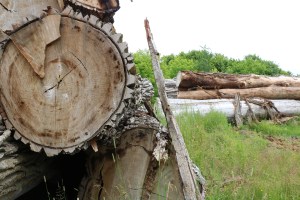
That definitely can be said about the cottonwoods. In December, Shelburne Farms commissioned the removal of the 16 eastern cottonwood trees that once bordered its iconic Poplar Drive. The trees stood on the property for an estimated 127 years and reached nearly 100 feet at their peak. But time and weather and disease took their toll. The stately trees exceeded their expected lifespan by nearly 50 years and had become a hazard.
“It was just at the point where so many of the tops were dying back, so many of the branches were coming down that it was just an unsafe thing with so many people using that road,” said Marshall Webb, whose role these days is carbon drawdown coordinator at the farm.
The removal of the cottonwoods elicited a passionate community response.
“There was disappointment, and there was education that was needed to answer the question ‘why,’” said Dave Jonah, who manages the welcome center and farm store.
In his position, Jonah interacts with nearly everyone who visits the farm and walks its paths. “It was a sanctuary for folks, loving that walk, going through those trees and knowing the history that was behind them,” he said.
In an effort to preserve and honor the beloved cottonwoods, Shelburne Farms has partnered with a number of local artisans and woodworkers to repurpose the trees, Monks and his company among them.
Vermont Tree Goods is processing the bulk of the old cottonwood trunks, while Tom Tintle of Shelburne and Reed Prescott of Bristol are working to make smaller crafts from the branches and bark. Tintle has focused on creating wood bowls, while Prescott has repurposed his pieces into earrings, lightswitch covers and picture frames.
‘Special wood’ with family connections
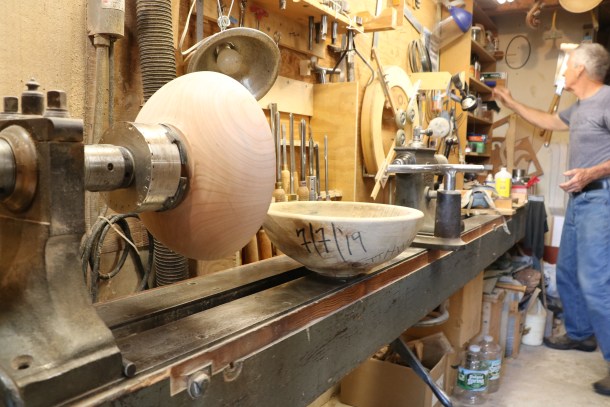
Much like inside Monks’s mill, mid-process projects crowd Tintle’s workshop, including a shelf of nearly 100 drying bowls. Tintle taught himself to turn wood over 40 years ago on a lathe his family bought from a local shop teacher in Long Island, N.Y., for $125.
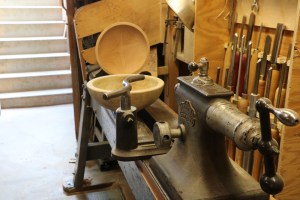
Since then, he has transitioned to a 140-year-old porch lathe, which he uses for both his bowls and for the custom cabinet knobs, balusters and furniture parts that make up his primary woodwork. Tintle turned “a couple of crude bowls” when he first taught himself, but then shifted to contracted work. He returned to bowl turning about four years ago. “It has become sort of an addiction. It’s so much fun,” he said.
Tintle explained that there’s excitement at being a part of this project.
“There are some trees that — just because of where they are, what they are — it’s special wood,” he said.
Reed Prescott’s involvement in the project stems from long-standing family connections to Shelburne Farms. His grandfather worked there as a farmer in his 20s, and his uncle as an accountant over 60 years ago.
Formerly working as an artist and oil painter for 20 years before transitioning to woodwork, Prescott has formed his own relationship with Shelburne Farms by participating in its annual art show and creating cards and crafts for their farm store.
Into each picture frame Prescott has made from the cottonwood, he’s inserted a picture of his grandfather standing with a few mules in front of a stone arch at Shelburne Farms from his days as a farmer there.
“I didn’t go to Shelburne Farms, but I grew up hearing stories constantly of him haying on Shelburne Farms,” said Prescott. “When I’m making these picture frames, I’m remembering these two or three stories. When I walk where they were cut down, I can picture that my grandfather was haying the field right next to that — it’s that kind of a connection.”
Back on Poplar Drive, Shelburne Farms Director of Communications Holly Braugh described in a blog post how on April 30, Vermont Tree Works planted 23 bare-root eastern cottonwood saplings from Springville, N.Y.’s Schichtel’s Nursery.
Each young tree is situated between where two old cottonwoods had grown. When planted, the trees were between 10 and 12 feet tall and they should grow one or two feet each year, forming a solid canopy in about five years, Braugh explained.
Final products
Visitors to Shelburne Farms can already find Tintle’s and Prescott’s crafts for sale in the farm store, but it will still be awhile before the tables will be ready for purchase.
Monks guesses that his team will finish the first tables by this winter at the earliest because allowing the wood to dry takes several months. He estimates that his company has enough cottonwood to make about 500 tables.
Monks hasn’t yet determined the sale price for the tables but he said they will be in line with the other custom-made tables the company produces. Many of the tables listed for sale on the company website retail for $1,500 to about $5,000.
“Our pricing is in keeping with other high-quality furniture that is built to last for generations to come,” Monks said.
Jonah hopes a few tables will end up in the Welcome Center, and Monks, along with Webb, plan for some of the slabs to become tables in local schools.
Some of the proceeds from Vermont Tree Goods’ table sales will go towards the latter effort. “Kids would be able to sit at a table four feet wide, and they could count the rings,” Monks said. “This story is closer to the beginning than to the end.”
Tree to table: Transforming the cottonwoods
Crafting raw lumber into tables, bowls and other products takes time.
At Vermont Tree Goods, wood for each table starts in the yard at the Bristol mill, drying for several months in preparation for milling.
Monks and his team cut each trunk crosswise into slabs, using a 22-foot saw that Monks designed himself. Each slab is labeled with a serial number indicating its milling date, species, and from which log it was cut.
After sealing the slabs, woodworkers must stand the wood up in the mill to dry the surface for about a week.
Monks likened cottonwood to “a wet sponge,” saying it takes longer than average to dry.
Then the wood goes through another round of drying, this time stacked for several months.
Heated drying comes next with the slabs going into a kiln, starting around 80 degrees and climbing to 100, then 200 degrees over the course of a week to a month.
Why not stick the wood into the kiln at the start to expedite the process?
“When you’re milling big pieces of wood, slower is better,” Monks said. “The slower it dries, the flatter it stays, the less it warps and twists.”
Once the wood is dry, Monks transports the slabs to Stark Mountain Woodworking in New Haven, where he and his team build the tables. They return to the Bristol mill for finishing. The final step is delivery to a customer or a spot in the Vermont Tree Goods showroom.

Many steps to a bowl
Tintle uses a similar process for bowl-making.
He begins by rough turning the wood into a slightly ovalular bowl with thick walls. He labels the bowl with wood origin and turning date and adds a little bit of wax on the end grain.
Next he wraps the piece in brown paper for a week or two—this slows down the drying process in the very initial stage. It then sits to dry for a few months.
Then he re-turns the bowl to refine its true shape. Reducing the bulk also aids the drying process which lasts another six months.
The final step is finishing with walnut oil and beeswax.
