



RANDOLPH — Taking the stage, Howard Russell is a seeming everyman.
“I grew up on a farm,” he says. “Had a wonderful family.”
Except he’s not.
“I knew there was something different about me,” he continues. “Something I felt I had to hide. In fact, being up here — as an actor — performing a role feels strange because I spent the first 23 years of my life playing a role that wasn’t me.”
Russell is a longtime LGBTQ activist. But raised in the small town of Hinesburg, he’s one of an untold number of Vermonters who once suppressed their sexuality and believed they were alone.
The Green Mountain State was the first to adopt same-sex civil unions and to approve full marriage rights by a legislative vote. But natives helped by such laws know there’s a reason they were needed.
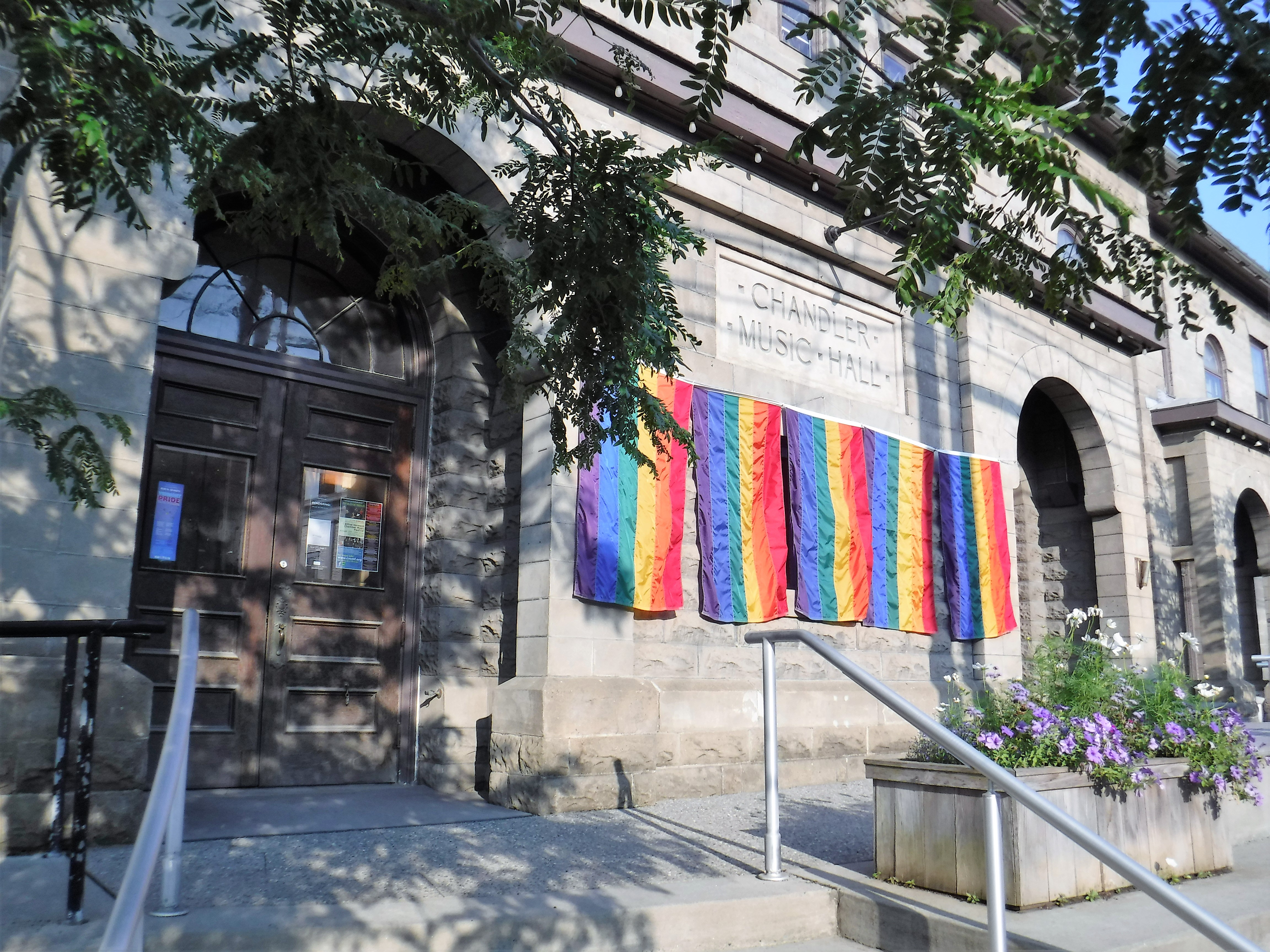
Enter a new show, “Standing In This Place: Growing Up LGBTQ in Vermont.” The production, set for Saturday at Randolph’s Chandler Center for the Arts, taps real people telling true stories to chronicle the often unseen and unspoken challenges past and present.
“I thought if anybody knew what I was really like …” begins one cast member.
“They would hate me,” says a second.
“There were no role models,” says a third.
“There were times when I wanted to …” says a fourth.
Take Middlebury Pratt of Williston.
“Started out in life as Laura but, well, I’m more of a Middlebury,” says the woman more comfortable wearing a tie than a scarf. “I was in a Walt Disney movie in the 1970s, ‘Justin Morgan Had a Horse.’”
But when Pratt told her parents about her sexuality as a teenager, she was soon out of the family.
Or consider Russell, the first openly gay Vermonter to run for state Senate.
“When I went to the University of Vermont in the 1980s, there was a ‘coming out’ table set up in the Howe Library,” he says. “It had a sign. And pamphlets. Once a month someone set up that table. No person, no face behind it. No one ever went near it. I certainly didn’t.”
Playwright Maura Campbell created the script by weaving together the memories of 18 lesbian, gay, bisexual or transgender Vermonters from Barre and Brookfield to St. Albans and Sheldon as well as speeches and newspaper stories that show how much has changed in the past half-century.
The state’s largest city of Burlington, for example, is preparing for its annual Pride Vermont parade and festival Sept. 8 — an event with a less promising start upon its introduction 36 years ago.
“Shame on all of you for allowing corruption on our streets for our children to witness and form ideas,” one resident wrote in a 1983 Burlington Free Press letter to the editor that’s shared in the show.
The former LGBTQ newspaper “Out in the Mountains,” published from 1986 to 2007, went on to report friendlier headlines about such advances as discrimination protections adopted by the state Legislature in 1992 and same-sex relationship rights decided by the Vermont Supreme Court in 1999.
The latter ruling called on the Legislature to craft a specific law.
“Mr. Speaker,” an actor is set to read from a 2000 speech by one of the 68 House members who voted against the bill. “If Vermont moves toward recognizing same-sex couples, I’m worried about whether it might hurt the state’s business climate and whether there’ll be a boycott against the state.”
That’s when Democrat Rep. William Lippert of Hinesburg steps onto the Randolph stage to repeat the words he spoke at the Statehouse nearly two decades ago.
“I think it’s important to put a face on this,” said Lippert, identifying himself as a gay man. “Our mailboxes have been filled with letter after letter talking about abomination, talking about sinfulness, talking about judgment day coming soon. I’m here to tell you that gay and lesbian people and gay and lesbian couples deserve not only rights, they deserve to be celebrated. Our lives, in the midst of historic prejudice and historic discrimination, are to my view, in some ways, miracles.”
The show reveals many of those problems.
“Secrets — they have a way of holding you silent,” one man says. “There was one night … I was walking home along a back road … No one used the term ‘hate crimes’ in those days. I only knew that I was raped.”
One woman recalls being a substitute teacher when a 13-year-old girl, bullied because of her sexuality, committed suicide.
“It’s easier now, right?” she asks. “In schools, I mean.”
Madison Messier, a local woman whose birth certificate bore the name of Matthew, isn’t sure.
“Every day, I paid someone a dollar to get my lunch tray,” she recalls. “Because if I got in line, it would be hell.”
Then again, the show — which closes with Vermonter Christine Hallquist’s run last year as the country’s first transgender major-party gubernatorial candidate — cites progress.
“At Randolph Union High School and lots of other high schools in the state, we have a group for any student who identifies as LGBTQ, as well as students who wanted to show support and be an ally,” one actor says. “Although later we changed the name to G.L.O.W. Meaning, gay, lesbian or whatever.”
“There is work to do,” another actor concludes, “and we are doing some of it on this stage.”
