

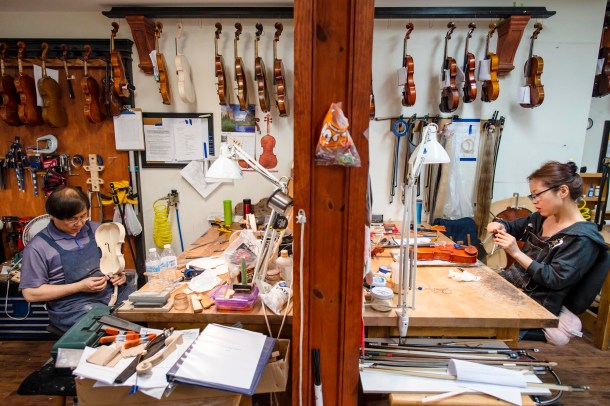
[V]ermont Violins started as a hobby for Oren Kronick and his wife Kathy Reilly in 1994.
The two, both working full-time in day jobs, started renting violins and violas at a shop in Montpelier that was open for just a couple of hours in the evening. By 1998, both were working full-time at the shop, which by then was providing instrument repairs and sales and selling items like sheet music and cases.
Now Vermont Violins has three locations – in Montpelier, Burlington, and Lebanon, N.H. Two years ago, Vermont Violins started making its own instruments, which it sells to music stores and retailers as far away as Utah. The company has 13 employees, including seven luthiers who make or repair instruments.
The new line of violas, which the couple has named V. Richelieu in honor of the French inspiration of the viola’s design and of the Richelieu River in Quebec, was the couple’s answer to a problem music teachers often described. The small violas that children used in lessons were just modified violins, and had a very different sound from full-size violas, said Kronick.
“Teachers don’t like them; they just put up with them,” he said of the child-size violas. “Kathy has always had this problem when she’s teaching.”
Vermont Violins is the only place in the country making violas in all different sizes for young students, said Claire Givens, who owns the store Claire Givens Violins in Minneapolis. She met Kronick and Reilly two months ago and recently sold one of their instruments to a young person studying with a violist in the Minnesota orchestra.
“He was just thrilled at how great it sounded for the size,” Givens said.
Reilly — who had trained both as a concert violist and a botanist — has studied luthiery and has taken lessons in viola and violin restoration. She said that she’s also gotten valuable advice from a friend’s father who had worked as an instrument-maker. When the couple decided to start making violas one at a time in 2017, they already had trained luthiers on staff for their repair business. Kronick said there was an immediate response to the instruments they produced from spruce and maple, which they call fractional violas.
“A teacher in D.C. called it a game-changer,” said Kronick. “Up until discovering our instrument, she wouldn’t teach viola to younger kids because violas for children were so bad.”
Last June, the pair showed their instruments at a conference of the Viola Society of America in Los Angeles, and identified a need for mid-range instruments in the market – better than the inexpensive ones available from China, but affordable enough for a family to buy for a child. The V. Richelieu instruments cost between $3,000 and $5,500.
“China does the lower end very well, and it’s hard for Germany or America to compete with an inexpensive Chinese instrument, which we don’t care for particularly,” said Kronick. “$5,500 is an awkward price range to offer and V. Richelieu fills it really, really well. It’s a great instrument for that price.”
With regular sales to music schools and retail stores, Vermont Violins is quietly ramping up production in its low-key workshop, which occupies a basement and a room at the back of the retail store on Church Street in Burlington. The company made 50 violas last year and hopes to make 75 this year, Kronick said.
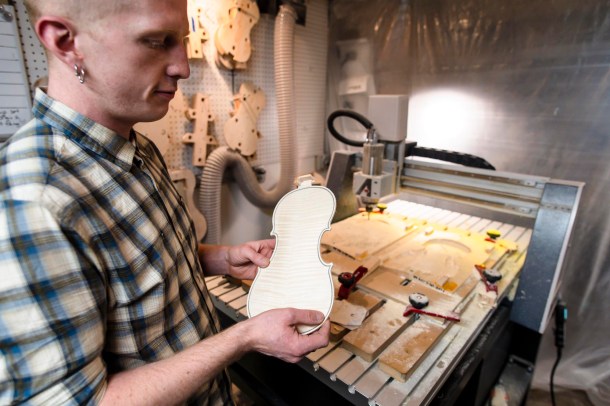
Reilly said that the company’s computer-aided drafting, or CAD, technology is what makes it possible for Vermont Violins to create affordable instruments. The company uses LMGI, a Siemens dealer in Maine, to train its staff on CAD. In early June, the company received a $11,000 workforce training grant from the Vermont Training Program through the state Agency of Commerce and Community Development. They will use the grant to train six of their luthiers to make face plates and scrolls for the instruments that they are buying now from China, Reilly said.
“It’s filling a niche in the marketplace that nobody wanted to deal with, because if you’re trying to build these things by hand, you can’t do it,” Reilly said. “There are too many sizes and too many things that can go wrong. Most of the work is by hand, but we can cut a significant amount of time with a machine, and it also offers us consistency.”
“The artistic parts of the instrument, like applying the varnish and carving the plates, will never be done by a machine,” said Kronick.
The Gifted Music School in Salt Lake City has purchased instruments from Vermont Violins. The school’s artistic director, Eugene Watanabe said that while music education in schools doesn’t get the investment it needs, there is a bright spot: good-quality instruments are becoming more readily available.
“There has never been a time when there are so many wonderful violin-makers who are putting out high-quality instruments,” said Watanabe, who teaches violin. “The mass-produced violins are increasing in quality as well.”
But nobody else is making fractional violas, as the instruments from Vermont Violins are known, said Givens.
“I applaud them for figured out how to design a viola that will work in these small sizes and still have a viola-like sound,” she said.
Reilly played in the youth orchestra in Burlington as a child and graduated from Oberlin College with a degree in performance. She later earned a master’s in botany from the University of Vermont. She said learning how to run a business didn’t require a huge transition. Her father worked for IBM for years, and she said her two brothers, who both work at large companies, have taught her a lot over the years as Vermont Violins grew.
“Building a team that can work together is one of the most beautiful things you can do,” Reilly said. She said a lot of the rules for making stringed instruments have been thrown out as luthiers gain access to new building technology, as well as innovations in acoustical equipment that can measure and quantify sound. Vermont Violins’ luthiers have many debates in the shop in the course of making an instrument.
“There is nothing written in stone; it’s all being debated,” she said. “You have to trust the other person is doing something you can then work with and keep going. What I have enjoyed and learned from these guys is you can have those constructive debates and come out with a beautiful product, but it might evolve over time.”
The market for stringed instruments seems to be in a good spot; Reilly said there are a dozen names on a waiting list for the V. Richelieu. While public school music programs took a hit when the education policy pendulum swung sharply in the direction of standardized testing several years ago, kids’ interest in music seems resilient, Kronick said.
“Whether you are playing guitar or drums or violin or saxophone or whatever, they all require dedicated effort, and I don’t see that going away at all. Kids’ passion for music is very strong,” he said. “When a school program cuts back, we see increases in private studios. After-school music programs are doing very, very well in the Upper Valley.”


