

Bill Schubart is a regular columnist for VTDigger. He is a retired businessman and active fiction writer, and was a former chair of the Vermont Journalism Trust, the parent organization for VTDigger.
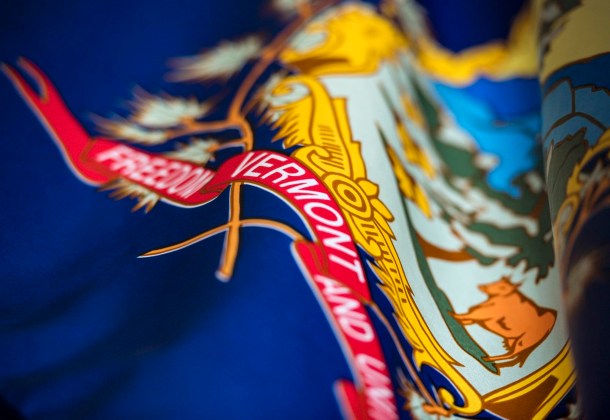
“Freedom and Unity” is Vermont’s motto and has been since 1788. It expresses the unattainable equipoise between freedom of the individual and the shared well-being of the community in which the individual lives and works. Like a sine wave oscillating through our 231-year history we’ve struggled to achieve this delicate balance with regular overreaches on both sides.
Since its inception, the Ethan Allen Institute has championed freedoms of the individual: freedom to drive the car of one’s choice, freedom to benefit from union activity without paying dues, freedom to make one’s own educational and health care choices, freedom to consume sugary drinks, freedom to acquire and carry guns, freedom to use plastic bags and so on. Its arguments are well-reasoned within the context of personal and marketplace freedoms unburdened by restrictions often deemed in the public good. Its sturdy belief in the capacity of free people and markets and minimally regulated business to behave in the best interests of the whole lies at the core of its mission, but belies the imperfect nature of humanity.
On the opposite side lie a myriad of government agencies and nonprofit organizations advancing certain restrictions deemed in the public interest. Among the best known is the Vermont Public Interest Research Group (VPIRG), whose very name defines its mission to advocate for the good of the commonweal. Their work is largely focused on environmental issues. They’ve advocated for a ban on new fossil fuel infrastructure, carbon pricing, government weatherization funding for the needy, more electric vehicle incentives, a national Green New Deal, solar energy growth, limiting toxic chemical use, enhanced broadband deployment and the like. And there are countless nonprofit, business, and government sector advocacy organizations more narrowly focused on health care, educational quality and access, nutrition, mental health, homelessness, addiction and employment – most of which would argue they are working in the interests of the common good.
A lightning rod in this conundrum is private property. When can the government take and reimburse fairly for private property for the public good as they did to create the Interstate Highway System? Why do so many landowners post their property to keep away walkers, hikers or skiers? Because it’s their right to do so? Liability is hardly an answer as Vermont has strong “attractive hazard” laws. In Europe common walking paths are a centuries-old tradition and landowners cannot prevent amblers from using them. “Property rights” advocates have fought most common good restrictions like zoning, property tax, septic design restrictions, building density limits, animal migration path restrictions and so on. Just as the individual lives in a community so do the lands we own and steward. Animals, water, and flora know no property rights or limitations.
Is the Vermont motto then a formula for conflict or a call to balance? Can the interests of the individual be reconciled with the well-being of his and her community. Must they be antithetical or is there an achievable balance?
The partisan labels we use only advance the fractious nature of the discussion, “the nanny state,” “big government,” “mandates,” “welfare state” or on the other side “big business,” “the 1%,” “privilege,” “climate denier.”
These polarizing terms deny intelligent debate. Dorothy Canfield Fisher, now in disrepute because of her tacit support for the eugenics movement, stated it perfectly, “The Vermont idea grapples energetically with the basic problem of human conduct – how to reconcile the needs of the group, of which every man or woman is a member, with the craving to be what he really is.”
The polarity of our domestic and national debates is nothing new. Our state motto draws us into its vortex – a centripetal force pulling us into the complex center of every debate and calling on us to measure the good of the individual against the good of us all. It reminds us that no answers are simple or lie on either side of its equivalency. It puts the lie to the political bipolar disorder crippling our democracy that allows us to speak in easily repeatable nostrums like “the nanny state” or “the 1%.”
Its wisdom is infectious. Uhuru na Umoja is Swahili for “freedom and unity” and is the official motto of Tanzania as well.
Where’s the leadership today that understands this 231-year-old challenge and can lead our discussion towards the equilibrium it expresses?
