


[B]LOOMFIELD – DeBanville’s Store is so off the beaten path that when owners Jim and Mary Jo Mazzonna need a craft beer delivery, they have to meet the beer truck in St. Johnsbury, 50 miles southwest. It’s not worth the distributor’s time to journey to this spot 20 miles south of Quebec.
After owning a home in nearby Maidstone for years, the couple borrowed money in 2017 to buy and reopen the store with the goal of creating a social center for tiny Bloomfield and its rural neighbors.
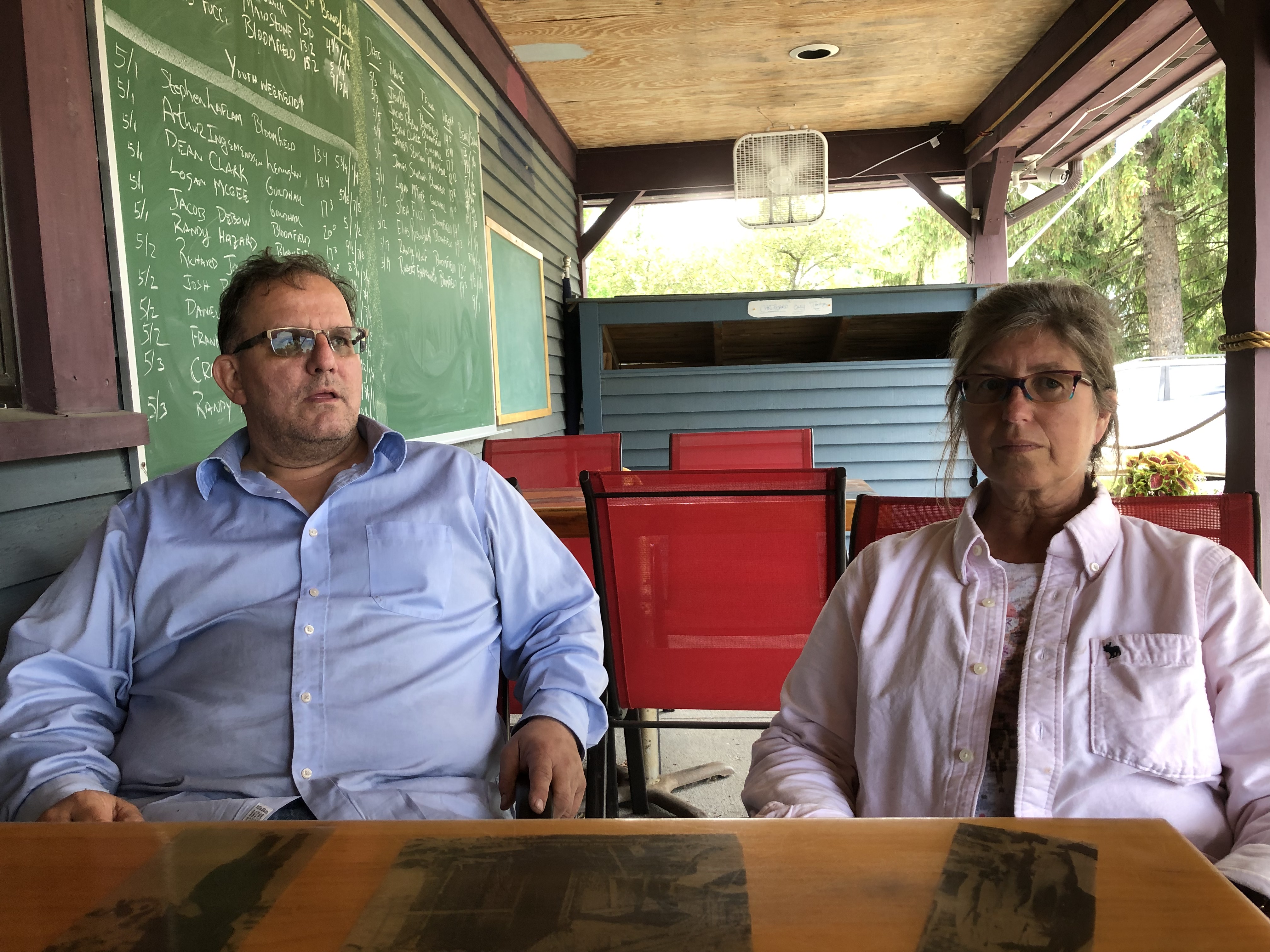
The store — which was fully rebuilt in 2003 — offers made-to-order sandwiches, craft beer, pizza, sundries and crafts. Outside are gas pumps and the chalkboard where hunters record their game. Jim Mazzonna, who is retired from the Coast Guard, has a full-time job in IT at St. Johnsbury Academy.
It’s well known that Vermont’s 150 or so country stores serve a powerful function as casual gathering places where people can meet informally and talk. And it’s obvious that it’s hard to make the stores survive financially. Shuttered country stores are a common sight.
But newly opened country stores are common too, because when stores close, community members, nonprofits, and individuals sometimes rally to get them back open again. They’re seen as the social hubs of Vermont’s rural areas, far more than just a place to gas up the car and buy a gallon of milk.
The Preservation Trust of Vermont has worked on store projects continuously over many years; the nonprofit owns Pierce’s General Store in Shrewsbury, which is run by a cooperative; and it’s helping a community group in Albany raise money to get the general store in that Northeast Kingdom town open again. It’s working with the Putney Historical Society to operate the Putney General Store while it looks for a new owner, with a group in East Calais hoping to buy that village’s store building, and it worked with the Barnard Community Trust to create a lease with an operator.
A group in Rupert is also working on opening a store there, said Paul Bruhn, director of the Preservation Trust. Meanwhile, the Taftsville General Store near Woodstock recently closed.
“It’s a very dynamic, ever-changing world out there,” said Bruhn. “These stores are really important to their communities, but the retail world is tough these days.”
To counteract the forces against them – including lower prices on things like beer in New Hampshire, which is just a half-mile away — Jim and Mary Jo Mazzonna provide every service they can think of. They learned how to make the pizza and a specific sandwich that DeBanville’s was known for, and added tables where people can eat; and they reserve a section of the floor as a gallery for local crafts. They supply fishing and hunting licenses for those who prefer not to do these things online, register snowmobiles, and sell trail passes for the local snowmobile club. They trade ideas and get advice from store owners in other towns about bringing people together.
The store serves as the designated check station for hunters who are required to report within 24 hours when they have killed a turkey, bear, moose or deer, and a bulletin board outside has several dozen entries.

“When this store was closed, you had to go either 15 miles up the road to Island Pond or to Lunenburg or Concord to check in your game, legally,” said Jim Mazzonna.
The couple reopened DeBanville’s, which originally opened in 1917, because they wanted their community to have a hub, they said.
“We used to be customers,” said Jim Mazzonna. “It was more about trying to figure out how to make this place work for the community and not see it vacant.”
Friends helped them renovate the store, repaid in pizza, and their first employees were neighbors with retail experience who taught them what they knew. They have five employees.
“If we don’t close this store for a day a week, nobody will get guaranteed time off,” said Mary Jo Mazzonna. “So we’re closed on Tuesdays even though it’s the busiest time of the year.”
Living in Bloomfield can be isolating. They feel that it’s their job as storekeepers to counteract that.
“It’s surprising how many times we have heard people say, ‘I haven’t seen you in 10 years,’ and then they chat,” Mary Jo Mazzonna said. “It’s very encouraging to see that happen. If I know two people here who should know each other, because they live close by, I’ll introduce them.”
Vermont country stores have always needed to adapt. The advent of supermarkets in the first half of the 20th century forced the stores – especially those near larger towns — to find other ways to bring customers in. Convenience stores with gas pumps, and now the internet, push stores to provide that one thing that much of the competition can’t: a gathering place.
But “I don’t think that it’s any easier or harder to run a store now than it was many years ago,” said Bruhn. He said the Castleton store distinguishes itself with a broad wine selection, and Guilford with its prepared foods. Pierce’s store in Shrewsbury has gained local renown for its baked goods. “It’s all about finding a niche where you can do well.”
Jack Garvin, longtime manager of the Warren Store in the Mad River Valley, which sells gifts, housewares, craft beer and other items, said that like every store, his has a group of regulars who meet every morning for coffee. Apart from participating in a huge range of events, Garvin finds it helpful to advertise on Front Porch Forum (FPF), the online bulletin board.
“Regardless of how loyal your customers are — and they love the idea of having a country store in their town — when it comes to bottom line and looking at your wallet and looking at your disposable income, they’ll by and large go to the better deals,” Garvin said. But he added he can see through FPF analytics that his ads reach people outside the Mad River Valley.
“We don’t know how that translates into people walking in the door, but people are paying attention,” he said.
Jim and Mary Jo Mazzonna, who don’t take any pay from their store, just want to make sure their store stays open. They’d like to finish the upstairs as an apartment for the storekeeper and a community space.
“We can’t do this forever; nobody can,” said Jim Mazzonna. “Honestly, the goal is to make it sustainable so that somebody can take it over and live here and have their home above their business. One of the things we believe is that there is just really a need for those kind of spaces. That is our vision, whether it is skewed or not.”
