

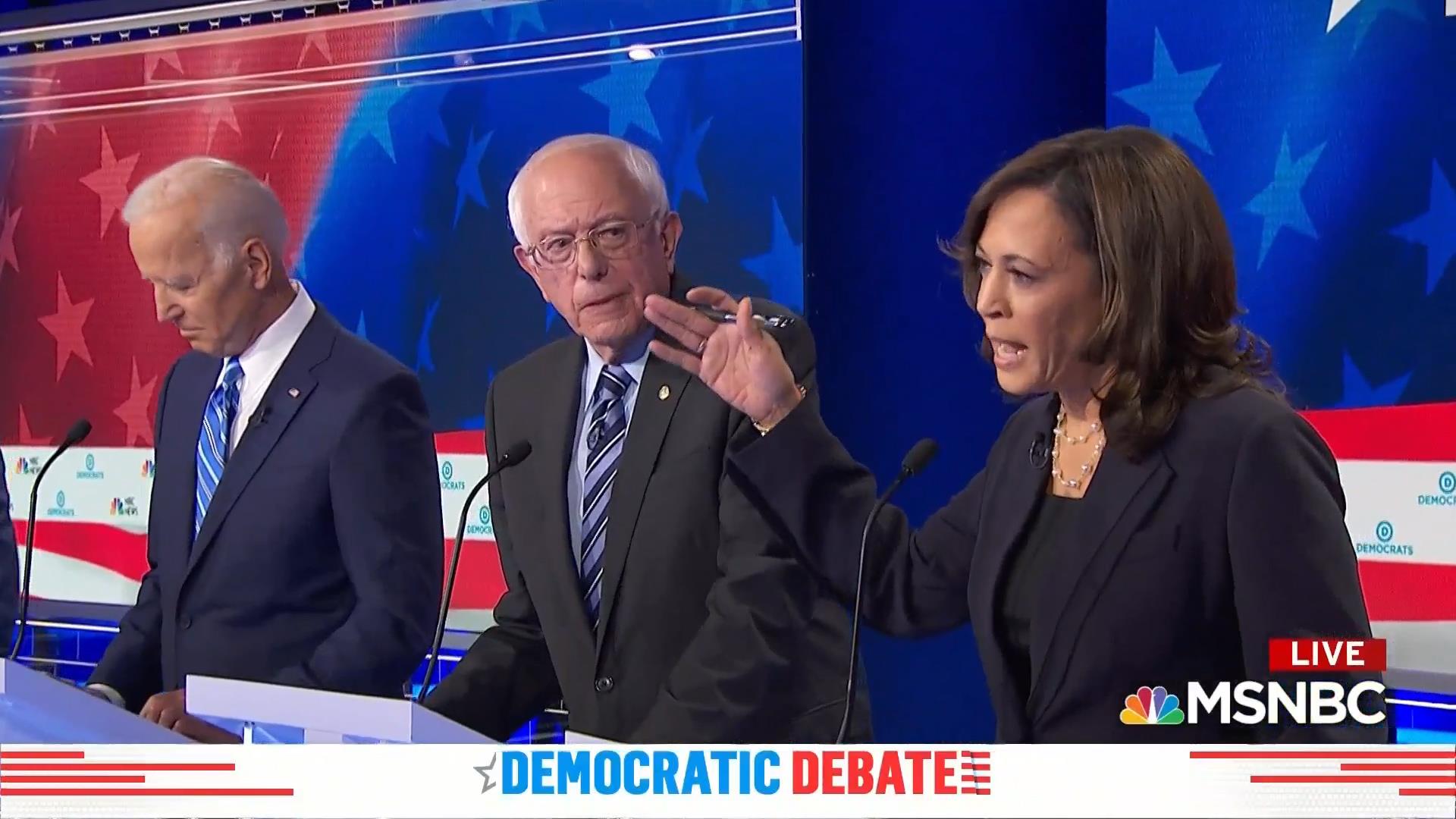
[A]t least Bernie Sanders didn’t have as bad a night as Joe Biden.
In fact, Sanders didn’t have that bad a night at all during the second installment of the Democratic candidate debate in Miami Thursday. He was himself, the same Bernie Sanders Vermonters have known for years, scowling at the camera (and sometimes the questioners), calling for “real change” and a “political revolution.”
Probably a good enough night for him to hang on to his base, but not good enough to broaden it.
Because he didn’t have nearly as good a night as two of the other candidates: Sen. Kamala Harris of California and Mayor Pete Buttigieg of South Bend, Indiana. Or as good a night as Sen. Elizabeth Warren of Massachusetts had on Wednesday.
Their gain may be more Biden’s loss than Sanders’. It’s the former vice president who was (and quite possibly remains) the front-runner in the polls. Sanders was a not-very-close second.
As he quite possibly remains. The impact of these candidate forums on public opinion is not always immediately apparent. It often evolves and changes as voters who didn’t see it (and some who did) digest the news accounts and appraisals of the supposed experts.
But Sanders certainly did not dominate the event. He spoke less than Biden, Harris and Buttigieg. He said nothing he had not said before, and while what he said came across as fresh and daring four years ago, it seemed closer to trite and stale now. One-on-one against Hilary Clinton, Sanders’ populist proposals seemed daring. With nine other candidates on the stage – none of them with Clinton’s personal baggage and some just as populist – he was just one among many.
Sanders may even have been hurt by Biden’s poor performance. Biden at times simply looked old. Sanders seemed more vigorous, but like Biden, he is old, at 77 a year older than Biden. A typical viewer might have come away from this event thinking that these guys are too old. Harris is 54. Buttigieg is 37. They were both sharper. It might be premature to suggest that a Democratic Party generational torch was passed this week. It may not.
Thursday’s installment was more rancorous than Wednesday’s, with candidates constantly interrupting each other, prompting Harris to warn, “Hey, guys. You know what? America does not want to witness a food fight.”
It didn’t always rise to that level.
Not that there was ever any hope that 10 candidates vying for what turned out to be not much more than 80 minutes of speaking time (Wednesday’s was 79.9) could intelligently explore a host of public policy issues. Seeing how little time they had, the lower-tier contenders (as measured by the polls) chimed in whenever they could, seeking their “break-out moment.”
They didn’t get one. In fact, the event demonstrated that the lower-tier contenders belong there. Coloradans John Hickenlooper and Michael Bennet were polite, intelligent and uninspiring. California Rep. Eric Swalwell wanted everyone to know that he was young (38). New York Sen. Kirsten Gillibrand struggled for attention and wanted everyone to know that she’s a woman. Businessman Andrew Yang didn’t say much.
And what, you ask, of Marianne Williamson?
Don’t ask.
An objective assessment would put Sanders in the middle here. He was more interesting and more authoritative than the lower-tier candidates, but less so than Harris or Buttigieg.
And less pitiful than Biden.
The most memorable exchange of the debate came when Harris confronted Biden about his recent statements about how he had worked with segregationist Southern senators such as James Eastland of Mississippi.
Hearing him say that, she said, “was hurtful … and it was not only that, but you also worked with them to oppose busing,” she said, looking right at Biden (Sanders, between them, standing quietly, staring straight ahead).
“There was a little girl in California who was part of the second class to integrate her public schools, Harris said, “and she was bused to school every day, and that little girl was me.”

This was obviously a planned attack, not a spontaneous improvisation. And it was an attack Biden had to know would come some day.
But he wasn’t ready for it.
“It’s a mischaracterization of my position across the board,” he said, before meandering into memories of his time as a public defender in Delaware, his longtime commitment to civil rights, how he was inspired by Martin Luther King Jr.
Another reminder of how long he’s been around.
Harris was unimpressed. “Do you agree today that you were wrong to oppose busing in America then?” she asked.
Biden tried to explain that he was only against some busing, only if it was ordered by the federal government. Then he stopped, perhaps realizing that he was on the verge of making a (James Eastland-ish) state’s rights argument.
“Anyway,” he said, “my time is up.”
Perhaps in more ways than one.
The result is not without risk for Harris and for the Democrats. Busing was neither a popular nor a successful policy, which probably explains why almost nobody proposes it any more. Probably not the banner Democrats want to march behind in the general election.
Neither is Sanders’ version of “Medicare for all,” which includes doing away with the private, employer-based health insurance system on which almost half the people now depend.
In the two debates, Sanders, Warren, New York Mayor Bill de Blasio and Harris held up their hands indicating that this is what they favored. Harris later said she’d misunderstood the question and that she would not completely do away with private health insurance.
“Private insurance is not working for tens of millions of Americans,” de Blasio said. That may be true, but another tens of millions of Americans think their private insurance is working out just fine.
At least so said a Gallup Poll of late last year that found that 70% of those with private insurance rated their coverage “excellent or good.”
And those people are more likely to vote than the millions for whom the system is not working.
Depending on who is nominated and how the party platform is worded, the Democrats risk going into the general election campaign with (effectively) this message: We’re going to abolish your health care system, which you (mostly) like, and replace it with something engineered and administered by the federal government.
That’s not a winning slogan.

