

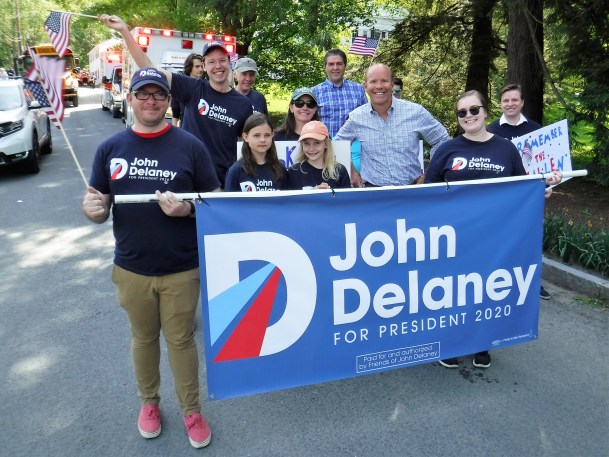
[C]HARLESTOWN, N.H. — Travel from Vermont to this small New Hampshire border town on Memorial Day and you’d see a Main Street parade where everyone knew everyone.
Everyone except the man behind the veterans, scouts and school band, that is.
“I’m John Delaney,” he said as he extended his hand to spectators and an occasional baby and dog.
Voters in this first-in-the-nation primary state have been inundated with news about the 23 Democrats running for their party’s 2020 presidential nomination. But for every member of the who’s who — be it former Vice President Joe Biden or neighboring U.S. senators Bernie Sanders of Vermont and Elizabeth Warren of Massachusetts — is another who elicits a “who’s that?”
Delaney, he’ll tell you, was the first person to announce a 2020 White House bid, doing so in a 2017 Washington Post essay titled “Why I’m Running for President.”
“My vision for the country is based on my own American Dream,” he wrote. “I was raised in a blue-collar family; my dad was a union electrician, and my parents didn’t attend college. Because of a great education and a helping hand from others, I was fortunate enough to become a successful entrepreneur.”
So much so, Delaney became a multimillionaire and former Maryland congressman before embarking on his current campaign. But even though the 56-year-old has made three times as many New Hampshire appearances (98 and counting, according to one tally) than his closest competitor, his RealClearPolitics.com national poll average of 0.4% is the lowest of the field.
Then again, Delaney’s not alone in the lack-of-recognition department.
Twenty candidates are set to debate Wednesday and Thursday in two live 9-11 p.m. broadcasts on NBC, MSNBC and their websites. To determine each night’s lineup, qualifying participants (those polling at least 1 percent in three separate surveys or raising money from at least 65,000 donors, with at least 200 each in 20 states) were split into two groups — those polling at least 2 percent and those below that — and divided again over the two evenings.
The top tier features, on the first night, Warren and fellow U.S. senators Cory Booker of New Jersey and Amy Klobuchar of Minnesota and former Congressman Beto O’Rourke of Texas and, on the second, Biden, South Bend. Indiana, Mayor Pete Buttigieg, Sanders and fellow U.S. Sen. Kamala Harris of California.
The rest of the field includes, on the first night, Delaney, Julián Castro (former U.S. secretary of housing and urban development), Bill de Blasio (mayor of New York City), Tulsi Gabbard (congresswoman from Hawaii), Jay Inslee (governor of Washington) and Tim Ryan (congressman from Ohio) and, on the second, Michael Bennet and Kirsten Gillibrand (U.S. senators from Colorado and New York), John Hickenlooper (former governor of Colorado), Eric Swalwell (congressman from California), Marianne Williamson (spiritual author and speaker) and Andrew Yang (like Delaney, an entrepreneur).
Kevin O’Connor breaks down the 2020 Democratic primary field in our latest Deeper Dig podcast:
Several of the candidates have Vermont ties. Ryan, a mindfulness advocate, has appeared at Stratton’s Wanderlust festival. Gabbard and Williamson publicly supported Sanders’ 2016 campaign. And Delaney is a friend of former congressional colleague Peter Welch, who’s officially supporting home-state candidate Sanders but has good words for his former Maryland peer.
“John was really focused on serious issues,” Welch recalls of their time together, “and came up with plausible plans.”
Welch thinks enough of Delaney to have read his book, “The Right Answer: How We Can Unify Our Divided Nation.”
“His grandfather had lost an arm when he came to Ellis Island,” Welch says. “People in that situation often got sent back. He got sent to another room and was waiting when he saw the person who was going to determine his fate. The guy only had one arm.”
The rest is history.
“John has a good personal story,” Welch says. “It really grabs you.”
Delaney will aim to share it at the debate. Ask about his low numbers and, like his fellow competitors, he instead talks about his high hopes.
“It’s a very large field — the challenge is making sure we get attention,” he says. “I just have to work harder than everyone else.”
