

Editor’s note: David Moats, an author and journalist who lives in Salisbury, is a regular columnist for VTDigger. He is editorial page editor emeritus of the Rutland Herald, where he won the 2001 Pulitzer Prize for a series of editorials on Vermont’s civil union law.
[A]mericans have been susceptible to the lure of Paris since the early years of the republic, as historian David McCulloch showed in his 2011 book “The Great Journey: Americans in Paris.” His book chronicles the experiences of American writers, artists and other figures of note whose journeys to Paris throughout the 19th century shaped their lives in profound ways. People such as Samuel F.B. Morse, painter and inventor of the telegraph; Emma Willard, pioneering educator from Middlebury; painter James Singer Sargent; and novelist Henry James, went to Paris in search of learning, enlightenment and an enhanced appreciation of life. Later waves of artists and writers have kept the tradition alive.
My visits have been more touristic than artistic, though I managed in 1972 to track down the apartment where Ernest Hemingway lived, and lately I saw the apartment where Frederic Chopin died. Nor have my encounters with Paris had the immense personal meaning that the city has had for others, such as New York Times columnist Roger Cohen, a South African who came of age in France and wrote a moving account recently of what Paris means to him. But I keep going back, when I can, and this spring, I went back again.
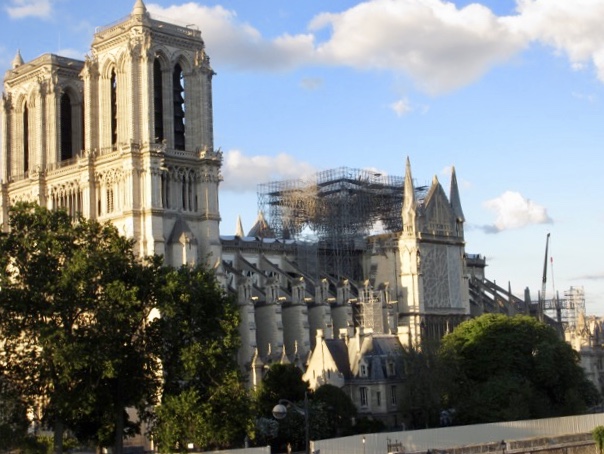
The place that Paris maintains in the culture and civilization of the Western world was evident in the aftermath of the fire in April that destroyed the roof of Notre Dame, the cathedral in the heart of the city. It was a shocking reminder of the fragility of our cultural touchstones, even if the continuing presence of the cathedral over the centuries, through war and revolution, is a reminder also that Western values have enduring strength.
The movie “Midnight in Paris” made a joke of Americans’ infatuation with Paris, thrusting the hero back in time to the era of Hemingway and Fitzgerald, Picasso and Gertrude Stein. Then as an additional joke it thrust him back further in time to the era of Renoir, Monet and Toulouse-Latrec.
Those eras are gone, even if Americans continue to romanticize them, filling the cafes and strolling the streets of Montmartre and the Latin Quarter. But conditions allowing for periods of intellectual ferment and pioneering artistic achievement have continued through the years and remain visible today. If the “yellow vest” protest movement rocking French politics in recent months is not as turbulent or bloody as the French Revolution, it partakes of the deeply rooted values of justice and equality unleashed upon the world by the revolution, values always under siege. Every “ism” is vulnerable to abuse — rationalism, romanticism, republicanism, Catholicism, socialism, capitalism. But those “isms” that have animated Western culture in a positive way over the decades have flourished in Paris.
The liveliness of the culture is most evident in the cultural diversity that is visible everywhere. Ever-present in the neighborhoods of the city are the Africans and Arabs whose connection to France is owing to the nation’s colonial history, but who have been drawn there by opportunity and openness. We bought delicious sandwiches from a Lebanese sandwich shop — chicken or sausage with garlic sauce and hummus. The genial young sandwich maker asked us about the American president, allowing me to deploy the two words I was hoping I’d have the chance to use: “monstrueux” and “gangster.” The Lebanese Frenchman laughed.
Our best lesson in France’s cosmopolitan meaning came from our hotelkeeper, a gentle Peruvian named Francisco, who grew up in the Andes, earned a doctorate from the Sorbonne and now manages the small hotel with fellow Peruvians and a young Iranian woman. In serving his clientele, he moves easily from French to English to Spanish. Notre Dame was just across the river, within view of our fourth-floor room, and Francisco understood that the damage to the monumental building by the recent fire was an injury not just to France but to the larger culture, which includes the United States and Peru. America is newer than France, he said, but it is part of the same thing — the same cultural fabric.
The topic of Donald Trump came up with Francisco when we acknowledged the damage America has suffered from the president’s erratic, boorish and criminal behavior.
“We as well,” Francisco said.
In other words, because the culture and civilization of France embrace the United States, and vice versa, the injuries suffered in America hurt the people of France as well — just as the fire at Notre Dame hurt the people of America.
That is the largeness of vision — on the part of a Peruvian Frenchman speaking in English with a pair of Americans — that allows France to be more than another parochial backwater, some walled off enclave, seeking to find its meaning in a narrow understanding of itself.

To experience Paris is not just to experience beautiful buildings and gardens. The botanical garden has beauty aplenty, but it is also a lesson in botany, laid out in a way that shows the connections among plants and their uses and honors the tradition of scientific inquiry pioneered, in part, by France. The streets are not just a place to walk and shop. Alongside the Seine in a small amphitheater built into the quay, a tango lesson was under way. Outside the church of St. Germain des Pres, a pair of young jazz guitarists offered a free concert with echoes of Django Reinhardt, the great Gypsy guitarist, resounding off stones laid in the Middle Ages. At a jazz club in a cellar on the Left Bank, a guitarist from Chicago grooved with a French vibraphone player of an earlier generation who was a master of the instrument and of a form that had originated in New Orleans in America.
The culture of Paris resonates through the centuries and across continents. Already the scaffolding on the roof of Notre Dame sends a message of persistence in time. “We as well” is a message embracing the world.
