


The Deeper Dig is a weekly podcast from the VTDigger newsroom. Listen below, and subscribe on Apple Podcasts, Google Play, Spotify or anywhere you listen to podcasts.
[W]hen Montpelier High School students became the first in the country to raise a Black Lives Matter flag at their campus last year, Randolph Union High School students asked their principal, T. Elijah Hawkes, if they could do the same. He said no — not yet.
“The students in Montpelier have done a lot of work to create community-wide dialogue to buttress this courageous act, and to generate support,” Hawkes told them at the time.
The Randolph students took Hawkes’ advice to heart. After organizing community events about the flag-raising, they turned to another effort: the state’s first student-led anti-racism conference, held at the school last week.
The event capped a school year when student activism about race issues was increasingly visible. Schools in Hinesburg, Rutland and South Burlington raised Black Lives Matter flags this year. Over 300 students from Edmunds Middle School participated in an anti-racism walkout in Burlington last month. And students helped push for H.3, a bill that sets statewide standards around ethnic studies education, which passed unanimously and was signed into law in March.
Student activists have pushed back on the idea that Vermont, typically viewed as a progressive state, does not have a problem with racism.
“Growing up in Vermont as a person that looks different, it’s pretty challenging,” said Randolph senior Brandon Ryan, one of the organizers of the conference. Ryan came to the United States from South Korea and said he’s dealt with racial slurs and Asian stereotyping throughout his time as a student.
“I really felt like we needed a collective group of students and also educators to try and talk about problems,” he said about last week’s event, “so no one feels really alone in the fight against injustice in our schools.”
On this week’s podcast, VTDigger education reporter Lola Duffort recaps Randolph’s racism conference — and looks at why rising numbers of students are taking up the cause.
[showhide type=”pressrelease” more_text=”Read full transcript” less_text=”Hide full transcript” hidden=”yes”]
Do you want to start in Randolph?
Duffort: Yeah, let’s start in Randolph.
Our education reporter, Lola Duffort, has been looking at the rise in student-led activism in Vermont schools. Last week, she covered an event that seemed to be the first of its kind in the state.
Duffort: So I went down to Randolph where the high school there was hosting the state’s first-ever statewide student-led anti-racism conference.
What exactly does an anti-racism conference consist of?
Duffort: It was, you know, a conference where you have things like workshops and keynote speaker and it’s all about how to tackle racism in school. You had workshops about things like how to create an ethnic studies course and get it into your local curriculum, or about how to deal with bias in athletics or how to talk to your white friends about the ways in which they might be racist. It was this practical conference about how to deal with this problem that a lot of people don’t think impacts Vermont because people think of Vermont as a mostly white and also very progressive place where this isn’t a problem.
But these students are getting up there and saying, no, this is a problem here.
Duffort: Yeah, absolutely.
Brandon Ryan: I just want to give a quick shout-out to all the schools here.
Duffort: I mean, this was an extremely well-organized and sophisticated event. It was like 200 people, there was food, there was a day’s worth of events. You know, people came from all across the state. I think there were 18 schools represented.
Ryan: So when I call your school name, I want you to make a little noise. How about that? So we have Vergennes High School, U32, Cabot High School.
Duffort: The keynote speaker was Jamila Lyiscott. She is a professor at the University of Massachusetts in Amherst. She’s also a very frequent speaker at you know, anti-racism events, and also an education consultant.
Lyiscott: Each and every one of you are here today because there are issues of racial justice that are manifesting itself in your world that you know, have to, must be, challenged in order for us to live in the world that we know we deserve.
Duffort: The keynote was talking about how you know, when you think about racism, there is obviously like very overt forms of racism that manifest themselves in kind of explicit discrimination, not going to rent to you because you’re black, I don’t want you to date my daughter because you’re Hispanic, etc., etc. But racism also manifests itself equally as importantly in ways that are much more subtle and it’s in the ways that we code forms of speech and dress and culture that are predominantly black and brown as inferior.
Lyiscott: In the black community, the black-American community, often young black people are corrected for saying axe instead of ask. Right? The word is ask not axe. It turns out that the word used to be axe, which is wow right? So I’m like in class reading this, I’m like, oh, God, like there’s no way that I used to get in trouble for this and this used to be the word. I have no idea how it found itself into the African-American lexicon. I don’t know what happened there.
Duffort: The speaker was talking about how she was studying medieval literature at one point and came across axe as ask in The Canterbury Tales, right? So these things that we think of as unsophisticated or lesser than are not at all. We’ve just coded them that way because they help legitimize structural forms of oppression.
Lyiscott: By the end of the day, it really just goes to show you that language is a living thing. That culture is a living thing. And in our society, who writes the narrative, who tells the story, who paints the picture of who’s in power and who is not is political.
Duffort: You know, this is an incredibly important conversation to be having in the context of education, because this is where we impart to people ideas about what is intelligent, sophisticated. It’s where we construct our idea of the world, right? And so she was talking about how it is in educational settings that often, black and brown kids are seeing their ways of being devalued.
I’m curious how did you see Dr. Lyiscott’s message fit into the agendas for the rest of the day in what you were hearing at the conference?
Duffort: A lot of students talked about microaggressions, so all of the little things that people can say where it’s not ill-intentioned, but it’s still reflects a certain ignorance and bias, as well as like, very explicitly racist stuff. Right? I was talking to a faculty advisor of a racial justice club down in Springfield, who was talking about how students had made like a mural for Black History Month. And there were comments from within the student body about the quote unquote chimp exhibit. Right? So sometimes it’s that bad. Sometimes it’s that explicit. There was also this narrative there about the importance of having this kind of critical mass of people meet and be able to network to talk about this problem because Vermont schools are often overwhelmingly white. And so being a student of color, aside from you know, all of the implicit and explicit racism that you might encounter, is also just kind of very isolating sometimes because you can be the only one.
Brandon Ryan: I am of Asian heritage. So I was born in Seoul, South Korea, and then brought over when I was a baby to the United States. And the divide that we see in schools now, especially in Vermont schools, when a lot of the percentage of our schoolers are white is that kids are really not exposed to different cultures. There’s just no diversity in Vermont at the moment.
This is Brandon Ryan. He’s a senior at Randolph Union High School — for about another week, he’s graduating. Brandon said he helped organize this event so that students of color in other schools would know they weren’t facing these issues alone.
Ryan: I really felt like we needed a collective group of students and also educators to try and talk about problems. So no one feels really alone in the fight against injustice in our schools and also injustice in the nation.
And can you describe, when you talk about problems, what those problems are, you know, what specifically, were you hoping to address and having these conversations?
Ryan: So I would say growing up in Vermont as a person that looks different, it’s pretty challenging. One, because you look different than most people and then sometimes fitting into groups is not your best scenario, because there was studies done of how we always try to find people in a group that look like us, and so growing up in Vermont, that’s been pretty hard. And when I came to Randolph in seventh grade, I think that’s when I really started to notice a lot of injustice in our schools, and how people that look different than white people will always be treated differently, in the sense that they’re not living up to a standard of the institution.
Can you give a specific example of how you’ve seen that play out?
Ryan: We have a foreign exchange program with a sister school over in Shizukuishi, Japan and they come to visit every single year and they perform for the middle schoolers. And when I was in seventh grade, I had a bunch of middle school girls asking me if I understood what they were saying, and if I could communicate with them as if they were kind of like different animals in a sense, and how that right there was certainly not OK because, one, I don’t speak a word of Japanese and/or that I’m not of Japanese heritage either, and then also just like little things that really kind of bothered me I guess, seeing swastikas and bathrooms and/or the n-word written in bathrooms saying how all n-words should die and burn. And I think on a personal level it definitely irritates me a lot because this is a school and that’s basically a threat to the school and to the people on it. But also at the same time that personally I’ve only experienced like little microaggressions, I would say to a certain extent, but nothing to the extent that we’ve seen in these past recent months.
Duffort: We should note that basically like any analysis that’s ever been done, when it comes to things like discipline, for example, or academic outcomes, have shown that just like the rest of the country, kids of color in Vermont, are in fact, disproportionately disciplined more harshly and underserved academically.
They’ve got the numbers to back it up.
Duffort: Yeah, I mean, and sometimes it’s hard to do these analyses because sometimes you have such small cohorts of students of color. So it’s also hard to, like showcase these problems sometimes, because you can only often do kind of top line statewide analyses, because if you’re looking at numbers in individual districts, often that data has to be suppressed because we’re talking about such small numbers, and then you get concerns about privacy.
Like if only one or two students of color report something, it would be easy enough to identify exactly who the students are?
Duffort: Right. Or, like you get this a lot with academic outcomes. So often when you’re looking at academic scores for schools, they won’t have desegregation by ethnic groups. Because if you do that then you would automatically know what the scores of the only black kid in the class was. That is like a practical problem about how to measure the impacts of racism on kids in Vermont schools. Right? Data analysis can be a little tricky.
But the data that we do have does show this is happening here.
Duffort: Right. Any statewide analysis that’s ever been done has shown that there are disparities. There was this big report that came out, I believe, from Vermont Legal Aid, a few years ago, that really took a hard look at discipline data that, you know, showed pretty clearly that there are huge disparities at play.
Got it.
Duffort: I had a conversation with the principal, Elijah Hawkes, who was talking about how the requests to raise the Black Lives Matter flag had come last year and how he had been kind of concerned about just allowing it to happen without there being a larger conversation.
Hawkes: There were a couple of students who just individually contacted me and said, we’ve noticed Montpelier has raised the Black Lives Matter flag, I’d like to do the same thing. And I said, the students in Montpelier have done a lot of work to create a community-wide dialogue to buttress this courageous act, to generate support, to use it as a catalyst for learning.
Duffort: And also, something I thought was really valuable that he said, was kind of in relation to the conference and all of the work that had happened, which is that he largely stayed out of it and trusted students and staff to do that work.
Duffort: What did you think when your students came up to you with this idea?
Hawkes: For this? Just got out of the way. This is exactly what can happen when a school allocates the resources during the school day for teachers and students to do work in contemporary problem solving.
Duffort: It’s not just that there’s a club at Randolph Union. There’s an entire class dedicated to racial justice. And he really emphasized that an undertaking of this magnitude, which is a conference hosting 200 people, can’t happen if you let an after-school club do it, right, like you have to give people real time and resources to achieve something like that.
This is kind of a new thing, it sounds like, to have, you know, this level of activism and education going on about this topic in schools.
Duffort: Yeah, I mean, I’ve been really surprised at how front-and-center student activism has been in this whole conversation. Kids have convinced administrators to raise the Black Lives Matter flag. First there was Montpelier but since, there’s been Rutland and Hinesburg and Randolph, Brattleboro I believe was another, South Burlington. There was a walkout at Edmonds Middle School the week before last and they were kids from a Burlington Middle School at the conference. Kids testified, or I should say teens, testified before the Legislature this year when they were considering H.3 which is now Act One, which is the ethnic studies bill. And the ethnic studies bill basically just creates a task force that is dedicated to thinking about how Vermont’s academic standards could be more inclusive of underrepresented and marginalized communities.
Amanda Garces: Time after time we have heard that Vermont is so predominantly why that in some schools, there’s only one black student, one Latinx student, one person with a visible disability, one, one, one. We say that one matters because the one exists and that should be enough.
This is Amanda Garces at the bill signing ceremony for that measure. She helped lead the effort as part of the Vermont Coalition for Ethnic and Social Equity in Schools.
Garces: Students may sometimes feel in their experience, they should know, they’re not alone.
Duffort: It’s important to note that the state of Vermont cannot write or dictate curriculum, but it creates kind of top line academic standards, which kind of says like this is generally what we want people to know.
Garces: Every student deserves to have access to their history and education that represents the community they come from. Communities who have been excluded, targeted, and enslaved and underrepresented in every facet of our society.
Duffort: This task force that’s been set up is going to be thinking more deeply about how that can be used to really encourage schools on the ground to create a curriculum. So, you know, lesson plans, etc., that are more inclusive. So that should be really interesting to see what they recommend.
With the Black Lives Matter flags going up, and with the school walkout at Edmunds that you mentioned, and with a conference like this, all this activism seems to be coming from the bottom up. It’s all coming from the students. Why do you think that this is such a student-led effort?
Duffort: I would say that it’s because even though the student body is still kind of overwhelmingly white, it is more diverse than teachers and administrators tend to be, so it is felt more directly by students. And even though it is very much a student-led effort, there is also recognition by a lot of adults in the room that this is important. The teachers union kind of notably, has made racism, you know, a key issue. And they’ve got a whole tool kit for administrators and parents and also students about kind of practical ways to address racism. Obviously, it was social justice and civil rights advocates who pushed for the legislation even though students were testifying at the Statehouse. But I think the reason it has been really, you know, from the bottom up is because those are the people that are impacted. I don’t know why it feels like students are maybe bolder now than before. Maybe it is the national conversation that we’re having about this. Right? Maybe the fact that Black Lives Matter is in a lot of ways a social media phenomenon. And obviously, that is a medium that is native for students of this generation. So I think they probably are able to connect themselves and educate themselves that way.
But it seems like for the most part, the school administrators have been pretty receptive to these types of activism?
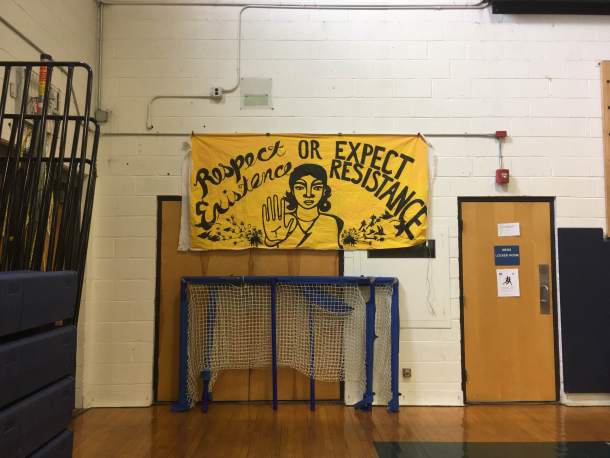
Duffort: I think the places we’ve heard about where the flag has been raised, obviously the administrators have been on board. But I have heard often from students and I heard at this conference, about students thinking that their administrators or their teachers didn’t get it. Right? I mean, I think it varies. I think you have some administrators that are obviously like completely on board. The administrators in Randolph were totally OK with having an anti-racism conference with Abolish ICE posters on the wall and inviting the media in. It is hard to imagine that that would be universal.
Got it. Thanks, Lola.
Duffort: Thanks for having me.
[/showhide]
Subscribe to the Deeper Dig on Apple Podcasts, Google Play, or Spotify. Music by Blue Dot Sessions.

