


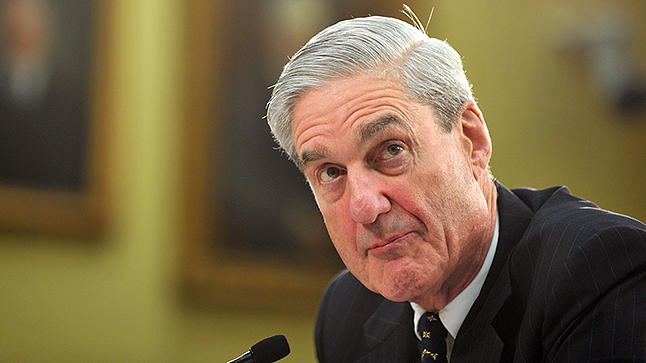
[S]pecial counsel Robert Mueller broke his public silence Wednesday on his two-year investigation into Russian interference in the 2016 election, and failed to clear President Donald Trump of obstruction of justice.
“If we had had confidence that the president clearly did not commit a crime, we would have said so,” Mueller said.
The special counsel’s comments come in sharp contrast to Attorney General William Barr’s summary of Mueller’s report that had cleared President Trump any criminal activity.
In April, Barr said there was no evidence of collusion between the Russian government and the Trump campaign. At the time, Barr also said he hoped Mueller hadn’t intended to leave the decision to bring criminal charges against the president up to Congress.
But during his measured 10 minutes of speaking, Mueller squarely put the decision to bring charges against the president on Congress.
“The Constitution requires a process other than the criminal justice system to formally accuse a sitting president of wrongdoing,” Mueller said.
Hours after Mueller’s brief remarks, VTDigger spoke with Rep. Peter Welch, D-Vt., who is a member of the House Intelligence and Government Oversight committees — both of which are investigating the Trump administration and claims of Russian interference in U.S. elections.
Since the beginning of the new legislative session, when Democrats took back control of the lower chamber, Welch has been vocal about the need for Congress to avoid being consumed by investigations, and to pass solid legislative proposals.
Welch has also recently voiced support for the decision by House Speaker Nancy Pelosi, D-Calif., not to bring articles of impeachment against Trump at this time.
VTDigger caught up with Welch by phone as he was in Vermont for the Memorial Day recess. The interview has been edited for length and clarity.
VTDigger: We have talked previously about your view that in addition to aggressive oversight this session, the House also has to get to work on policies that will be good for people who voted for President Trump and for those who did not. But with the recent discussions around Speaker Pelosi and special counsel Mueller coming forward, I wanted to chat about where things stand with impeachment and your role in discussions with Speaker Pelosi and being on committees that are part of the oversight arm of Congress.
Peter Welch: Well, the Mueller report was the gold standard and it is very damning on the question of obstruction. I urge people to read the report rather than read the Barr summary of the report. It goes through 11 instances in exhaustive detail where there was an energetic, concerted effort on the part of the Trump administration to try to thwart the investigation. So the Mueller report is very serious. Mueller’s statement today essentially refuted the Barr whitewash, so I think that escalates the demand for further investigation.
So I think that Barr clearly was chosen by Trump to try to protect him. Barr unfortunately is a person who before his service this time as attorney general, had a reputation as an upstanding lawyer and has clearly made the choice to be the Trump protector rather than America’s top law enforcement officer. And today’s statement from Mueller just shows the real contradiction between what Barr said on behalf of Trump and what Mueller’s report said about obstruction. So I think in Congress that is going to create more energy to continue the investigation particularly in Judiciary and on the Oversight committees — and I serve on on the Oversight Committee.
The Mueller statement today was extremely dramatic in my view about the immense effort that Russia made with some success to interfere with our election. And my work on the Intelligence Committee relates to that Russian interference, and our goal there is really to get to the bottom of how that happened and come up with recommendations of how to prevent that from happening again. So it’s much more in the Intelligence Committee a counterintelligence effort. How did the Russians do it how do we stop them from doing it again. And what is appalling about the Trump response is that he has consistently said the Russians didn’t interfere.
Now the Mueller report says that there was no collusion on the part of the Trump campaign but there were certainly benefits. But as president, Trump has been contradicting the unanimous view of the Mueller report, the opinion and information from the FBI and the CIA. So these investigations will continue — counterintelligence on the Russian interference and the real questions on the obstruction.
VTD: Have you spoken to Speaker Pelosi about impeachment proceedings?
PW: Well in caucus it is a regular topic, where are we on that. We have regular caucuses and all of us speak and Speaker Pelosi speaks as well. The statement from Mueller came out today, we’re on recess I’m in Vermont and will be back next Monday. But I know that the Pelosi reaction to this, and in her own statement, is that this intensifies the urgency of Congress fulfilling its investigative job — follow the facts. And Mueller did that and laid out, in the case of obstruction 11 specifics and our committees will be doing follow-through on those incidents.
VTD: Has your view on the role of oversight — and possibly going down a road to impeachment proceedings — changed at all from the beginning of the session to now?
PW: Well my view hasn’t changed because we have an oversight responsibility and legislative responsibility. So that is always the case. What I’ve said is that there is a tendency for the oversight to be the one that gets the attention, particularly the media attention, and we’ve got to do that job, that’s our duty. But let’s remember that we also have to do our level best legislatively to lower the cost of prescription drugs, to get a real infrastructure program and make higher education more affordable.
So I do see us as having dual responsibilities here of oversight and legislating. I’m in many ways a composite example because I’m on two committees that have significant jurisdiction on both sides of the oversight on this question of Trump — the Russian interference and then the obstruction. But I’m also on the Energy and Commerce Committee where we began moving out prescription drug legislation and we had a hearing on a broad rural based infrastructure program. And that doesn’t get the media attention, but its work we’re doing and I’m determined to continue doing — whatever happens on the oversight.
VTD: The use of the subpoena power is, in a sense, getting the ball rolling on impeachment proceedings without formerly starting the process. Is there a path by which the House continues its role of oversight, with this dovetailing into impeachment proceedings if the speaker of the House ever chooses to go down that route?
PW: Well it could, sure. I mean that is very much a live question and as presidential candidates are starting to weigh in. So where this will end remains to be seen. My view is that we need to proceed carefully, thoroughly and factually and then make a decision when the investigatory work is done. One of the added factors here is, in addition to obstruction, is the stonewalling by the administration. And that’s a challenge to the constitutional doctrine of the separation of powers. No president is above the law and every president and every elected official has to be held accountable. The means by which the president is held accountable is through congressional oversight and President Trump is totally stonewalling on cooperating with the legitimate oversight function of Congress. So he’s putting himself as if he’s above the law and beyond accountability. That is a very dangerous action by a chief executive.
VTD: Some have argued that questions about President Trump are best brought to the American people, while others say Congress ought to step in with impeachment proceedings before 2020. Where do you fall on this?
PW: Well I think, first of all the 2018 election, that was a referendum on America’s view of President Trump and he got hammered. The Democrats took the House back and I think that was because Democratic candidates dominated in districts Donald Trump had won in. So that process of citizen involvement began in 2018 and that’s critical because it ultimately will be the American voters who decide who their president is — whether Trump is the candidate or he isn’t.
And that decision, by the American people, is the one that has the most credibility and durability — rather than an action by Congress. The reality is that these investigations and how Trump reacts to them with the stonewalling, have a life of their own. At a certain point, Congress will have a duty to decide. So this really is a work in progress.

Everything can’t be put neatly on a timetable. All of us who are involved don’t control the timetable and what happens along the way. For instance, Mueller’s issuing of a statement today where he clearly distances himself from Barr adds momentum to more aggressive investigations. Trump’s stonewalling adds momentum to more investigation and pressure to hold him accountable for putting himself above the law and beyond accountability.
At the end of the day, in a democracy, the decision of the people is the decision that rightly gets the most deference, but Congress does have its own independent ability — whether that leads to impeachment or not — but that is not just a political calculation about whether you want to do it in 2020 or right now.
VTD: Based on what is being discussed in caucus, do you and Speaker Pelosi share those same concerns you just outlined?
PW: Well I’m supportive of the approach Pelosi has taken: investigate, follow the facts, do our work.
VTD: Since you have been on the Intelligence Committee, has there been information that has come to light that has made you more concerned about Russian interference during the election?
PW: I’m getting much more immersed in it and I am increasingly disturbed. That information has been pretty well documented in the Mueller report. You know, I’m living it in hearing from agencies who have done the work on it. But the information that is shocking to me is what is publicly available in the Mueller report. And you heard Mueller in his statement: he was very emphatic about the enormous effort Russia made to interfere by hacking into the Clinton emails and then carefully disseminating that information — calculated to do the maximum damage to her candidacy. Mueller says there is no evidence of colluding with the Trump campaign — hacking and dissemination — but it is clear that the Trump campaign was quite happy to benefit from that illegal, outrageous, activity.

