



[P]opulation growth and workforce development are pressing concerns in many parts of New England, and particularly in southern Vermont.
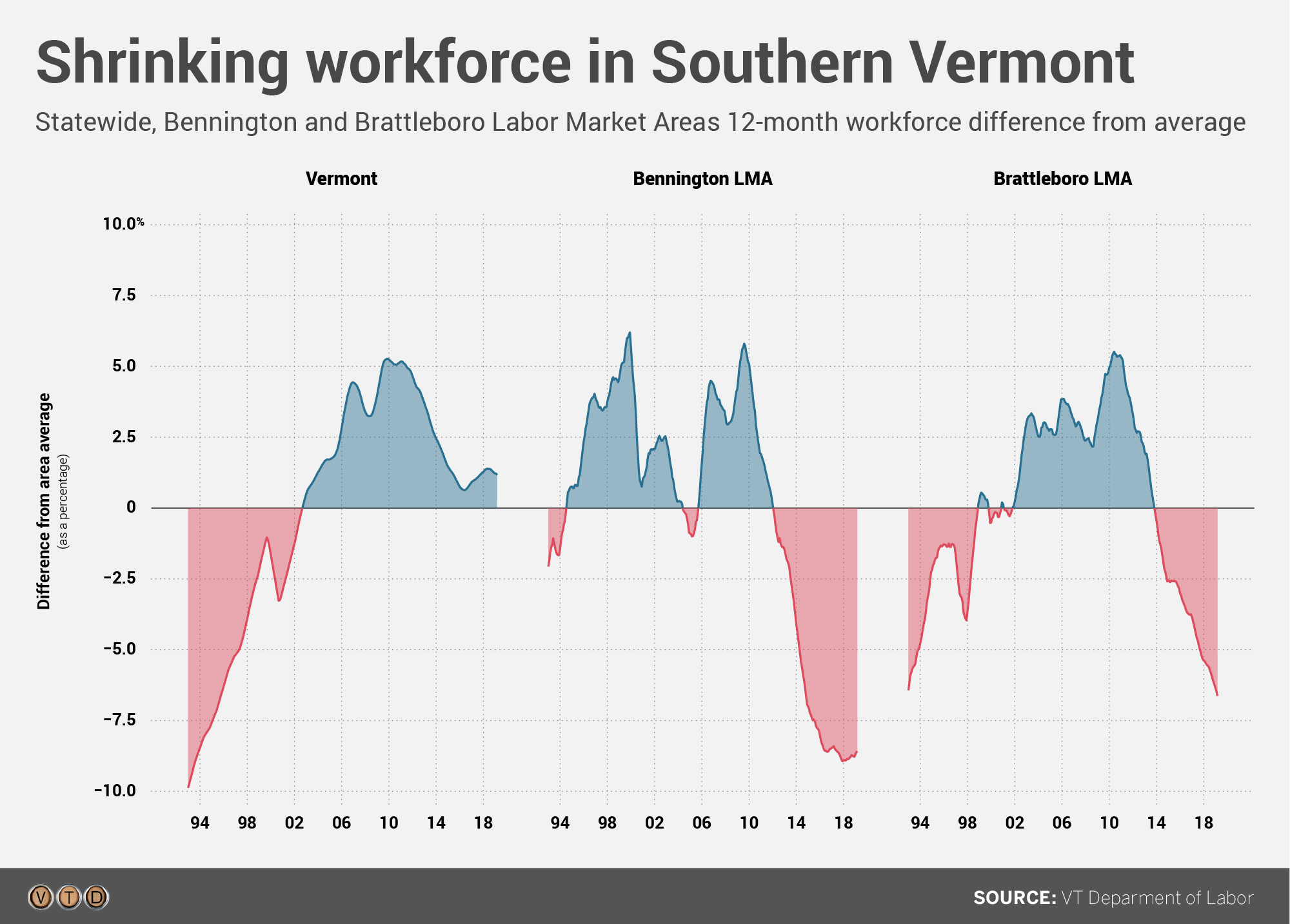
Statewide, Vermont’s population barely grew between 2014 and 2018. In southern Vermont’s Bennington, Rutland and Windham counties, the population dropped 4% to 5% in that period, a trend that is expected to continue. Meanwhile, the population grew 5% in Chittenden County in that period and nearly 6% nationally.
Population and workforce are among the top priorities for officials putting on the Southern Vermont Economy Summit May 23 at Mount Snow in Dover. The event is aimed at finding strategies to reverse the economic decline in Vermont’s two most southern counties, Windham and Bennington.
Southern Vermont is home to Brattleboro and Bennington, two small cities separated by the spine of the Green Mountains. The area is larger than the state of Rhode Island, but has a population of only 80,000. It’s home to ski resorts including Magic Mountain, Mount Snow, Stratton and Bromley, and also the town of Manchester, a popular tourist destination.
Southern Vermont has taken some hard blows in recent years, including the 2014 decommissioning of the Vermont Yankee nuclear power plant, once the largest employer in the Windham County region. The Bennington area is liable for major public infrastructure improvements because of PFOA, or perfluorooctanoic acid, contamination in soils and drinking water from the ChemFab plant in North Bennington. There are also lingering effects from Tropical Storm Irene and questions about the future of the Hermitage Resort, a major employer. In January, Green Mountain College in Poultney founded in 1834, , Southern Vermont College in Bennington, and College of St. Joseph’s in Rutland, all announced closings this spring.
Workers in southern Vermont earn less on average than their peers elsewhere in the state. The average wage in Vermont is $46,186, but it’s only around $41,000 in the Bennington and Brattleboro labor market areas, according to the federal Bureau of Labor Statistics. The average wage in the Manchester area is $40,640.

In 2015, the Vermont Legislature designated the two counties and the town of Weston an economic development zone. Area officials received a federal grant and private donations to work on the two-county economic development strategy.
The summit, the area’s third, is one outgrowth of that work. Adam Grinold, the executive director of the Brattleboro Development Credit Corp. or BDCC, said about 110 people attended the summit in the first year, and about 200 the second. This year, summit organizers are focused on getting more employers to attend.
“You’re putting people together on a shared path to find ways to work together,” said Grinold. “They might not have had that networking prior to this.”
The Bennington County Regional Commission & BDCC commissioned a written economic development strategy for the area that was released in 2019. Known as the Comprehensive Economic Development Strategy, or CEDS, the report identified several objectives as priorities: Increasing the area’s population; improving physical infrastructure, improving quality of life and stability for residents; improving job opportunities and encouraging job growth; and helping economic development officials and partners work together.
“The most important priority for the region is increasing population,” said state Rep. Laura Sibilia, I-Dover and director of regional economic development strategies and programs at BDCC.
The report found that health care is the largest industry in southern Vermont. It includes Southwestern Vermont Medical Center psychiatric and addiction treatment hospital, Brattleboro Retreat, a private psychiatric facility, and Brattleboro Memorial Hospital. Tourism is also a critical part of the mix, although the report noted that tourism jobs were seasonal and tend to pay lower than the average.
Tourism can be an important recruitment tool, authors of the report said. The state Department of Economic Development has created programs aimed at encouraging visitors to put down roots in Vermont.
“Strategies to serve the tourism industry should be developed to continue to look for ways to increase the length of the season, apply innovative approaches to marketing (including converting visitor attraction into new permanent residents), find ways for employees to have year-round work, and help businesses remain flexible to the changing trends of tourism,” the report said.
One program reimburses people up to $10,000 if they move to Vermont and work remotely. Another program pending approval in the Legislature would reimburse people $5,000 if they move to Vermont to take any job.
Not everyone is enthusiastic about the incentives.
Julie Lineberger, owner of LineSync Architecture in the southern Vermont town of Wilmington, said her business does not have difficulty attracting workers.
“We pay decently; we always pay above a living wage,” she said. “We always have a list of people wanting to work for us.”
She sees the region’s greatest challenge as supporting businesses that are already in Vermont.
“It is difficult sometimes to hear the extra support being given to people who want to move here when there are businesses that are struggling and that could use that kind of support,” she said.
The CEDS report reflects a general movement in economic development circles away from the once-popular notion of attracting one large employer to town.
“In a place like Southern Vermont, it is not going to be one or two major employers coming to town that will “fix everything,” the report said. Instead, it said, people in different industries need to work together “to innovate, be nimble, find solutions, and get creative in order to be sustainable and adaptable.”

Broadband, an area of need throughout Vermont and in rural areas elsewhere, is also critical to southern Vermont’s economic growth, the report said — a fact well known to lawmakers and to the administration of Gov. Phil Scott. The report said the average download speed in Brattleboro is 20.60 Mbps — 13.6% slower than the average download in Vermont and 97.8% slower than the national average. The average download speed in Bennington is 38.08 Mbps, 59.8% faster than the average in Vermont but 7% slower than the national average.
Poor broadband connectivity deters tourists, harms residents’ quality of life, and creates real barriers for businesses in industries like agriculture and forestry, where important work happens in very remote areas, the report said.
A lack of racial diversity is also holding the region back, the report said.
“Discussions around the intersection of economy, inclusion and racism have identified substantial shortfalls in the region when it comes to creating a community that works for all,” it said.
