


[M]IDDLEBURY — It was a cold, early spring morning, but the Beeswrap factory floor was warm, peaceful, and industrious – in fact, a hive of industry.
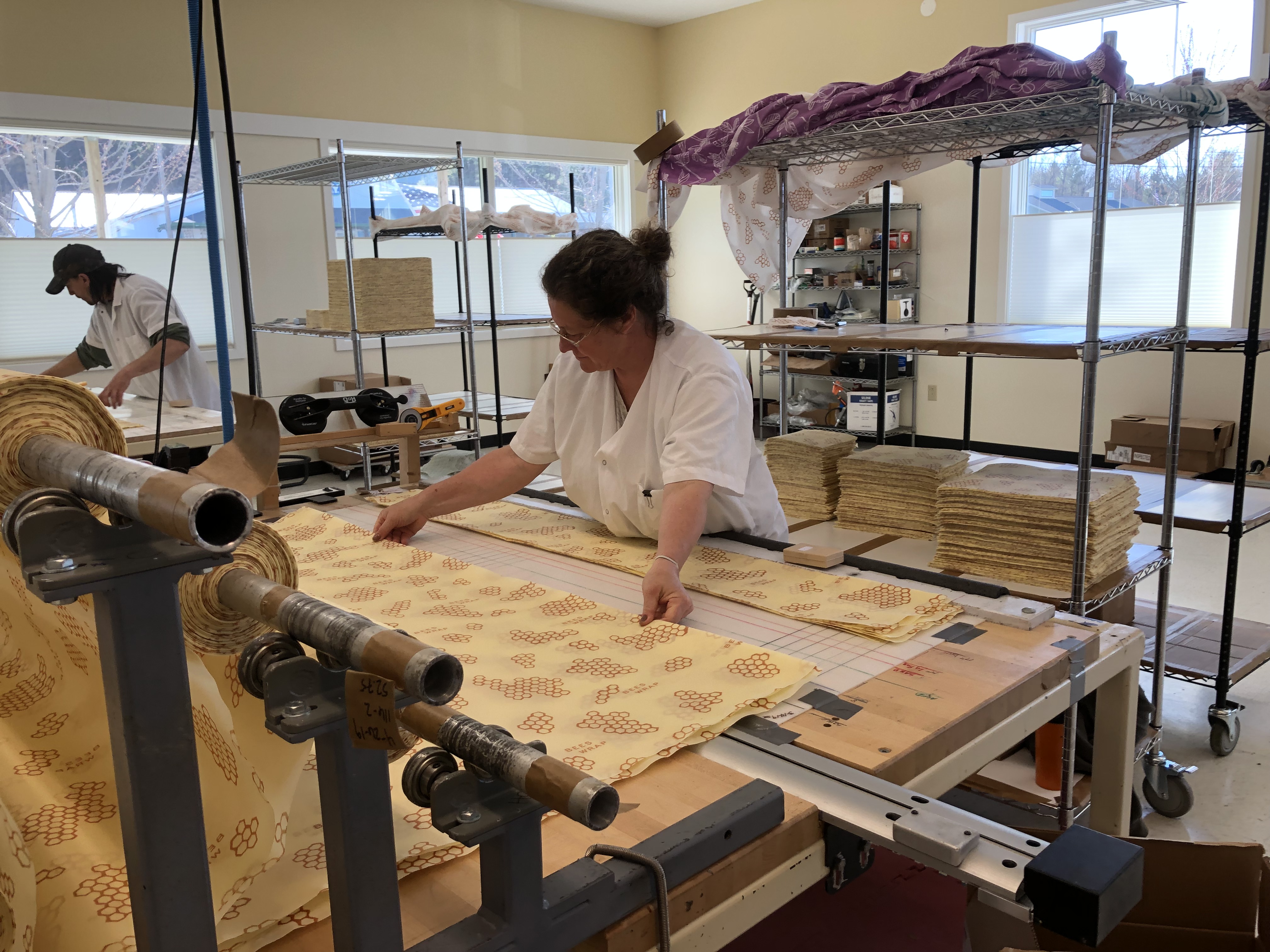
In the sunlit production area, workers were cutting, folding and packaging Beeswrap, a wax-infused cloth food wrapper that its Vermont-based creator markets as an alternative to the plastic products now used in most homes to cover food. Others were monitoring a pair of machines that coat the fabric with beeswax.
Sarah Kaeck of New Haven cooked up the Beeswrap idea and started selling it online in 2011. Kaeck, who at the time had a sewing business and did some farming as she raised her young children, perfected the product at home by melting wax in an electric skillet she had received as a wedding present. She later moved the company to its own space in Bristol, and this winter moved again to a 12,000-square-foot industrial space in Middlebury. There, 35 employees design, make and sell the simple product, coating colorful organic cotton with beeswax.
Propelled by reviews in home magazines and homemaker blogs, Beeswrap is now so popular that Kaeck said she’s already looking for space to expand again. She said the company has grown 70% in the past two years.
The company distributes its wrap in 41 countries, including some in Asia. It’s in natural food chains like Natural Grocers, national home stores like Anthropologie, and big kitchen chains like Sur La Table. It’s shipping its first order to Crate and Barrel in May, Kaeck said. It’s in major grocery chains in Germany and England like Waitrose and Lakeland.
Not unlike its product, Beeswrap’s marketing has been mostly organic, originating with the plethora of blogs written by homemakers and mothers. While Kaeck and her husband have promoted Beeswrap at traditional sites like the large national and European food and home shows, she said she’s gotten the most publicity over the years by continually reaching out to bloggers. Beeswrap isn’t inexpensive; a single sandwich wrap costs $11. But it can be washed and reused for about a year, the company says.
Beeswrap got its first big rush of attention in 2013 when the blog Design Sponge did a feature on it, resulting in hundreds of orders.
Another, larger boost came in 2017 after Kaeck hired a PR firm that reached out to Buzzfeed. Through Buzzfeed, the Beeswrap story reached Facebook and other channels, and Kaeck said Facebook made its own short video about the wraps, using photos and product supplied by Kaeck.
“They created it themselves, and it went totally viral,” reaching 80 million views within the first few days, said Kaeck. Now the video is up to 90 million views.
“It completely cleaned us out,” she said. The staff headcount grew rapidly from seven to about 20. “We quickly had to bring in fabric and beeswax, we had to upgrade our wax melter, we had to make new systems for ordering and processing … all within days, and bring in people, lots of people.”

Beeswrap’s timing couldn’t be better. Concern about the amount of plastic in the ocean and in marine wildlife has reached an all-time high, with the United Nations estimating that more than 8 million metric tons of plastic ends up in the oceans each year. Several cities and countries have moved to tax or limit the use of disposable plastics. After action in the Legislature this spring, Vermont appears likely to become the fourth state in the country with a ban on single-use plastic bags.
Many of the bloggers who promote Beeswrap and its competitors cite the sustainability of the products as their No. 1 reason for buying them.
Kaeck said she only uses USDA-tested pesticide- and herbicide-free wax, communicating with many suppliers, and organic jojoba oil. She buys organic fabric from India and resin from Indonesia. A local fabric designer helped with the product’s honeycomb print and its packaging. She acquired her first waxing machine in 2013, and a second, different version last fall.
Kaeck herself has a degree in art and women’s studies and has had to pick up her business knowledge along the way. Her father, a former business owner who now works for her company, has helped a lot, she said. She also worked closely with the Small Business Development Center.
“I had great mentors there,” she said. “They taught me how to create a budget, and gave me resources around the state for exporting, for finding an accountant … they helped me create spreadsheets for projecting fabric usage, and raw goods and materials. I still use some of those today.”
Kaeck said she also learned how to quickly meet customer demand.
“That’s been very exciting for us,” she said. “Not all businesses get to be in this position, where they are responding to the demand as opposed to having to create the demand.”
She’s not interested in stores like Walmart or Target.
There’s a lot of room to grow in other markets where we feel we are better aligned,” she said.
Kaeck hasn’t had to borrow money for the company, she said. She said she’s received some state funding to attend trade shows. She plans to keep the company in Vermont, although she said it’s difficult to find the industrial space she needs.
“It was a struggle to find a place to move our business. It’s not like we had five options on the table. This opened up, and we were here like that,” she said. Act 250, the state’s development control law, and the cost of construction were major obstacles to building a new facility. “It’s hard to scale here. I understand the need for it to protect our environment and communities, but balancing it with growing our economy in these small communities is important.”
As for expanding the product line, Kaeck sees a bright and interesting future.
“We’re talking about all kinds of exciting things right now,” she said.


