



[T]he Senate has once again delayed a vote on paid family leave, as negotiations over dueling Democratic priorities started playing out behind closed doors Friday.
Senate leader Tim Ashe, D/P-Chittenden, said Thursday evening that the decision on whether to move on paid leave was up to his colleagues on the Senate Economic Development Committee.
The Senate is also negotiating with the House over the Senate’s top priority, the $15 minimum wage bill, which was watered down before being passed in the House this week. Ashe said the decision to hit pause on paid leave was unrelated to minimum wage talks.
“I think they are just trying to make sure it as close to agreeing with the House as possible, because there’s obviously significant changes from what they passed,” Ashe said Thursday evening of the Senate Economic Development Committee.
However, the committee chair, Sen. Michael Sirotkin, D-Chittenden, said his committee was not calling the shots.
“I don’t know if it can be attributed to anybody,” Sirotkin said, “but the general consensus is we need to wait until next week to see all the pieces coming together on this.”
House leaders, like their counterparts in the Senate, are unhappy about how their own priority, paid leave, was narrowed in the other chamber.
Both sides are hoping to bring the bills closer to their original version during negotiations, but there are major concerns over whether either bill can win a veto-proof majority, if the governor attempts to block it.
The Senate’s more aggressive minimum wage timeline risks losing votes from more moderate Democrats in the House, and makes a veto more likely if it gets that far.
Majority leaders in both the House and Senate said the two issues were inextricably linked in ongoing negotiations between the chambers.
Senate Majority Leader Becca Balint, D-Windham, said some members of her caucus would not support the paid leave bill, which is funded through a payroll tax, unless they were confident that Vermonters’ were also getting a pay raise.

“So it’s not a tit for tat, it’s not a we won’t move it if you won’t move it, it’s just that we know that we will have a stronger vote, continue to have a stronger vote, on paid family leave going into the conference committee and hammering out the differences if we end up going to conference committee,” she said. “So both those things are still in play.”
Balint said she remained hopeful that the Democratic caucuses in each chamber could reach deals on both bills that would have strong support, whether it’s in conference committees or through proposals going straight to a floor vote. “But nothing has been agreed on,” she said.
House Majority Leader Jill Krowinski, D-Burlington, said pushing back the date for adjournment has given time for the two bodies to work out a deal.
“We are going to do everything in our power to make sure we can get those two bills across the finish line,” Krowinski said. “I don’t know how that looks going back and forth.”
During a first vote earlier this week on H.107, the paid leave bill, 19 senators voted for the bill, putting an override in reach. Last month, the House got 92 votes on a more robust paid leave program, with six Democrats absent — again putting the body within striking distance of an override.
The minimum wage bill, S.23, has a much tougher path forward. Even the watered down version of the bill only won 90 votes in the House, putting leadership 10 votes away from beating a veto. At least 22 of the 24-member Senate Democratic caucus supports a $15 wage by 2024.
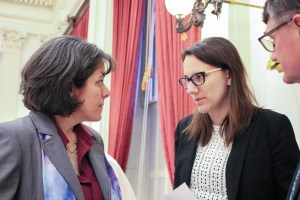
Ashe said Thursday that middle ground on minimum wage could look something like a $1 increase each of the next two years — a compromise that has been rumored in recent days. Balint has signaled a willingness to accept a shorter timeframe.
It’s less clear where a compromise might lie on paid leave, or whether a compromise is needed at all if Ashe and Balint try to whip the votes for the House version of the bill, which includes paid time off for personal illness or injury.
Even if the House and Senate do strike a compromise, there’s the looming question of whether they can get Gov. Phil Scott to sign on. And whether House and Senate leaders would attempt an override if he vetoes the bills, given their seemingly fractured majorities.
Legislative leadership have expressed their frustration this week about Scott failing to communicate his positions on specific issues, but instead expressing his general concern about overspending.
Rebecca Kelley, Scott’s spokesperson, said Friday he is prepared to tell legislators where he stands on bills, once Democrats agree amongst themselves on a concrete proposal.
“The governor is ready to react,” she said, “but he needs something to react to.”
