


[B]URLINGTON — A forensic psychiatrist testified Friday that Steven Bourgoin was not insane when he drove the wrong way on the interstate and killed five teenagers, rebutting two experts for the defense who told the jury the opposite earlier in the murder trial.
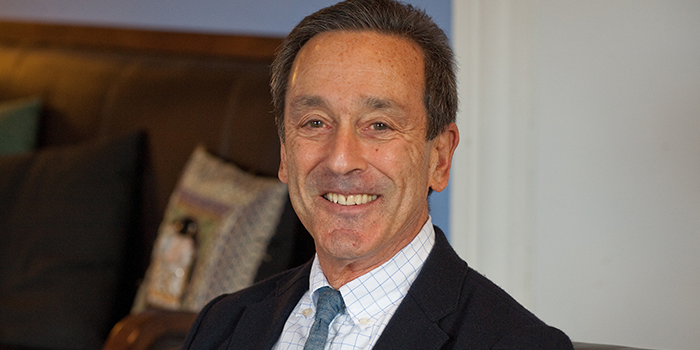
Dr. Paul Cotton, a Burlington-based forensic psychiatrist who is contracted with the state Department of Mental Health to conduct forensic psychiatrist exams, was called to the stand by the prosecution on the 10th day of the trial.
Bourgoin is standing trial on five counts of second-degree murder, as well as other charges stemming from an Oct. 8, 2016, late-night crash on Interstate 89 in Williston that killed the five teens.
“My opinion was he was not insane,” Cotton testified Friday of Bourgoin.
The doctor added that he believed Bourgoin knew his actions were wrong the night of the crash.
“Do you have an opinion about whether he could appreciate the wrongfulness of his conduct?” Chittenden County State’s Attorney Sarah George, the prosecutor, asked.
“I do,” Cotton responded.
“And what’s your opinion on that?” George said to the doctor.
“That he appreciated the wrongfulness of his conduct,” Cotton testified.
Court proceedings ended Friday before Bourgoin’s defense team had a chance to cross-examine Cotton. That is now expected to take place Monday.
Also Monday, on the trial’s 11th day, closing arguments are expected, and the jury will then began deliberations.
Prosecutors spent Friday trying to dispute the contention by Bourgoin’s attorneys and experts they presented during the trial that the former Williston man was insane at the time of the fatal crash.
Bourgoin’s attorney and defense witnesses have told the jury about Bourgoin’s belief that he was on a top-secret government mission in the days leading up to the crash, receiving signals through devices, such as his computer and over his vehicle’s radio.
Prosecutors have contested that claim, suggesting instead Bourgoin was in a rage, possibly suicidal, over his finances and a child-custody dispute with his ex-girlfriend, and, after the crash, may have been feigning symptoms of a mental disease.
Prosecutors say Bourgoin drove his 2012 Toyota Tacoma northbound in the southbound lane before crashing nearly head-on into the 2014 Volkswagen Jetta carrying the teens.
Killed in the crash were Mary Harris and Cyrus Zschau, both 16, and both from Moretown; Eli Brookens, 16, of Waterbury; Janie Chase Cozzi, 15, of Fayston; and Liam Hale, 16, of Fayston.
After the crash with the teens, according to prosecutors, Bourgoin stole a police cruiser from a Williston officer who responded to the scene and was attempting to rescue the teens from the flaming wreckage of their vehicle.
Bourgoin drove that cruiser southbound before doubling back, and slammed into his crashed truck.

‘Acute single thought’
Cotton, testifying Friday, said Bourgoin told him that after the initial crash with the Jetta, he went to the median where the car had rolled over and come to a stop, and looked inside.
Bourgoin reported seeing mannequins inside that vehicle, which he described as a “frightening, bizarre sight for him,” according to Cotton.
George asked the doctor if that was an example of delusional thoughts from Bourgoin.
“He, in my, opinion,” Cotton said, “like what happens when there’s a catastrophic event that occurs, that people in the immediate aftermath of the catastrophic event can have a thought that is irrational.”
The doctor added that Bourgoin’s report of seeing mannequins in the car rather than people is “clearly” irrational.
And that does raises questions, Cotton testified.
“Is that off the moment when he came to grips with seeing what happened, or was that part of a mental disease that’s ongoing at the time?” the doctor said he asked himself.
“It was my opinion,” Cotton said, “it was more the acute single thought rather than a mental disease.”
The doctor talked about other things Bourgoin did in the days leading up to the crash without any signs of mania, including going to work and carrying out tasks there and having lunch with a friend.
Cotton said he diagnosed Bourgoin with adjustment disorder with disturbance of mood behavior, a condition that arises from “identifiable” stressors.
“I did not find data to support a mental disease,” Cotton said. “I used the disorder because of the fact it can describe, in my opinion, what he was experiencing and some of the stressors that led to his actions.”
Those stressors, according to the doctor, included the child-custody dispute and his financial problems.
Prosecutor Sarah George also asked Cotton about Bourgoin stealing the cruiser, driving away, returning to the scene, and crashing into the pickup truck at more than 100 mph.
“It would seem to me that he would just, as one would be, just so overwhelmed by the whole thing that he just lost it, in terms of his behaviors,” the doctor said. That doesn’t mean Bourgoin was legally insane at the time, he added.
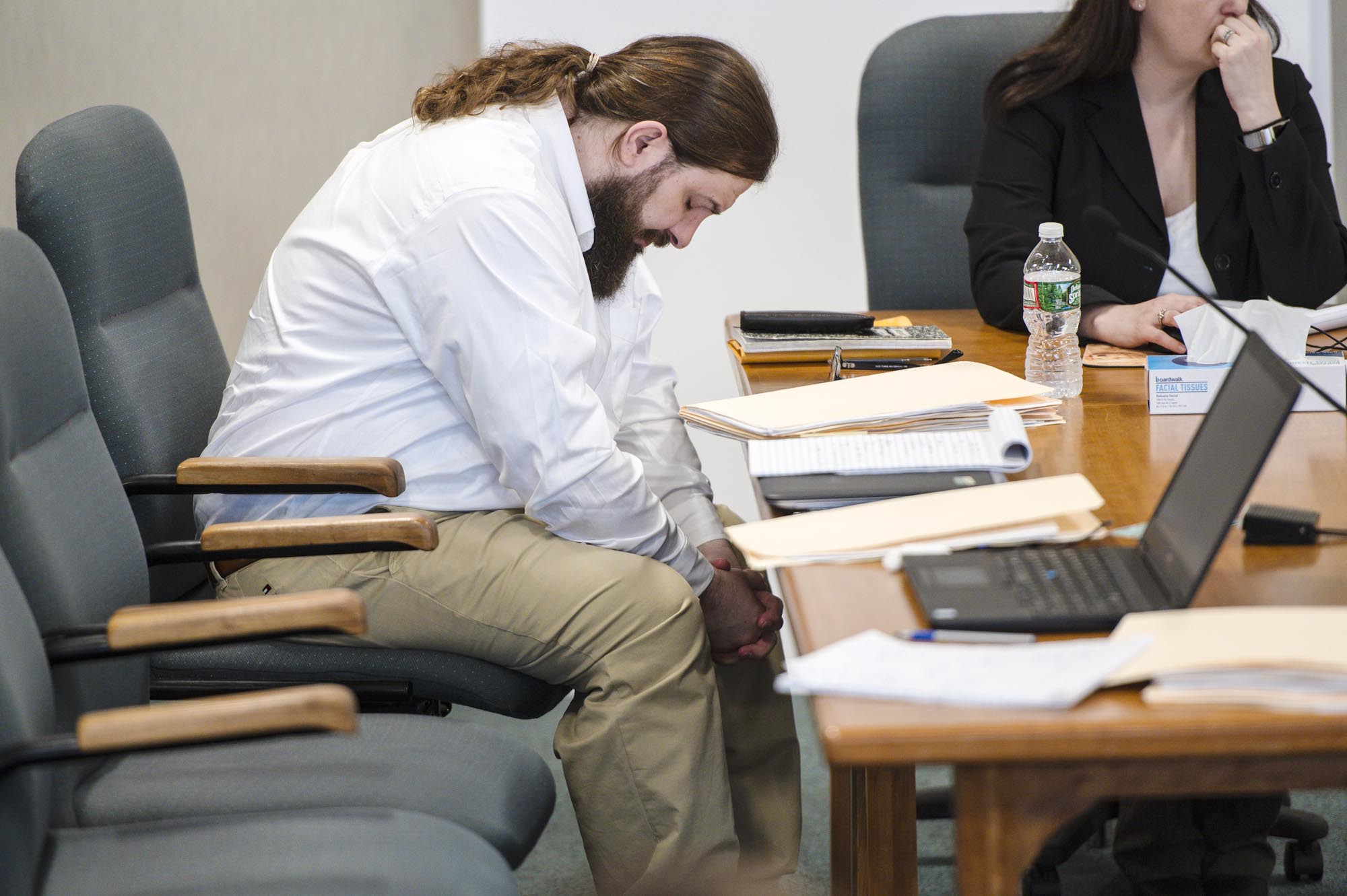
Earlier this week, Dr. David Rosmarin, a forensic psychiatrist at McLean Hospital in Belmont, Massachusetts, and hired by the defense, testified. He told the jury Bourgoin was insane at the time of the crash.
Dr. Reena Kapoor, a forensic psychiatrist at the Yale School of Medicine in New Haven, Connecticut, also testified this week. Kapoor, initially hired by the prosecution and later dropped, was called by the defense.
Kapoor, like Rosmarin, told jurors that she concluded Bourgoin was insane at the time of the crash, diagnosing him with a personality disorder, with traits of borderline personality disorder and paranoid personality disorder.
A person with such a condition, Kapoor said, would have “vulnerability,” or “predisposition,” to becoming psychotic under stress.
George, the prosecutor, asked Cotton on Friday if he felt a need to reexamine Bourgoin after learning of the two other opinions.
“I felt confident in my opinion,” Cotton replied. “It’s not uncommon for people to have different opinions.”
The doctor also said the two other forensic psychiatrists examined Bourgoin well after he did. “I didn’t see any reason to change it based on these later reports,” Cotton said of his conclusion.
Cotton met with Bourgoin about six weeks after the fatal crash. He conducted the examination following an order by the court seeking to determine Bourgoin’s competency and sanity.
The prosecution retained Cotton as an expert after it dropped Kapoor. That change was made after the prosecution learned Kapoor had concluded that Bourgoin was insane at the time of the crash.
Cotton, on the witness stand Friday, said he has testified for prosecutors and defense attorneys in court proceedings over the years. In other cases, he has found defendants facing homicide charges insane.
Also on the stand
Two psychiatrists who talked with Bourgoin while he was treated at the University of Vermont Medical Center in Burlington for injuries he suffered in the crashes, including a broken hip and facial fractures, also testified Friday.
They told the jurors they saw no signs of mania, paranoia, or psychosis in Bourgoin during their interactions with him in the days after the crash. The defense, in questioning those two witnesses, suggested to the jury that those interactions were limited.
Earlier Friday, Vermont State Police Detective Sgt. Eric Jollymore testified on a review of activity on Bourgoin’s computer in the roughly four days before the fatal crash.
The detective said the computer found in Bourgoin’s bedroom showed about 50 Google searches and almost two dozen Wikipedia searches.
Jollymore testified that he didn’t find anything unusual with the searches conducted by Bourgoin in the days leading up the crash. He also said he didn’t see any searches dealing with government conspiracies, as discussed earlier in the trial by the defense.
The jury didn’t hear, though, exactly what had been searched for.
Robert Katims, Bourgoin’s attorney, in cross-examining Jollymore, suggested that his client could have accessed the internet on other devices, including his cellphone.
Jollymore said he didn’t find anything remarkable about the material he reviewed on Bourgoin’s computer.
“It appeared to be a run-of-the-mill home PC,” the detective said.
Arraignment day
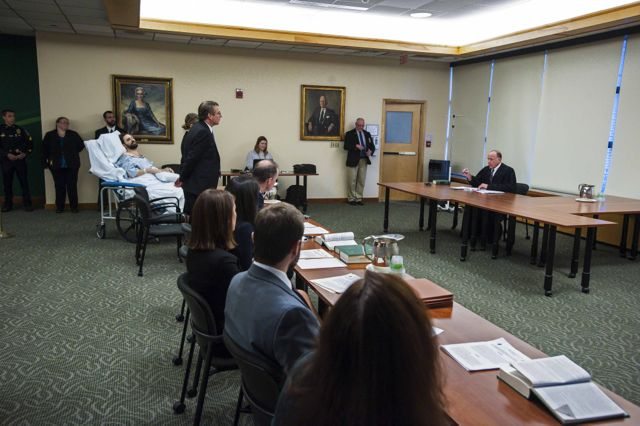
Another witness, Dr. Roger Knakal, medical director of physical medicine and rehabilitation at the University of Vermont Medical Center, told the jury that he watched Bourgoin’s arraignment on the murder charges on television on Oct. 14, 2016.
The arraignment took place in a conference room at the medical center as Bourgoin was receiving treatment there, and he was wheeled into the room in a hospital bed for the makeshift court proceeding.
Knakal said he watched the arraignment, in part, to get “eyes on” Bourgoin, whom he had been treating.
During that visit before the arraignment, Knakal said Bourgoin was alert, though non-responsive to some questions.
The doctor said Bourgoin chose to be non-responsive. The images of Bourgoin from the arraignment he saw on the television the next day were much different. Bourgoin laid largely motionless with his eyes closed during the proceeding that last only a few minutes.
“There did not, in my opinion,” Knakal said, “exist a reason for his obtunded-appearing state based on his medical injuries.”
“I’m not sure I know what obtunded is,” George, the prosecutor, said to Knakal.
“Out of it,” the doctor replied, “really out of it.”
During cross-examination, Sara Puls, an attorney for Bourgoin, suggested that Knakal, who is not a psychiatrist, was not qualified to offer a medical opinion on her client’s mental state.
Moments earlier, after the attorneys in the case emerged from a conference at the bench with the judge, Knakal was asked to spell out the term for his medical expertise, which is very close to the word “psychiatry.”
“P-h-y-s-i-a-t-r-y,” Knakal spelled out for the jury, referring the branch of medicine focused on physical medicine and rehabilitation.
