


[B]URLINGTON — The physician assistant who examined Steven Bourgoin earlier on the day he killed five teenagers in a wrong-way crash testified Tuesday that he told her he was stressed about job and family problems but not suicidal or homicidal. She said she did not pick up signs he was delusional.
He left the University of Vermont Medical Center, which he said he came to seeking a “safe place,” while she was preparing his discharge papers.
Lauren MacNee said she met with Bourgoin for 15 to 20 minutes in the medical center’s emergency department in an exam room late on the morning of Oct. 8, 2016, and he talked of relationship issues with his ex-girlfriend and stress over a job change.
“He said he came to the hospital to be in a safe place because of these ongoing psychosocial stressors in his life,” she said.
MacNee, on the witness stand on the seventh day of Bourgoin’s murder trial, recounted her exchanges with him in that exam room, which included those items he reported were causing him stress, as well as his medical history and alcohol and marijuana use.
“Then we discussed kind of next steps to address his concerns,” the physician assistant said. “I talked to him about seeing a crisis clinician, or a mental health clinician, and he declined that.”
He denied being suicidal or homicidal, MacNee said.
She said she talked to Bourgoin about following up with his primary care doctor and she provided him with a crisis clinician’s phone number to reach out to on an outpatient basis, if he felt a need to.
“He verbalized an understanding of that and was reassured,” MacNee added. “I said was going to leave and type up his discharge paperwork.”
Before she could return, according to MacNee, Bourgoin had left the medical center.
Later that night, he got behind the wheel of 2012 Toyota Tacoma and, traveling north in the southbound lanes of Interstate 89 in Williston, slammed nearly head-on into a car with five central Vermont teens in it, killing them all.
The five friends in the car were Mary Harris, 16, and Cyrus Zschau, 16, both of Moretown; Liam Hale, 16, of Fayston; Eli Brookens, 16, of Waterbury; and Janie Chase Cozzi, 15, of Fayston, who were returning from a concert in South Burlington.
Bourgoin is standing trial on five counts of second-degree murder in their deaths, with his attorneys claiming Bourgoin was “legally insane” at the time of the crash.
A defense expert testified Monday and into Tuesday that Bourgoin was indeed insane, with increasing delusions and paranoia over thoughts that the government was communicating with him through electronic devices, such as his computer, cellphone and even his vehicle’s radio, about a top-secret mission he had been selected to carry out.
At UVM Medical Center
Bourgoin had gone to the medical center’s emergency department in Burlington on Oct, 8, 2016, about an hour prior to checking into the emergency department and meeting with MacNee in the exam room.
In that earlier visit, he was found in a nonpublic area of the emergency department and left after security told him he wasn’t supposed to be in that area.
On his return trip, MacNee, in her testimony Tuesday, described Bourgoin in the exam room as attentive, answering questions when asked.

“Have you interacted with individuals who don’t tell you that they’re experiencing delusions but you can tell they are?” Chittenden County State’s Attorney Sarah George, the prosecutor, asked MacNee.
“I have encountered patients who are having delusions and they don’t know they’re delusions,” MacNee replied.
“Did you observe any of those cues during your interactions with Mr. Bourgoin that day,” George asked.
“I did not,” MacNee responded.
Victoria Poulin, a registered nurse, was working at the UVMMC emergency department as a triage nurse that day.
She described Bourgoin chatting with two other patients on stretchers who he knew as he made his way into an exam room.
“Was he able to tell you why he was there?” Robert Katims, Bourgoin’s attorney, asked her.
“He said that he was there for relationship concerns and he had some concerns related to safe housing,” Poulin replied.
She did say that Bourgoin asked her to read a sentence on the top of a pain scale on the desk.
“When I did this Mr. Bourgoin indicated a zero on the numeric pain chart,” Poulin said.
“Is that something unusual, being asked to read the pain chart?” Katims asked.
“It seemed unusual,” she replied.
Poulin added that Bourgoin’s speech was clear, but there was some latency, or hesitation, after each question asked.
“Do you remember if his sentences were disjointed or fractured?” Katims asked.
“Yes,” she replied.
The defense attorney then asked if she was able to determine after “triaging” him what was wrong with Bourgoin.
“It was difficult to understand why he was in the emergency department,” she said. “Having concerns about a relationship or a safe place and having no pain, are not really reasons to be in the emergency department.”
She then took him to a room where he was later examined by MacNee.
Is he faking?
Earlier Tuesday morning, George cross-examined Dr. David Rosmarin, a forensic psychiatrist, who a day earlier had testified for the defense that Bourgoin was “grossly psychotic” at the time of the crash, and suffering from a bipolar disorder.
She questioned him about whether Bourgoin may have been faking his symptoms.
“You mentioned that in direct that you believed that Mr. Bourgoin could be motivated to lie given the charges he faces?” George asked Rosmarin, who examined Bourgoin twice in 2018.
“Anybody, any defendant, could be motivated to lie,” responded Rosmarin, who works at McLean Hospital, a Harvard Medical School affiliated psychiatric hospital in Belmont, Massachusetts.
George then said to Rosmarin: “In your assessment of whether he was lying to you, you look for whether he had a practiced response, correct?”
“One of things,” the doctor replied.
George questioned Rosmarin about inconsistencies in parts of Bourgoin’s recounting of events leading to the crash.
Rosmarin had testified that while Bourgoin thought he was getting signals about a top-secret government mission he had been selected to carry out, he also began to wonder whether he may be in danger.

Bourgoin, according to Rosmarin, questioned whether the government may actually be out to hurt him and others, including his young daughter.
Rosmarin said that inconsistencies in Bourgoin’s recollection of events makes his recounting all the more believable.
“I’d be surprised if there wasn’t,” he said of inconsistencies.
“I considered them,” Rosmarin added, “but I think that the fact they come out in the normal way that we remember things over time, with uncertainties and lack of clarity about the order of certain things, that’s consistent with recounting the best one can.”
Prosecutors have contended Bourgoin’s actions on the night of the crash were intentional, that he was in a rage, possibly suicidal, over his finances, a child custody dispute with his former girlfriend, and his job at Lake Champlain Chocolates, which he quit a day earlier.
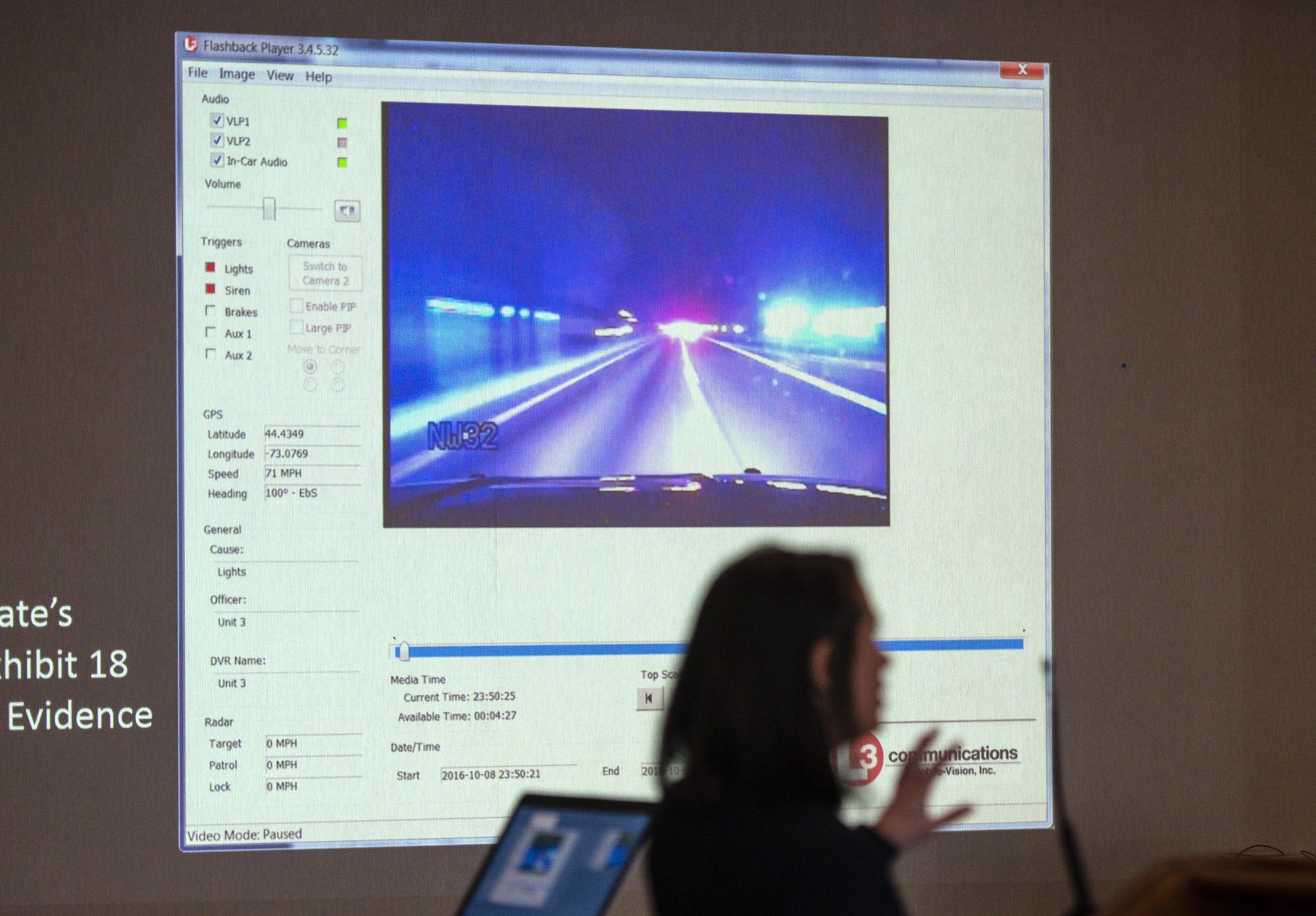
After the first Williston police officer arrived on the crash scene and hurried to help the teens trapped in their vehicle, Bourgoin took that officer’s cruiser and fled, heading southbound.
Then, he turned around on the interstate, headed the wrong way and raced at more than 100 mph back to the crash scene. He crashed the cruiser into his own truck and other vehicles that had pulled over on the highway.
Rosmarin rejected conjecture that Bourgoin’s actions that night may have been an attempt to kill himself.
Instead, the doctor said, Bourgoin was doing everything he could to preserve his life, including earlier on the day of the crash by going to the emergency room in search of a “safe place” as the delusions increased.
George, the prosecutor, asked Rosmarin about Bourgoin’s actions, when he drove the cruiser at more than 100 mph the wrong way on the interstate and slammed into his pickup that he had abandoned after the earlier crash.
“That is not life preserving,” George said to Rosmarin.
“That is the reaction of a terrified, disorganized man,” the doctor responded.
“Are those actions life-preserving?” the prosecutor followed up.
“They are almost certain death,” Rosmarin replied.
Dr. Madelon Baranoski, a psychiatry professor at Yale School of Medicine in New Haven, Connecticut, testified Tuesday that based on tests she administered to Bourgoin she did not believe he was lying.
She described Bourgoin as having an IQ of 118, putting him in the “high-average” population. Baranoski said her conclusion was that he suffered from a borderline personality disorder.
Bourgoin and marijuana
Katims, Bourgoin’s attorney, asked Rosmarin on Tuesday if he believed his client had some sort of marijuana-induced psychosis at the time of crash.
“I have an opinion,” Rosmarin replied. “It wasn’t.”
Bourgoin had 10 nanograms of THC, the active ingredient in marijuana, in his blood several hours after the crash, according to a toxicology report. For comparison, in Colorado, a driver with 5 nanograms of THC in their blood is presumed under the influence.

Rosmarin described the level detected in Bourgoin as “low” for a regular marijuana user.
“Those were the levels that were in his blood, not in his brain,” the doctor said of Bourgoin. “This was consistent with someone who had chronically used.”
Rosmarin testified Tuesday that he took a “careful history” from Bourgoin of his marijuana use, and also consulted with a colleague knowledgeable in that area.
“Marijuana was not the cause of a manic psychosis,” Rosmarin said, adding, “He used the marijuana as a sedative, a calming agent, and marijuana is a depressant.”
The doctor added that Bourgoin had reported to doctors in the past that he did not use marijuana to get high, but to help him relax.
“He did not go out and party with it,” Rosmarin said. “He used a little bit before work, a little bit after work, and a bit to go to sleep.”
The doctor said it was a mental condition that was the “predominant” factor in Bourgoin’s actions leading to the crash, adding that he was “psychologically coerced.”
Looking ahead
The defense is expected Wednesday to call Dr. Reena Kapoor, a psychiatrist from the Yale School of Medicine in New Haven, Connecticut, to testify.
Kapoor had earlier in the case been a prosecution expert and also examined Bourgoin.
She has determined that Bourgoin was insane at the time of the crash, though with a different diagnosis from Rosmarin.
Baranoski, who testified Tuesday, had been also been initially hired by the prosecution as part of Kapoor’s evaluation of Bourgoin.
The prosecution later in the trial, to rebut the insanity defense, is expected to call Dr. Paul Cotton, who has determined that Bourgoin was sane.
‘Why do you disagree with Dr. Cotton?” Katims, Bourgoin’s attorney, asked Rosmarin on Tuesday.
“In my opinion,” Rosmarin replied of Cotton’s examination of Bourgoin, “it was not up to the standard of care.”
