


Rutland Regional Medical Center has requested an emergency state permit to spend up to $4 million to address potential safety issues for “patients at high risk for self-harm.”
In a letter sent to the Green Mountain Care Board, a law firm representing Rutland Regional says a recent assessment of the hospital identified “urgent risks” due to tightening federal regulations. The focus is on fixing “ligature points” that could be used for hanging or strangulation.
In addition to patient safety concerns, the letter cites the possibility of regulatory action that could endanger the hospital’s federal funding.
Rutland Regional, which has an inpatient psychiatric unit, has added staff in order to implement one-on-one supervision for high-risk patients. But that’s only a short-term solution, said Claudio Fort, the hospital’s president and chief executive officer.
“I don’t believe that it’s an unsafe environment right now,” Fort said. “But there is a sense of urgency. When we know that there could be a potential problem, we want to be in full compliance with those standards.”
Vermont hospitals have been struggling to care for an increasing number of mental health patients with increasingly acute needs. In some cases, hospitals have gotten into regulatory trouble after inspections found evidence of mistreatment or unsafe environments.
Ligature points – a structure to which someone could attach a cord or rope – are considered part of an unsafe environment. And federal officials have been looking more closely at the issue: In a December 2017 memo, the Centers for Medicare & Medicaid Services said “the presence of ligature risks in the psychiatric patient’s physical environment compromise their right to receive care in a safe setting.”
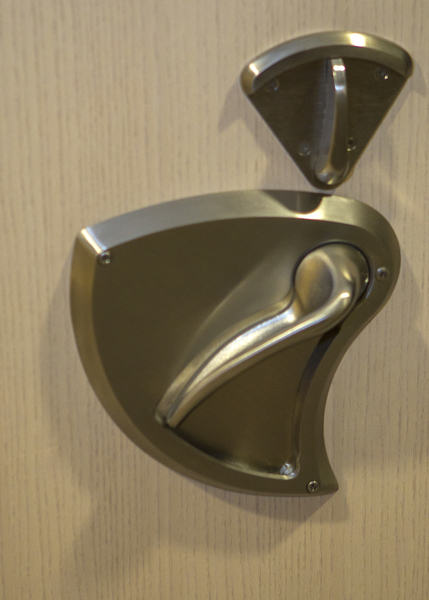
The federal document also listed numerous potential examples of ligature points including “shower rails, coat hooks, pipes and radiators, bedsteads, window and door frames, ceiling fittings, handles, hinges and closures.”
The variety of ligature points used in patient incidents “contributes additional concern that, if there’s a ligature risk, (hospitals) really need to look into getting it corrected,” said Hyosim Seon-Spada, survey and hospital certification and enforcement branch manager at CMS’ Boston office.
She also cited increasing suicide rates as a major concern. Vermont’s suicide rate far outpaced the national trend between 1999 and 2016.
CMS is in the process of finalizing new guidance on ligature risks, which are now subject to more serious regulatory citations. In response, Rutland Regional is expediting construction plans at the facility.
The hospital undertook an accreditation assessment last summer. According to the hospital’s letter to the care board, that evaluation found “a high risk associated with the unmitigated ligature risks that would be subject to an adverse finding” by inspectors.
Documents detail a wide variety of concerns including medical beds, furniture, shelving, a fire alarm system and doors. Other potential safety issues include inward-swinging doors that allow for “a barricade opportunity,” as well as certain rooms that allow “access to numerous self-harm objects.”
Fort said hospital administrators are looking to tackle safety concerns inside and outside Rutland Regional’s inpatient psychiatric unit. “We feel that it’s our obligation to try to address this in all the areas of the hospital,” he said.
Having worked for months to “identify the extent of necessary changes,” hospital leaders say they now have enough information to request a certificate of need from the Green Mountain Care Board. And they’re asking for the care board to follow an emergency process that could be much faster than typical certificate of need deliberations.
“When we recognized that there could be a risk to patients, we thought it was important to try to do these physical plant fixes as soon as possible,” Fort said.
Patient safety concerns are paramount, administrators say. But there also are “serious ramifications that (Rutland Regional) may face if it is not able to undertake this project in the most expeditious time frame possible,” the hospital’s letter says.
That’s because compliance with federal regulations is, in serious cases, tied to federal funding through Medicare and Medicaid. The hospital’s letter also says any deficiencies could lead to limits on the number of patients admitted to Rutland Regional, “especially where dedicated inpatient psychiatric space is required.”
“In the state of Vermont, we cannot withstand the loss of inpatient psychiatric beds, given the current lack of statewide capacity,” the letter says.
To try to head off regulatory trouble for the time being, Rutland Regional has beefed up staff to “provide one-to-one supervision for all patients at high risk of self-harm in areas that require renovation,” hospital administrators write.
The hospital says it will add 20.6 full-time-equivalent staff as a response to safety issues. But as soon as the proposed renovation project is done, there will be no need for about half of those employees.
“Operationally, this is a very expensive stopgap measure,” Fort said of the extra staffing.
The construction project is described in state documents as “complex and substantial.” It carries a price tag estimated at $3.46 million to $4 million, and that’s no small price at a time when most Vermont hospitals are struggling.

Fort said the renovations are not in Rutland Regional’s budget, but the project will be covered by reserve funding. The expense is “concerning,” he said, “but I’d rather try to be proactive on this.”
The state of Vermont has a stake in Rutland’s project, given that there are six state-contracted beds among the hospital’s 23 adult psychiatric beds. The state beds were added after Tropical Storm Irene’s flooding closed the Vermont State Hospital in 2011.
State Mental Health Commissioner Sarah Squirrell said she and the department’s deputy commissioner toured Rutland Regional last month and are familiar with the work the hospital is undertaking.
“We don’t have any concerns related to the situation at Rutland,” Squirrell said. “We actually appreciate that Rutland is being proactive to address and mitigate risks to ensure patient safety.”
