

House lawmakers have given a tentative green light to legislation requiring every pre-K-12 school and child care provider to test their drinking water for lead.
The metal is a potent neurotoxin, and the water crisis in Flint, Michigan, has spotlighted the need for better testing and treatment of public water systems. Lead poisoning affects both children and adults, but its consequences are more acute in developing brains.
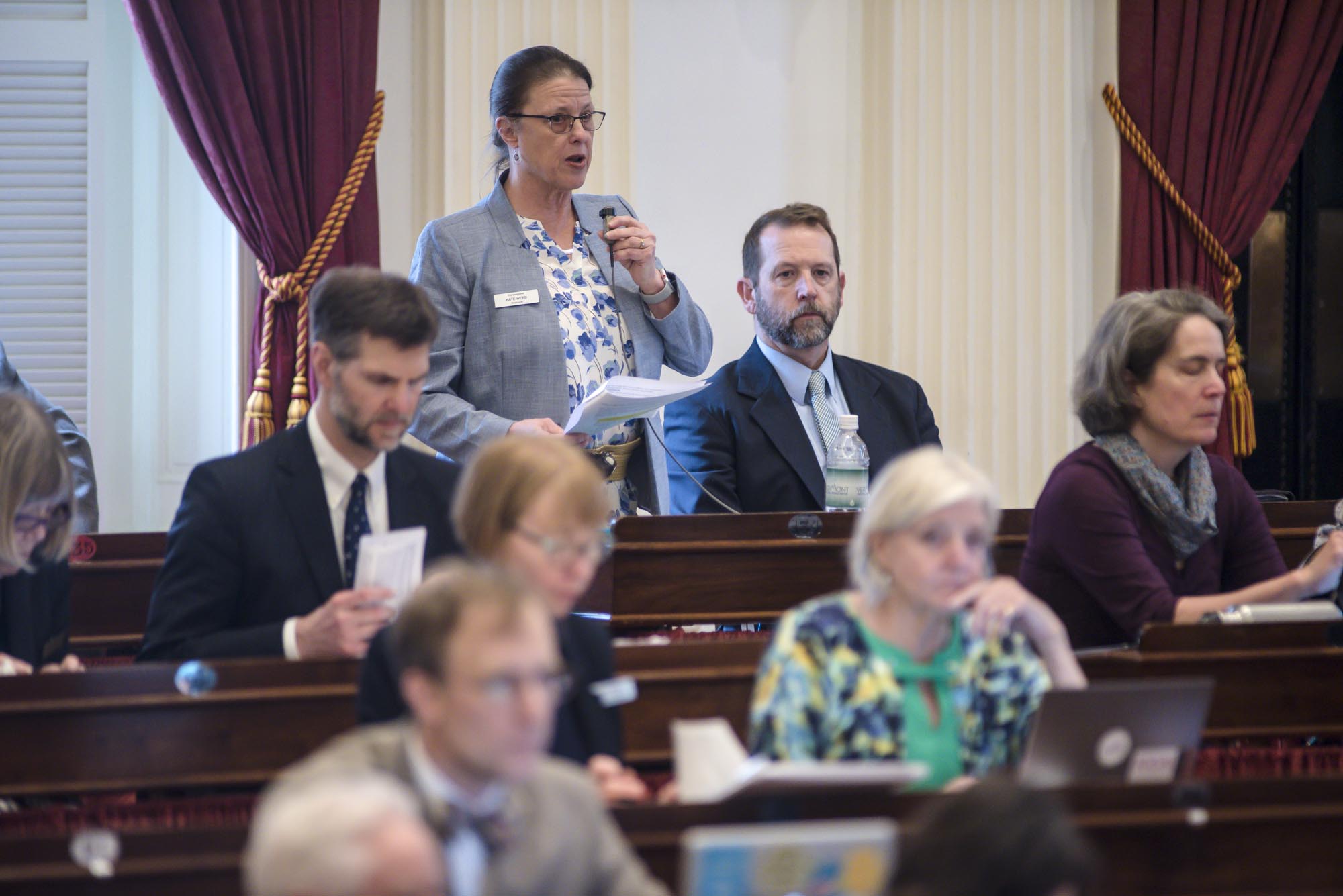
“There is no cure. The results are irreversible. Thus prevention is paramount,” House Education Committee chair Kate Webb, D-Shelburne, told her fellow lawmakers on the House floor.
The Senate has passed its own version of S.40, requiring a stricter standard for remediation but reimbursing schools at a lesser rate. As passed by the upper chamber, schools and child care providers would have to test each of their drinking outlets by Jan. 1, 2020. The House’s version extends that deadline to the end of 2020.
Lawmakers introduced legislation to mandate testing statewide after a pilot program in 16 schools found elevated levels of lead in several schools. Five of the 16 schools tested had at least one tap that tested above 15 parts per billion, the action level set by the Environmental Protection Agency for public drinking water systems. All schools had at least three taps that tested above 1 ppb, which is the action level recommended by the American Academy of Pediatrics.
The House’s version of S.40 sets the action level at 5 ppb. The Senate’s sets it at 3 ppb.
Jeff Francis, the executive director of the Vermont Superintendents Association, complimented the House for taking its time on S.40. The VSA prefers the House’s take on the bill to the Senate’s, which Francis said more carefully considers the “details” of the policy, and reimburses schools at a much higher rate.
“I think that this is a bill that reflects favorably the due diligence that they brought to the matter,” he said.
The Senate’s version, which would reimburse schools for 50 percent of remediation costs, was projected to cost $2.5 million. The House’s version, which attempts to cover the full costs of remediation, would cost $3.2 million.
Environmental advocates, meanwhile, are expected to lobby lawmakers to lower the threshold for remediation. The Conservation Law Foundation and VPIRG have both sought to convince legislators to set the action level at 1 ppb.
The House still has to vote one more time to formally advance the bill, and lawmakers will likely need to form a conference committee to hash out the differences between the Senate and House versions of the legislation.
