[P]aul Capcara delivered blistering testimony Tuesday about the use of physical restraints at the Woodside Juvenile Rehabilitation Center, telling a judge that if practices don’t change the risk of harm to minors as well as staff remains.
“I believe the practice of restraint and seclusion at Woodside is inappropriate,” Capcara testified Tuesday. “And potentially dangerous.”
Capcara, a registered nurse and director of the inpatient psychiatric unit at Cottage Hospital in Woodsville, New Hampshire, spoke Tuesday on the witness stand in a lawsuit brought the Vermont Defender General’s office.
The complaint alleges that a teenager boy was the victim of excessive force at Vermont’s only juvenile detention facility.
The lawsuit comes as lawmakers are debating whether to foot the bill to replace Woodside with a new, more therapeutic facility, in line with changes being made to juvenile justice practices across the country.
Capcara spoke Tuesday of the training documents he reviewed and are used at Woodside.
“The training materials largely seemed to be developed for an adult prison setting,” he said. “In fact, some of the documents are still stamped Department of Corrections.”
Assistant Attorney General David McLean, representing the Department for Children and Families, which oversees the Woodside facility, attempted to show during Tuesday hearing that Capcara is biased.
He said that Capcara had provided critical testimony in past cases about the use of restraints and isolating youth at Woodside.
“I was providing my professional opinion about the use of seclusion and restraints,” Capcara replied.
“And your professional opinion happened to be in favor of the plaintiff’s case against Woodside?” McLean asked.
“Yes,” Capcara responded.
McLean then asked Capcara about his view of Woodside’s management when it comes to physical restraints at the facility.
“You think it’s hubris, correct?” McLean said.
“The fact that it’s not been addressed or corrected does reflect that,” Capcara responded. “Yes, I do believe that.”
A video recording of the incident exists, though it’s unclear if the public will get to see it.
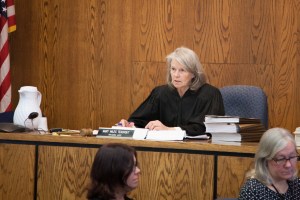
When it came time during Tuesday’s hearing when the video of the incident was going to be played, McLean, the lawyer representing DCF and Ken Schatz, its commissioner, asked the judge to seal the courtroom, and order the public out.
He cited privacy concerns for the teen, whose face would be revealed in the video and whose name could be heard on the recording.
Attorneys for the defender general’s office agreed with McLean, also asking the judge to close the courtroom to the public when the video was played.
Before ruling, Judge Mary Miles Teachout said she needed to step off the bench to research the matter. When she returned a few minutes later, the judge agreed to the joint request to close the courtroom to the public while the video was playing, and to seal the video as evidence.
The judge then reiterated her ruling after VTDigger objected to the closing of the courtroom.
‘Not standard practice’
Testimony in the latest case against Woodside and DCF regarding physical restraints and is being heard this week in Washington County Superior civil court in Montpelier.
The Defender General’s Office, in its lawsuit filed earlier this month, is seeking to stop the facility from using the “purposeful affliction of pain” when restraining minors.
The action also calls for Woodside to stop restraining minors while face down and to follow nationally recognized approaches when using restraints.
The plaintiff in the lawsuit is a 17-year-old boy, identified in the filing by his initials and referred to as “juvenile 1.” The lawsuit alleged that one staff member pushed a knee into his back as other staff members held him face down as restrained his arms and legs in March.
Capcara testified Tuesday that he had seen a video of the incident and was also shown still pictures.

“The biggest risk with taking the step of using restraint, using force on an individual, particularly when they are in a prone position, as juvenile 1 was, is applying pressure to the back of the torso which makes it difficult for the individual to expand their lungs and breathe,” Capcara said on the witness stand.
“Secondarily,” he added, “applying pressure across the spinal cord runs the risk of injuring their spinal cord, which would also be a seriously bad outcome.”
Capcara also talked of the “twisted” wrists of the boy while being restrained.
“That’s not standard practice,” he said. “I’ve never seen anything like that in a treatment setting.”
Kerrie Johnson, an attorney with the Vermont Defender General’s Office who is representing the juvenile bringing the lawsuit, asked Capcara about other videos he’s seen of restraints at Woodside of staff applying “downward pressure” to a child’s torso.
“Yes, I’ve seen it repeatedly,” he responded. “it appears to be incorporated into their training based on the fact that it reoccurs.”
According to the lawsuit, the boy had been making “suicidal comments,” on the day of the incident. Also, before he was restrained, the filing stated, the teen had motioned as if he was trying to hit a staff member as he tried to push through staff and get out of his cell.
The lawsuit alleges that the March incident involving the 17-year–old boy isn’t isolated, adding that in 2018 Woodside staff members used “similar techniques” on four other children.
As the case works through the court, Woodside’s future and funding remains up for debate in the Legislature as the session nears an end.

Last fall, the state decided to no longer pursue its two-year effort to secure federal funding to help cover the costs of running the facility, with the federal government saying the facility didn’t meet its criteria for a psychiatric residential treatment facility provider.
As a result, the facility was not eligible for the roughly $2.6 million in annual Medicaid funding it received in the past to help pay for the roughly $6 million cost of running the center.
Schatz, DCF’s commissioner, told the House Committee on Corrections and Institutions earlier this session that the decision regarding the federal funds prompted officials to look at Woodside’s future.
He described the current 30-bed Woodside facility for youths aged 10 to 18, built in 1984, as “jail-like,” inefficient for providing therapeutic care, and in need of many repairs.
He termed the need for new facility more a “programmatic” issue than simply a space one, as the facility has seen dwindling numbers in recent years.
Schatz said that having no facility would lead to having no place to put youth who pose a risk to themselves or others, and cannot be managed in less restrictive programs.
In a statement issued earlier this month in response to questions about the lawsuit, officials with DCF, which runs the facility, said that staff at Woodside do everything they can to avoid physical restraints.
However, according to the statement, sometimes physical restraints become necessary to protect staff as well as youth in the program. The department added that Woodside has not seen a serious injury stemming from a restraint in more than 10 years.
McLean, in cross-examining Capcara Tuesday, painted a picture of Woodside staff as justified in their actions in restraining the teenager at the center of the lawsuit, taking steps proportional to his behavior.
At one point, McLean questioned Capcara if he had become so emotional over the issue of physical restraints that it affected his ability to provide an objective opinion on the matter.
“Observing practices that causes children pain and harm do evoke an emotional response in me but it doesn’t bias my ability to be objective,” he said. “It’s the practice itself, that’s actually what I’m objecting to and reacting to.”