


[C]OLCHESTER — The first thing Bill Reichert does when he wakes up in the morning is check the price of copper on COMEX. As CEO and president of Champlain Cable, he buys about $40 million worth of the metal each year.
Champlain Cable uses the copper to make more than a billion feet per year of coated copper wire. The company buys the copper in cable form, covers it with various polymers depending on what it’s going to be used for, and then exposes the finished product to electron-beam radiation to strengthen the polymer.
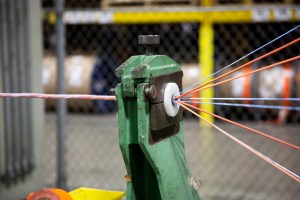
The result: a process of melting, movement and weaving that takes the copper wire from its own reel through a lengthy series of steps on the factory floor. The end product is a coated wire that ends up in a variety of uses including automobile transmissions, bus drivetrains, and industrial engines.
Champlain Cable was started in 1955, and in 1964 the company built a 180,000-square-foot white, windowless manufacturing plant in Colchester with a tall bay to house the 30-foot-high machines that the company was using then as it made cable for the aerospace industry. The company was purchased in 2003 by the Stamford, Connecticut private equity firm American Industrial Acquisition Corp., which has hung on to it ever since.
By the late 1980s, 80% of Champlain Cable’s business was with aerospace customers such as Boeing and McDonnell Douglas, Reichert said. But there were seven or eight competitors who made exactly the same products. And the company wasn’t as focused on new product development as it needed to be to keep up with changes in the industry, he said.
“We really kind of took our eye off the ball,” Reichert said.
“Getting out of aerospace was a pretty easy decision to make back then,” he added. “We weren’t set up to do commodity products.”
In the mid-1990s, the largest part of the business was data communications for local area networks. In the early 2000s, Champlain Cable’s business shifted again, and now about half of the cable produced by the company goes to auto companies, many of which have factories in Mexico, Honduras, Nicaragua, China, India and Europe. The rest goes to commercial vehicles such as trucks, buses and heavy equipment, with a small amount used for technology such as streetlights and shipboard wiring for the U.S. Navy.

While it’s one of the largest companies in Vermont, Champlain Cable is just a tiny piece of a huge global wire and cable industry. Various industrial research groups estimate that the value of the industry will be around $300 billion by 2025. Thanks to urbanization, investment in power infrastructure, and autonomous vehicles, the industry is expected to have a growth rate of about 5% between now and then. That’s the rate at which Champlain Cable has grown for the last few years, Reichert said.
Like so many Vermont companies, Champlain Cable competes with commodity producers by creating a value-added product, in this case a cable with polymers transformed by a highly charged beam of electrons. The radiation units, which perform a process called electron beam irradiation or crosslinking, are housed in six-foot-thick concrete bunkers on the factory floor and cost $4 million each, Reichert said. Champlain Cable has three of the units in Vermont and four at its two plants in El Paso. Every strand of cable that comes out of the factory receives the radiation treatment, which changes the chemical makeup of the polymer.
“If we made commodity products, we couldn’t afford to be in Vermont – or, depending on the product, in the U.S.,” Reichert said.
With a steel shop in Michigan, a copper tubing business in Oklahoma, and two cable plants in El Paso, Champlain Cable expects to have annual revenues this year of $170 million, making it one of Vermont’s largest manufacturing companies. It has 400 employees, 130 of them in Vermont.
Despite the company’s reach, Reichert is bedeviled by a general misunderstanding of the name; he said many people in Vermont assume it’s a Lake Champlain-area cable TV company. That’s a problem when Champlain Cable is trying to recruit workers. Reichert is working to address it by doing more public visits to schools and technical centers. He said the average starting wage at Champlain Cable is $22 per hour.
The fact that the world is moving toward wireless transmission doesn’t worry Reichert at all. In fact, he said, it’s good for the cable business.
“In the wireless business, you still have to go back in some point in time to a station or base or tower, and you need wire for that particular application,” he said. He added that the company tries to make at least 25% of its revenue each year from new products. Scientists at the Colchester plant carry out research on new materials; the company has more than 10 patents and has three pending, Reichert said. There’s plenty of demand, he said.
“Everyone wants things lighter weight, to perform at higher temperatures, to be flexible, abrasion-resistant, and small, and to do more things in the same space without affecting performance,” he said. “As things evolve, we evolve.”
Also, he said, the company makes products that are used on electric cars and buses, and on autonomous vehicles, all of which require wire.
“Really what you have got is a moving data center,” he said. “You’ve got a vehicle going down the road, and the split second decisions have to be made just as fast or faster than local area network decisions are made. That’s how we use wires.”

