


[W]ith little opposition and only a brief debate, the House on Tuesday gave preliminary approval to a bill that would raise Vermont’s legal smoking age from 18 to 21.
A final vote is required in the House on S.86, and the Senate will have to consider a House amendment to change the effective date to Sept. 1. But Tuesday’s vote was a significant step that moves Vermont closer to joining a growing number of states that have implemented what backers call “Tobacco 21.”
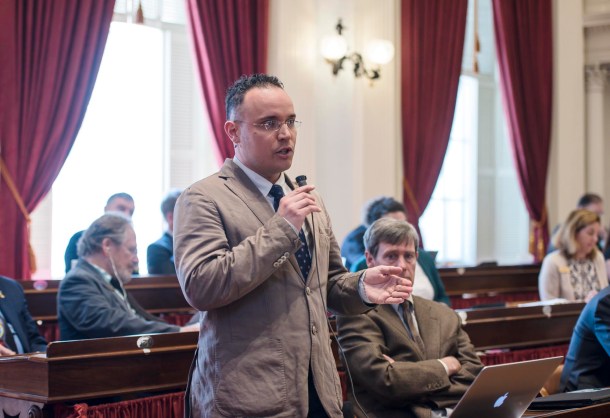
Rep. George Till, D-Jericho, and a longtime advocate for raising the smoking age, highlighted a legislative finding that leads off S.86: an estimated 10,000 Vermont children alive today are expected to die prematurely due to illnesses related to smoking.
“It’s almost certain that every person in this body knows some of these kids,” Till said before the House voted 124-14 to approve the measure.
Opponents cited concerns about preserving personal responsibility among young people. Rep. Anne Donahue, R-Northfield, said taking up smoking is a “bad choice” but noted that those over 18 can choose to join the military and can face life in prison for certain crimes.
“I think these things matter in terms of consistency between rights and responsibilities,” Donahue said.
The Tobacco 21 effort is growing nationwide. A recent count shows that 12 states have adopted the measure since 2015, and there have been several states added to that that list this year.
There’s also a possibility that the change could be enacted at the federal level.
The momentum may be due in part to increasing concern about the effects of nicotine on young people. “Teens get addicted to nicotine at lower levels than adults, and addiction is much more difficult to overcome,” said Rep. Jessica Brumsted, D-Shelburne and a member of the House Human Services Committee who presented S.86 on the House floor Tuesday.
Another factor is concern about big jumps in e-cigarette use among middle school and high school students. The age restrictions in S.86 also apply to electronic cigarettes.
Gov. Phil Scott cited his worries about youth e-cigarette use in proposing a tax on the devices, a measure that is still moving through the Legislature. The governor also has said he is not opposed to raising the smoking age.
Tina Zuk, Vermont government relations director for the American Heart Association, said there has been much clearer support for Tobacco 21 this year than in past years when the measure didn’t get through the Vermont Legislature.
“I think one of the huge differences is the skyrocketing use of e-cigarettes,” Zuk said.
No matter whether the issue is e-cigarettes or traditional cigarettes, advocates say raising the age will help prevent teen use. That’s because those under 18 often get tobacco or tobacco substitutes from friends who are between the ages of 18 and 21, officials say.
S.86 quotes the National Academy of Medicine as saying that raising the tobacco age to 21 would reduce tobacco use by 12 percent and would decrease smoking-related deaths by 10 percent. “Given that Tobacco 21 is expected to prevent 10 percent of smoking deaths, that would be 1,000 young lives saved – a whole Vermont high school,” Zuk said.
S.86 imposes restrictions on the possession and sale of tobacco products, tobacco substitutes and tobacco paraphernalia.
Selling to those under 21 would be subject to maximum civil penalties of $100 for the first offense and $500 for subsequent offenses. Possession by those under 21 would lead to confiscation of the product as well as a civil penalty of $25. Existing penalties for underage tobacco sales and possession would continue.
Supporters of the bill have included the heart association as well as the American Cancer Society and the American Lung Association. In legislative testimony, the lung association said tobacco use “is still the number one cause of preventable disease and death in Vermont” and urged lawmakers to pass S.86 “to help prevent Vermont teens from a lifetime of addiction.”
The House Human Services Committee also heard support from tobacco giant Altria, which owns companies including Philip Morris USA. In testimony, an Altria representative said the company is supporting Tobacco 21 measures because they are “the most effective step available to reverse rising underage e-vapor rates.”
However, another tobacco company – New Jersey-based JT International U.S.A. – told state lawmakers that “there is no evidence that merely increasing a minimum purchase age leads to any meaningful reduction in youth access to tobacco products.”
“We believe the most effective measure would be to introduce mandatory identification verification for the purchase of all tobacco products, irrespective of retail location, product type or the age of the prospective purchaser,” the company said.
If Tobacco 21 takes effect, Vermont will lose tobacco tax revenue, which also is used to draw down federal matching money for the state’s Medicaid program. The Joint Fiscal Office estimated that the age change would cut state revenues by $450,000 in fiscal year 2020, with a “gross impact” of $975,500 due to the loss of matching federal money.
With the effective date pushed to Sept. 1, the fiscal office lowered its estimates of lost revenue to $370,000 in state revenues and $802,000 in gross impact for next fiscal year.
“Revenue losses will diminish slightly in future years as tobacco usage in general declines across all age cohorts,” the Joint Fiscal Office wrote.
While saying the “long-term public health benefits of reducing smoking rates are undeniable,” the fiscal office said the state’s financial gains from those health benefits “are difficult to estimate.”
But Till, speaking on the House floor Tuesday, said “it’s abundantly clear that the lost revenue will be offset by health care savings in short order.”
