

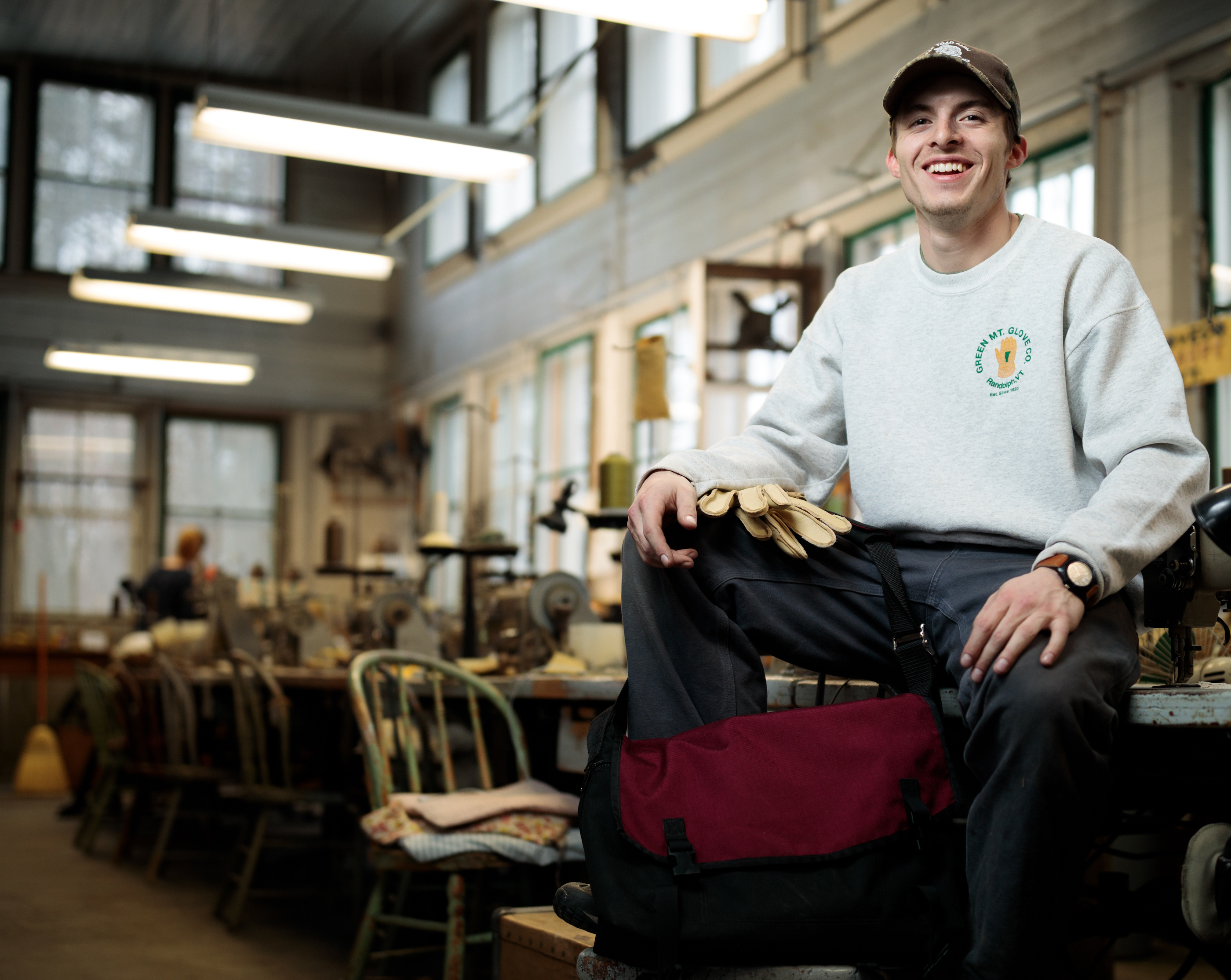
[B]ack in the 1960s and 1970s, business was brisk at Green Mountain Glove. At its peak, the company was one of the larger employers in Randolph, with 30 workers, and was selling work gloves to electric utilities in more than 40 states.
But by the time Sam Hooper, 25, came on board to learn the business in 2017, the century old company had lost market share and had only three employees. It was only turning out about 200 pairs of gloves a month.
Hooper bought the business with a partner last year and they are now on track to get it back to profitability by the end of the year. Green Mountain Glove is making the same product it has produced for years – goatskin work gloves – with a focus on quality and durability.
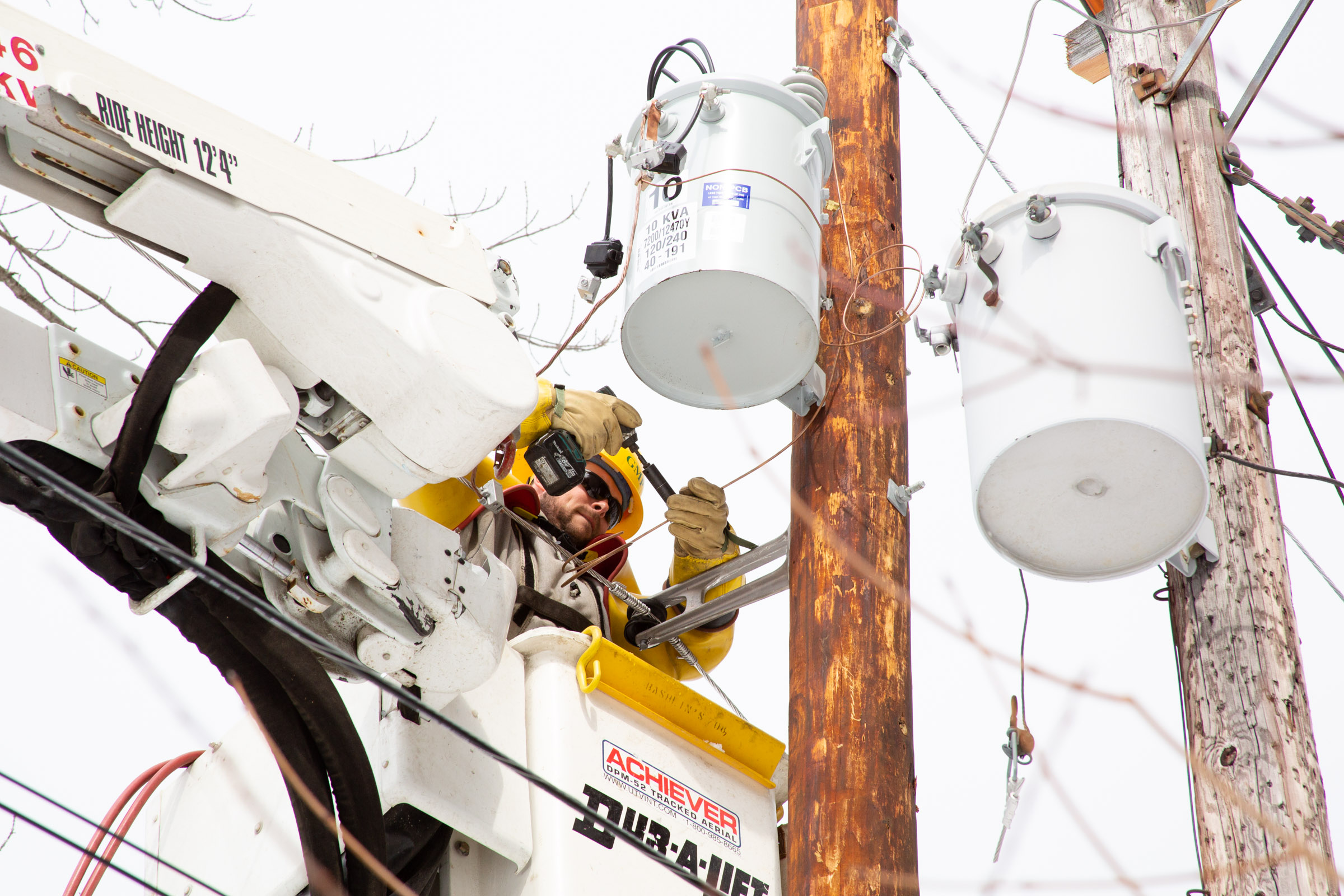
“We don’t compete on price,” Hooper said. Green Mountain Glove now produces about 500 pairs a month for 60 customers such as Green Mountain Power, Eastern Maine Electric Coop, and the Massachusetts Department of Transportation.
“We offer a value proposition that will take price out of the equation,” Hooper said. “This isn’t me just being a sales and marketing guy. This is utility companies coming back to us saying we can save them money annually because they’ll go through a fraction of the gloves for their utility workers by buying from us.”
Brookfield Renewable, a utility in Skowhegan, Maine, has been buying gloves from Green Mountain Glove for 35 years, said Wanda Watson, a production clerk who takes glove orders for employees. She said orders have declined in recent years because younger workers prefer thinner gloves without seams. Hooper is diversifying his customer base by marketing to the construction industry, placing his $100 gloves in Vermont stores and selling them online.
Hooper got his start in business working at the company his mother founded, Vermont Creamery. He also has experience with goats, and his brother, Miles, runs a goat dairy and meat company in Randolph. Hooper buys his goatskins from three suppliers – one in the Midwest and two on the East Coast. This week, he started taking goatskins from his brother.
While manufacturing makes up nearly 10% of Vermont’s GDP, the state has very few clothing makers. One of them, Ric Cabot of Cabot Hosiery in Northfield, is on Green Mountain Glove’s board. Cabot said the difficulty Hooper faces in hiring skilled workers isn’t unique to the clothing business.
“It doesn’t mean he won’t be successful,” Cabot said, noting Cabot Hosiery has always had to teach its new hires how to make socks. In a state as small and rural as Vermont, workers with specialized knowledge are generally scarce.
“You could say the same for plastics and night vision goggles,” Cabot said. “If there are one or two people in a manufacturer’s industry, that’s a lot.”
This week, Green Mountain Glove received a $6,330 grant from the Vermont Training Program to train leather stitchers. Hooper said the grant will help the company obtain the ISO 9001 certification he needs to enter new markets. Vermont Training Program grants are administered by the state’s Department of Economic Development.
Green Mountain Glove has nine employees now, not including Hooper. Many of them are stitchers making gloves on 1950s-era industrial sewing machines. The state grant, he said, will help him train more industrial stitchers. To keep them on, he said he plans to offer wages of $15 an hour and, eventually, health insurance as well as a 401(k) program.
“The reason I appreciate capitalism and profitable business is to be able to make a difference in people’s lives and in our local economy,” Hooper said. “I can’t do that if I’m not creating jobs.”

