


WHITE RIVER JUNCTION — After serving for more than three years in several clinical and administrative roles at Veterans Affairs Medical Center, psychiatrist Brett Rusch took the reins of the White River Junction facility on Friday.
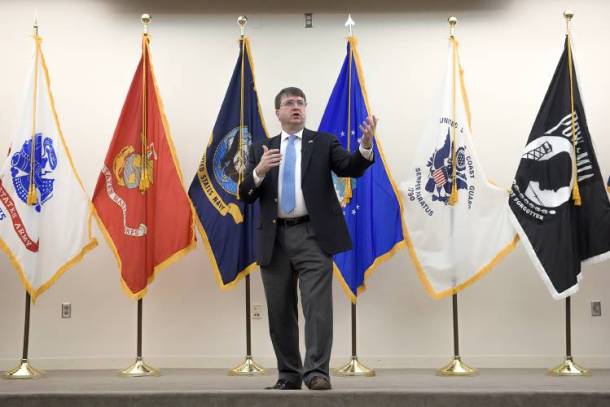
VA Secretary Robert Wilkie announced Rusch’s appointment on Friday during a visit with the center’s staff on his tour of the agency’s northern New England facilities.
Rusch, who came to White River in 2015 to oversee the center’s mental-health services, also served as chief of staff to then-director Alfred Montoya and later did a stint as acting director after Montoya left in 2017.
Rusch had most recently been serving as chief of staff to acting director Laura Miraldi, who now will resume her duties as associate director for nursing and patient-care services. The White River Junction VA serves about 26,000 veterans in Vermont and four contiguous counties in New Hampshire.
In addition to Rusch’s appointment, Wilkie spent part of his stop pledging to ramp up help for veterans of the Iraq war who are claiming that they developed cancer and other life-threatening ailments from breathing toxic smoke from so-called “burn-pits.”
As acting VA secretary and after his confirmation to the Cabinet last summer, Wilkie worked with the Department of Defense and the Senate to set up a registry to help those claimants start the process of qualifying for benefits.
“Coming from a Vietnam family — my dad was a major in the Army — I don’t want us to go through another episode like (the jungle-clearing herbicide) Agent Orange,” Wilkie said during a brief interview. “The last of our military personnel pulled out of Saigon in April of 1975, and we didn’t start responding in a meaningful way until 1991.
“I don’t want that to happen again.”
Earlier this year, a federal court ordered the VA to pay benefits to so-called “blue-water sailors” — between 1,500 and 2,100 personnel who served as flight and ground crews for the C-123 aircraft that flew from aircraft carriers to spray Agent Orange. In the case of the burn-pit registry, Wilkie said, the VA is striving to head off such conflicts.
“It’s a matter of getting a complete program of compensation that we haven’t done yet,” Wilkie said. “That’s something that involves the Congress, and I’m going to be spending a lot of my time after this trip in front of the appropriations committees.”
In early March, Iraq veterans with cancer, and surviving families of veterans who died, testified to the Vermont Senate about their ordeals during hearings to set up a state registry to “raise awareness” of health hazards of possible exposure to smoke from pits where military personnel burned not only garbage but abandoned and destroyed vehicles, discarded combat meals and pipes made of synthetic material.
The witnesses included Hartford firefighter Wesley Black, a 33-year-old former Army National Guardsman who described his advanced colon cancer and the suffering of other veterans as “a nationwide health crisis.”
After the state Senate in early April approved the registry, 30-0, Black posted a news story on his Facebook page with the comment: “First steps, small though it may be, this is a victory worth celebrating.”
Rusch, the White River VA’s new director, said that his staff already is “seeing veterans who had had those kinds of exposures.

“We’re all trying to figure out how best to educate vets in Vermont and New Hampshire about the (federal) registry, so we can fully understand the scope,” Rusch said.
“Secretary Wilkie told us that he’s committed to all of them. In the meantime, we’re not awaiting absolute clarity on the causes of our patients’ cancers. The main thing is to treat them. This is happening on two fronts, but we’re not waiting for (eligibility for the registry) to do the other.”
Rusch received a bachelor’s degree in psychology from the University of Wisconsin and graduated from the University of Wisconsin School of Medicine and Public Health, where he also did a psychiatry residency, the VA said in a news release.
Later on Friday, Wilkie also visited the VA medical center in Manchester, where he told the Associated Press that agencies across the federal government are being tasked with combating veteran suicides and that he plans to find ways to get funding to state and local governments to track down and help those in need.
Wilkie said that veteran suicides couldn’t be seen in isolation. He said the issue must be tackled by working on ways to combat homelessness, drug abuse and mental illness among veterans. That means changing the way the VA prescribes opioids, he said, and boosting the amount of transitional housing for homeless veterans.
Last month, President Donald Trump signed order directing his agencies to develop a plan within 12 months to address veteran suicides. Currently, about 20 veterans die by suicide each day.
